 HYGO News
 "Tell Me Which Justices Are For Sale?" — Kennedy Questions Payne On SCOTUS Ethics
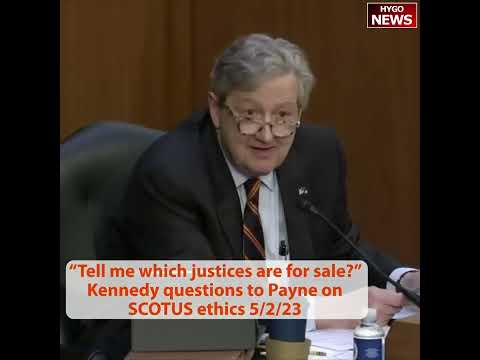
“Tell Me Which Justices Are For Sale?” — Kennedy Questions Payne On SCOTUS Ethics
Senator John Kennedy (R-LA) used a Senate Judiciary Committee hearing on Supreme Court ethics to confront a witness — identified at the hearing as Mr. Payne — about a November 21, 2022 social media post that described certain justices as “politicians in robes” thriving in a system where “access and influence are for sale.” Kennedy demanded a list: “Tell me which justices are for sale.” When Payne said he could not name any, Kennedy pressed why the post had been made at all. The exchange dramatized one of 2023’s central Senate ethics fights — whether public commentary about the Court’s integrity matches up with what witnesses are willing to defend on the record.
The November 21 2022 Post
- Original post: Payne’s post described “some justices” as “politicians in robes” thriving where “access and influence are for sale.”
- Date stamp: Kennedy cited November 21, 2022 as the date of the post.
- Retweet status: Payne initially asked whether the language was original or a retweet; Kennedy clarified it was a retweet on Payne’s account.
- Documentary submission: Kennedy offered to provide a printed copy of the post for the hearing record.
- Verification request: Payne requested time to “check it and triple check it” before fully responding.
The Tell Me Which Justices Question
- Direct demand: Kennedy asked Payne to name which justices are for sale.
- Witness response: Payne said he could not name any justices as for sale.
- Follow-up question: Kennedy asked whether Payne actually believed any justice was for sale.
- Witness clarification: Payne said he did not believe justices were for sale.
- Logical bind: Kennedy then pressed why the post was made if it could not be substantiated.
The Politicians In Robes Frame
- Recurring phrase: “Politicians in robes” became a recurring rhetorical frame in 2023 ethics commentary.
- Origin: The phrase has been used by ethics critics to suggest justices act on partisan rather than legal grounds.
- Republican objection: Republican senators argue the phrase undermines public trust in the judiciary.
- Witness exposure: The hearing exchange forced witnesses to engage with their own use of the phrase.
- Editorial line: Kennedy used the phrase to draw a sharp contrast between commentary and substantiation.
The Access And Influence For Sale Framing
- Cumulative implication: The phrase implies a market in which justices respond to access and influence.
- No specific basis: Payne could not point to a specific justice for whom the framing applied.
- Public perception layer: Payne defended the framing by reference to “American public…perception.”
- Kennedy challenge: Kennedy challenged the use of perception as a basis for a personal accusation.
- Hearing record: The exchange placed both the post and its retraction onto the formal record.
The Hearing Witness
- Identification: The witness — referred to as Mr. Payne — appeared as part of the witness panel.
- Public commentary: Payne had a record of public commentary on Court ethics on social media.
- Hearing posture: The witness defended general concerns about ethics while declining to name specific justices.
- Cross-examination: Kennedy used cross-examination to surface specific posts from Payne’s history.
- Documentary record: Kennedy offered to submit copies of Payne’s posts for the formal record.
The Public Perception Defense
- Witness framing: Payne defended the post as reflecting a “perception” held by the American public.
- Republican rejoinder: Kennedy argued perception is not a substitute for evidence-based accusation.
- Distinction problem: The exchange dramatized the difficulty of separating perception from accusation.
- Editorial choice: Kennedy treated the phrase “for sale” as a serious accusation requiring backup.
- Hearing relevance: The distinction matters for how Congress writes ethics rules.
The Republican Strategy
- Witness exposure: Republicans used hearings to surface specific public statements by ethics witnesses.
- Counter-narrative: The strategy aims to show that ethics critics overstate when off the record.
- Hypothetical method: Kennedy used hypotheticals and direct quotes to test witness positions.
- Public-facing posture: The strategy is designed to produce clips for distribution.
- Long arc: Republicans argue the ethics push is a political project; the witness exchanges are evidence.
The Democratic Reform Push
- Substantive concerns: Democratic senators have raised substantive disclosure concerns from ProPublica reporting.
- Legislative bills: Pending bills propose disclosure standards modeled on lower federal courts.
- Recusal proposals: Proposals would tighten recusal standards and create review mechanisms.
- Constitutional question: Constitutional debate continues on whether Congress can regulate Court conduct.
- Political layer: The political layer of the debate complicates legislative drafting.
The Documentation Standard
- Specific naming: Kennedy’s demand for specific names tested whether the post had a documentary basis.
- General concern: Payne defended the post as a general concern, not a specific accusation.
- Distinction: The hearing surfaced the distinction between general critique and specific accusation.
- Editorial discipline: Both parties privately acknowledge a need for more precise language.
- Hearing record: The distinction now sits in the formal hearing record.
The Justice Naming Refusal
- No names offered: Payne declined to name any specific justice as for sale.
- Editorial pivot: Payne pivoted to broader public perception as the basis for the post.
- Republican reaction: Kennedy treated the refusal to name names as evidence the post lacked substance.
- Witness posture: The witness’s posture protected against specific defamation but conceded the rhetorical premise.
- Future caution: The exchange is likely to influence future witness preparation for ethics hearings.
The Tweet Verification Request
- Authenticity question: Payne initially asked whether the post was authentic.
- Documentary submission: Kennedy offered to submit a copy of the post for verification.
- Triple-check request: Payne asked for time to “check it and triple check it.”
- Hearing record: The verification request itself entered the formal record.
- Authority sequence: The exchange placed Kennedy in the position of substantiating Payne’s social media history.
The Senate Judiciary Dynamic
- Chair-ranking tension: Committee debate on Court ethics has run on partisan lines since the 2022 term.
- Witness selection: Witness panels reflect the partisan split, with each side calling friendly experts.
- Procedural friction: Republican members have used floor and committee tools to slow ethics legislation.
- Democratic strategy: Democratic chairs have emphasized hearings and reporting to apply public pressure.
- Public-facing posture: Both parties treat the ethics fight as a base-mobilizing issue heading into 2024.
The Constitutional Argument
- Article III scope: Congress has broad authority over court structure under Article III.
- Internal conduct: Whether that authority extends to internal Court conduct is contested.
- Self-regulation: The Court has historically set its own ethics framework via internal practice.
- Statement of ethics: In late 2023, the Court would issue a written code in response to pressure.
- Enforcement gap: Even after the code, no external enforcement mechanism exists.
The Public Trust Layer
- Approval ratings: Court approval is at multi-decade lows in 2023 polling.
- Partisan divide: The partisan gap in Court approval is among the widest on record.
- Ethics narrative: Ethics stories have driven much of the recent decline in approval.
- Repair pathway: It remains unclear how the Court rebuilds public trust without binding rules.
- Long arc: The public trust question will outlast any single piece of reporting.
The Linguistic Precision Argument
- Bribery threshold: Bribery requires a quid pro quo connected to a specific official act.
- Disclosure violation: Most disclosure issues fall short of the bribery threshold.
- Public commentary: Some public commentary collapses the distinction between the two.
- Kennedy intervention: Kennedy used the exchange to draw a clear line between disclosure issues and bribery.
- Editorial discipline: Both parties privately acknowledge a need for more precise language.
The Hearing Strategy
- Soundbite construction: Senators on both sides structured exchanges for clip distribution.
- Documentary value: The exchanges produced extensive on-the-record material for future debates.
- Witness use: Witnesses were used to advance partisan narratives more than to draft rules.
- Substantive testimony: Despite the partisan layer, substantive testimony was placed in the record.
- Future reference: The exchanges will be cited in subsequent ethics debates.
The 2024 Implications
- Election-year horizon: 2024 campaigns will likely use Court ethics as a turnout issue on both sides.
- Court rulings: Major end-of-term rulings will sharpen attention to the ethics debate.
- Confirmation echoes: Republican memories of recent confirmation battles inform current posture.
- Down-ballot effects: Senate races may turn in part on competing Court reform visions.
- Long arc: How the Court itself responds will shape Court politics for the next decade.
The Witness Liability
- Defamation considerations: Witnesses must be careful about specific accusations to avoid defamation exposure.
- Public figure standard: Justices are public figures with a high standard for defamation claims.
- Hearing immunity: Statements made during hearings carry limited immunity from civil liability.
- Editorial caution: Witness preparation increasingly emphasizes documentary support for accusations.
- Long arc: Future ethics witnesses are likely to be more cautious in public commentary.
Key Takeaways
- Kennedy confronted Payne about a November 21, 2022 retweet describing justices as “politicians in robes.”
- The post said justices thrive in a system where “access and influence are for sale.”
- Kennedy demanded Payne name which justices are for sale.
- Payne could not name any, and said he did not believe justices are for sale.
- Payne defended the post by reference to public perception.
- Kennedy treated the refusal to name names as evidence the post lacked substance.
Transcript Highlights
The following quotations are drawn from an AI-generated Whisper transcript of the hearing and should be considered unverified pending official transcript release.
- “Some justices are politicians in robes who thrive in a system where access and influence are for sale” — Sen. Kennedy reading post
- “That’s a pretty bold statement” — Sen. Kennedy
- “Tell me which justices are for sale” — Sen. Kennedy
- “Do you believe that? Some justices are for sale and if so, which ones?” — Sen. Kennedy
- “No, senator, I do not believe that justices…” — witness Payne
- “The American public has a perception” — witness Payne
Full transcript: 154 words transcribed via Whisper AI.