 HYGO News
 Still requiring employees to wear apron with the rainbow heart symbol? not aligned Christian views
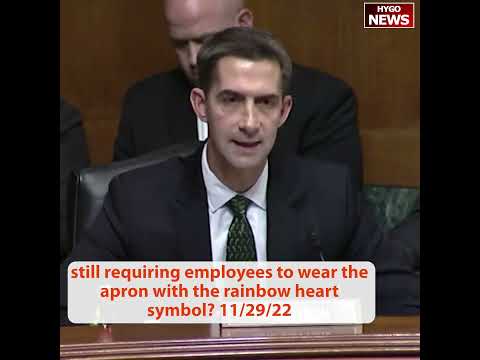
Senator Confronts Kroger on Rainbow Heart Apron: Still Required After $180K Religious Discrimination Settlement?
On 12/4/2022, a senator questioned Kroger’s CEO during a congressional hearing about the grocery chain’s continued requirement that employees wear an apron with a “rainbow heart” symbol — the same uniform requirement that had just cost the company $180,000 to settle an EEOC religious discrimination lawsuit. The case had involved Christian employees who were fired for refusing to wear the symbol they perceived as conflicting with their religious beliefs about sexuality. The senator asked if Kroger would now grant religious accommodations to employees who objected to the symbol. The CEO’s response was evasive: “I will thank you for the question. I will need to follow back up with our team with more of the details.” The exchange captured growing congressional scrutiny of corporate DEI policies that conflicted with employees’ religious beliefs.
”Still Requiring All Employees Without Accommodation”
The senator’s opening question was precise. “So is it the case that you are still requiring all employees without accommodation to wear this apron with the rainbow heart?” the senator asked.
The question had three key elements:
“Still requiring” — Despite the recent $180,000 religious discrimination settlement, was the policy still in place?
“All employees” — Was the requirement universal, applying regardless of individual beliefs?
“Without accommodation” — Were employees with religious objections being forced to comply without alternative options?
Each element was important because the EEOC settlement had been based on the allegation that Kroger had failed to provide reasonable religious accommodations. If the company was continuing the same practice after the settlement, it would suggest the settlement hadn’t changed the underlying approach.
The CEO’s Initial Response
The CEO’s response attempted to deflect. “If you look at the — our apron would be required for all associates to wear consistently across the company,” the CEO said.
The phrase “required for all associates to wear consistently across the company” confirmed that the policy was universal and that no accommodation was being offered. The CEO essentially answered “yes” to the senator’s question while trying to avoid the direct implications.
The framing of “consistently across the company” was meant to make the policy sound neutral — a uniform standard applied equally to all employees. But this framing obscured the religious discrimination problem. A policy that treats everyone the same can still be discriminatory if it burdens specific groups disproportionately. Religious employees who objected to displaying the symbol weren’t being treated differently from other employees — they were being forced to either violate their religious beliefs or lose their jobs.
”Does It Include the Symbol?”
The senator pressed for specificity. “Does it or does it not still include the symbol for which you just paid $180,000 to settle an EEOC lawsuit with your company?” the senator asked.
The CEO confirmed. “It would include a heart on it, Senator,” the CEO said.
The answer was itself a form of deflection. “A heart on it” was a minimizing description — as if the apron simply had a heart shape, rather than specifically the rainbow heart symbol that had been at issue in the lawsuit. Calling it “a heart” rather than “the rainbow heart” obscured the specific religious objection that had led to the EEOC settlement.
But the substance of the answer confirmed the problem. The apron still included the symbol. The company was still requiring employees to wear it. The settlement had apparently not changed the underlying policy.
”Are You Now Going to Grant Accommodations?”
The senator then asked the critical follow-up. “And having settled that lawsuit, are you now going to grant accommodations to employees who don’t wish to display a symbol that they may perceive as not aligned with their moral and Christian views?” the senator asked.
This was the question that would determine whether Kroger had actually changed its practices. The EEOC settlement had been based on the company’s failure to provide reasonable religious accommodations. The obvious response to such a settlement would be to implement an accommodation process going forward. The senator was asking whether this had happened.
The CEO’s response was evasive. “Senator, I will thank you for the question. I will need to follow back up with our team with more of the details,” the CEO said.
“I will need to follow back up with our team” was a non-answer that revealed important information. The CEO of the company was being asked about a major policy question concerning religious discrimination — an area the company had just paid $180,000 to settle — and couldn’t answer whether the company had changed its practices in response.
Either the CEO didn’t know, which was itself concerning (the CEO of a major corporation should know whether the company has changed its practices after a legal settlement), or the CEO knew but didn’t want to say publicly because the answer was “no.” Either interpretation was damaging.
The Underlying Lawsuit
The EEOC lawsuit that had resulted in the $180,000 settlement involved Kroger employees in Arkansas who had been fired or otherwise punished for refusing to wear the rainbow heart symbol. The employees had requested religious accommodations, stating that displaying the symbol conflicted with their religious beliefs about sexuality and marriage.
Kroger had declined to provide accommodations, arguing that the symbol was just a heart and didn’t represent an endorsement of any specific views. The EEOC disagreed, determining that the company should have provided reasonable accommodations for employees with sincerely held religious beliefs.
The settlement required Kroger to pay the affected employees and provide training on religious accommodation. It did not, however, require the company to stop using the symbol on uniforms. The question was whether Kroger would use the settlement as an occasion to revise its accommodation policies or whether the settlement would be treated as a cost of doing business that didn’t require broader changes.
The Religious Accommodation Standard
Title VII of the Civil Rights Act requires employers to provide “reasonable accommodations” for employees’ religious beliefs unless doing so would cause “undue hardship” to the business. This standard has been interpreted by courts over decades, generally favoring employees when accommodations are relatively easy to provide.
In Kroger’s case, accommodating religious employees would have been straightforward. The company could have:
- Provided alternative uniforms without the symbol for employees with religious objections
- Allowed employees to wear an employee ID instead of the uniform apron
- Created exemption procedures for sincerely held religious beliefs
- Provided the aprons with the symbol removable for employees who objected
None of these accommodations would have caused substantial hardship to Kroger. The company was a multi-billion-dollar corporation with millions of employees across thousands of stores. Providing limited religious accommodations was well within its operational capacity.
The question was whether the company wanted to provide accommodations or preferred to enforce uniform compliance. The EEOC settlement had established that Kroger’s refusal to accommodate was legally problematic. But as the senator’s questions revealed, the company hadn’t necessarily changed its approach after paying the settlement.
The Broader DEI Context
The exchange reflected broader tensions in corporate diversity, equity, and inclusion (DEI) practices. Many companies had implemented policies meant to signal support for LGBT employees and customers — rainbow flags during Pride Month, rainbow merchandise, DEI training programs, and similar initiatives.
These policies had generally been welcomed by LGBT employees and advocates. But they had also generated tensions with some religious employees who viewed the corporate signaling as requiring them to endorse views contrary to their beliefs. The Kroger lawsuit was one example of how these tensions could produce legal conflicts.
The senator’s line of questioning suggested growing congressional interest in how corporations navigated these tensions. If companies implemented DEI policies in ways that burdened religious employees without providing accommodations, they could face both legal consequences (EEOC enforcement) and political consequences (congressional scrutiny).
The Kroger case also connected to a broader conservative concern about corporate capture by progressive cultural priorities. Conservative senators argued that corporate America had adopted progressive positions on cultural issues in ways that discriminated against employees with traditional religious views. The rainbow apron was a specific example of this broader pattern.
”If This Merger Goes Through”
The senator’s final question referenced Kroger’s pending merger with Albertsons. “If this merger goes through, who’s going to be making decisions about uniforms in the combined company and whether to grant reasonable accommodations?” the senator asked.
The merger question added urgency to the accommodation issue. If Kroger acquired Albertsons, the combined company would become even larger, with more employees potentially affected by the uniform policy. A merger would be an opportunity to revise the policy — or to entrench it more deeply across an expanded operation.
The CEO’s response discussed “associate resource groups” and the uniform design process but didn’t directly address whether religious accommodations would be provided in the combined company. “Our fundamental uniform that was put in place, our associate resource groups work together in terms of designing the uniform” suggested that the accommodation decisions would be made through existing processes — which were the processes that had produced the EEOC lawsuit.
Key Takeaways
- A senator questioned Kroger’s CEO about continuing to require the rainbow heart apron after paying $180,000 to settle an EEOC religious discrimination lawsuit.
- The CEO confirmed the apron policy remained in place “consistently across the company.”
- When asked if Kroger would now grant religious accommodations, the CEO said he’d need to “follow back up with our team with more of the details.”
- The underlying lawsuit involved Christian employees fired for refusing to wear the symbol they perceived as conflicting with their religious beliefs.
- The exchange reflected broader congressional scrutiny of corporate DEI policies that conflicted with employees’ religious beliefs.
Transcript Highlights
The following is transcribed from the video audio (unverified — AI-generated from audio).
- Is it the case that you are still requiring all employees without accommodation to wear this apron with the rainbow heart?
- Our apron would be required for all associates to wear consistently across the company.
- Does it or does it not still include the symbol for which you just paid $180,000 to settle an EEOC lawsuit?
- It would include a heart on it, Senator.
- Are you now going to grant accommodations to employees who don’t wish to display a symbol that they may perceive as not aligned with their moral and Christian views?
- I will need to follow back up with our team with more of the details.
Full transcript: 180 words transcribed via Whisper AI.