 HYGO News
 Speaker McCarthy Rejects Dem Eric Swalwell From Intel Cmte After 'Relationship With A Chinese Spy'
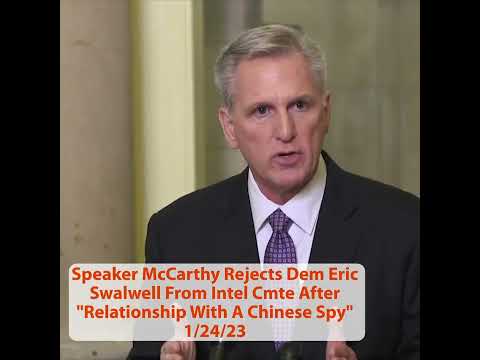
McCarthy: FBI Was Concerned About Swalwell on Intel Committee — Cites Confidential Briefing He Shared With Pelosi
In January 2023, House Speaker Kevin McCarthy offered detailed justification for removing Eric Swalwell from the Intelligence Committee, citing his knowledge from FBI briefing he shared with Nancy Pelosi. “If you want to talk about Swalwell, let’s talk about Swalwell, because you have not had the briefing that I had. I had the briefing and Nancy Pelosi had the briefing from the FBI. The FBI never came before this Congress to tell the leadership of this Congress that Eric Swalwell had a problem with the Chinese spy until he served on Intel. So it wasn’t just us who were concerned about it. The FBI was concerned about putting a member of Congress on the Intel committee that has the rights to see things that others don’t because of his knowledge and relationship with the Chinese spy,” McCarthy said. He concluded: “I do not believe he should sit on that committee. And I believe there’s 200 other Democrats that can serve on that committee.”
The FBI Briefing Claim
FBI briefing claim:
McCarthy briefed — By FBI.
Pelosi briefed — Also.
Shared knowledge — Between leaders.
Specific warning — About Swalwell.
Intel Committee concern — FBI’s.
McCarthy was citing specific FBI briefing that both he and Pelosi had received. This was claim of bipartisan security concern that elevated his argument above political attack.
”You Have Not Had the Briefing”
The exclusivity framing. “You have not had the briefing that I had,” McCarthy said.
The framing:
Classified information — McCarthy has.
Reporter unable — To access.
Judgment — Based on info.
Appeal to authority — Classified briefings.
Deference expected — To those with access.
The “you haven’t had the briefing” framing was appeal to classified information McCarthy had seen. Reporters and public couldn’t evaluate specific claims, had to rely on Speaker’s assessment.
The Pelosi Briefing Parallel
Pelosi briefing parallel:
Same briefing — Both received.
Bipartisan — Information.
Democratic leader knew — Also.
Concern — Shared.
Legitimacy — Bipartisan.
By citing Pelosi’s parallel briefing, McCarthy was making bipartisan argument. Both parties’ leaders had received FBI’s concerns. This wasn’t just Republican attack.
The Fang Fang Context
Fang Fang context:
Chinese national — Alleged spy.
Swalwell relationship — Alleged.
Romantic allegations — Some.
Fundraiser role — Also.
Intelligence operation — Alleged.
Fang Fang (also known as Christine Fang) was Chinese national alleged to have conducted intelligence operation cultivating various U.S. political figures including Swalwell.
”The FBI Never Came”
The timing claim. “The FBI never came before this Congress to tell the leadership of this Congress that Eric Swalwell had a problem with the Chinese spy until he served on Intel,” McCarthy said.
The timing:
FBI timing — Related to Intel appointment.
Pre-Intel service — Unknown to leadership.
Post-Intel service — Flagged.
Sequence meaningful — To McCarthy.
Significance — Security concern.
The sequence McCarthy cited was significant. If FBI’s concern was triggered by Swalwell’s Intel Committee appointment, that suggested real security concern specific to that position.
”FBI Was Concerned”
McCarthy’s characterization. “The FBI was concerned about putting a member of Congress on the Intel committee that has the rights to see things that others don’t because of his knowledge and relationship with the Chinese spy,” McCarthy said.
The characterization:
FBI concern — Claimed.
Intel Committee specifics — Security access.
Knowledge of spy — Cited.
Relationship — Also.
Reasoning — Substantive.
McCarthy was providing substantive security reasoning. If FBI specifically expressed concern about Swalwell’s access to classified information, this was serious matter for committee assignment decisions.
The Intelligence Access Concern
Access concern:
Intel Committee — Classified briefings.
National security secrets — Access.
Compromise risk — If member compromised.
Enemy intelligence value — Possible.
Real concern — Security.
The security concern was genuine. Intelligence Committee members had access to extremely sensitive information. Any compromise risk was serious matter.
The Denial of Political Motive
McCarthy’s denial:
Not just political — Attack.
FBI-based — Concern.
Bipartisan briefing — Received.
Substantive basis — Claimed.
Santos comparison rejected — Explicitly.
McCarthy was distinguishing Swalwell case from political attacks. His argument was substantive security, not political retaliation. Whether this was accurate was question.
”200 Other Democrats”
The alternative. “I believe there’s 200 other Democrats that can serve on that committee,” McCarthy said.
The framing:
Not anti-Democrat — Broadly.
Specific member — Problem.
Many alternatives — Available.
Party preserved — Representation.
Individual issue — Framed.
By emphasizing many other Democrats could serve, McCarthy was rejecting partisan interpretation of removal. The issue was individual member, not Democratic Party representation.
The Santos Context
Santos context:
George Santos — Newly elected GOP rep.
Fabrications — Widespread.
Lying — Documented.
Committee assignments — Had.
Hypocrisy charge — Against McCarthy.
The Santos comparison was made because Santos had lied extensively but kept committee assignments. Critics charged inconsistency — why remove Swalwell for alleged issues but not Santos?
”Santos Is Not on the Intel Committee”
McCarthy’s response. “So this has nothing to do with Santos. Santos is not on the Intel committee,” McCarthy said.
The response:
Committee distinction — Made.
Santos committees — Other.
Intel specific — Standards.
Consistency argument — Limited.
Distinction — Valid.
McCarthy was arguing Santos wasn’t comparable because he wasn’t on Intel Committee. Different committees had different standards. This was partial defense against hypocrisy charge.
The Santos Committee Issues
Santos issues:
Science Committee — Initially.
Small Business Committee — Initially.
Various lying — Documented.
Investigation — Congressional.
Eventually removed — Committees.
Santos had been placed on committees despite extensive known lies. Reports of his lies had preceded assignment. This was legitimate question about GOP consistency.
The “Those Voters Elected” Framing
McCarthy’s concession. “But you know what? Those voters elected shift, even though he lied. Those voters elected Swalwell, even though he lied to the American…” McCarthy said.
The framing:
Democratic elections — Respected.
Voters chose — These members.
House service — Protected.
Committee service — Different.
Distinction preserved — Between floor and committees.
By acknowledging voters elected Schiff and Swalwell, McCarthy was distinguishing between their House service (protected) and committee assignments (Speaker discretion). This was legal distinction.
The Lying Accusations
Lying accusations:
Schiff — Russia investigation.
Swalwell — Various claims.
Trump dossier — Promoted.
Alleged dishonesty — Charged.
GOP framing — Aggressive.
McCarthy had been accusing both Schiff and Swalwell of lying for years. The specific accusations related to their handling of Russia investigations and Trump-related claims.
The Russia Investigation Context
Russia investigation context:
Schiff leadership — During investigation.
Steele dossier — Promoted.
Trump-Russia claims — Various.
Mueller report — Mixed conclusions.
Disputed accuracy — Of various claims.
The Trump-Russia investigation period had produced many contested claims. Schiff’s role in promoting various allegations was subject to sustained GOP criticism. Whether this constituted “lying” was disputed.
The Swalwell Intelligence History
Swalwell intelligence history:
Strong anti-Trump positioning — Publicly.
Russia investigation — Active role.
Fang Fang allegations — Emerged 2020.
Denial of knowing — Spy role.
Continued Intelligence Committee service — Under Pelosi.
Swalwell had been prominent anti-Trump voice during Russia investigation. The Fang Fang allegations surfaced in 2020 but Pelosi kept him on Intelligence Committee then.
The Pelosi Decision
Pelosi decision:
Knew of briefing — Per McCarthy.
Kept Swalwell — On committee.
Different judgment — Made.
McCarthy now differs — From Pelosi.
Same information — Evaluated differently.
The fact that Pelosi had received same briefing but kept Swalwell on committee was relevant. Two leaders made different decisions based on same information. This reflected judgment rather than obvious conclusion.
The Speaker Authority
Speaker authority:
Committee assignments — Speaker has role.
Removal authority — Exists.
Traditional use — Limited.
Recent expansion — Political.
Institutional shift — Concerning.
The Speaker’s authority to shape committee assignments was real but traditionally exercised with restraint. Recent expansion of political use was institutional shift.
The Historical Context
Historical context:
Rare committee removals — Previously.
Recent normalization — Unfortunate.
Pelosi 2021 — Started escalation.
McCarthy 2023 — Continued.
Future concerns — Normalization.
The historical norm had been rare committee removals. Recent normalization was eroding institutional practice. Each side could justify their specific removals; cumulative impact was concerning.
The Democratic Response
Democratic response:
Strong objections — Made.
Precedent concerns — Legitimate.
Political retaliation charge — Raised.
Jeffries criticism — Sharp.
Coalition unified — Against.
Democrats were united in opposition to removals. Minority Leader Hakeem Jeffries had been sharply critical. The party framed this as political retaliation rather than principled decision.
The Jeffries Position
Jeffries position:
New Democratic leader — First test.
Sharp response — To McCarthy.
Committee assignments — Defended.
Political framing — Used.
Established positioning — Against McCarthy.
Jeffries as new Democratic leader was establishing positioning against McCarthy. The committee removal fight was early test of leadership. His firm response established his approach.
The Fang Fang Controversy
Fang Fang controversy:
2020 revelations — First.
Swalwell knew — Of her connection.
Relationship details — Disputed.
Security vulnerability — Alleged.
Continued questions — Years.
The Fang Fang case had been political issue for Swalwell for years. Republicans had used it to question his fitness for Intelligence Committee service. The issue resurfaced repeatedly.
The FBI Role
FBI role:
Briefing provided — To leaders.
Concerns shared — Per McCarthy.
Public statements — Limited.
Political exposure — Avoided.
Behind scenes — Operating.
The FBI’s role in briefing leaders about Swalwell was significant. Their willingness to share concerns with both parties’ leadership suggested genuine security concern rather than political operation.
The Political Consequences
Political consequences:
Swalwell’s profile — Elevated.
Martyrdom narrative — Possible.
Democratic unity — Strengthened.
GOP criticism — Continuing.
2024 implications — Various.
The removal had political consequences for both sides. Swalwell’s profile increased. Democrats unified. GOP maintained attack narrative. Each side claimed benefit.
The Long-Term Institutional Concerns
Long-term concerns:
Normalized removals — Possible.
Political retaliation — Pattern.
Institutional decay — Risk.
Bipartisan operation — Decreased.
Future consequences — Uncertain.
The escalating pattern of political committee removals posed long-term institutional concerns. Future Speakers might feel justified in further removals. Institutional practice was being undermined.
The Media Coverage Patterns
Media coverage:
Mainstream — Generally critical of McCarthy.
Conservative — Supportive.
Analysis varied — By outlet.
Swalwell coverage — Mixed.
Story sustained — Days.
Media coverage patterns reflected broader partisan divisions. Each side’s coverage preferences were predictable. The sustained coverage reflected story’s political salience.
The Press Conference Context
Press conference context:
Early Speaker days — McCarthy.
Committee removals — Fresh.
Press scrutiny — Intense.
Democratic attacks — Amplifying.
Coverage — Extensive.
The press conference was part of McCarthy’s early Speaker period where he was managing multiple controversies simultaneously. His press engagement style was still developing.
Key Takeaways
- Speaker McCarthy provided substantive justification for removing Eric Swalwell from Intel Committee.
- He cited classified briefing: “I had the briefing and Nancy Pelosi had the briefing from the FBI.”
- Key claim: “The FBI was concerned about putting a member of Congress on the Intel committee that has the rights to see things that others don’t because of his knowledge and relationship with the Chinese spy.”
- McCarthy distinguished from Santos case: “Santos is not on the Intel committee.”
- He framed decision as preserving committee representation: “I believe there’s 200 other Democrats that can serve on that committee.”
- The justification combined FBI briefing, Pelosi parallel receipt, and Intel Committee’s unique security access to provide substantive basis for removal.
Transcript Highlights
The following is transcribed from the video audio (unverified — AI-generated from audio).
- If you want to talk about Swalwell, let’s talk about Swalwell, because you have not had the briefing that I had.
- I had the briefing and Nancy Pelosi had the briefing from the FBI.
- The FBI never came before this Congress to tell the leadership of this Congress that Eric Swalwell had a problem with the Chinese spy until he served on Intel.
- The FBI was concerned about putting a member of Congress on the Intel committee that has the rights to see things that others don’t because of his knowledge and relationship with the Chinese spy.
- I do not believe he should sit on that committee. And I believe there’s 200 other Democrats that can serve on that committee.
- So this has nothing to do with Santos. Santos is not on the Intel committee.
Full transcript: 183 words transcribed via Whisper AI.