 HYGO News
 Speaker Johnson signs BBB, all the WINS, you get tired of WINNING yet? Melania 4th of July decorate
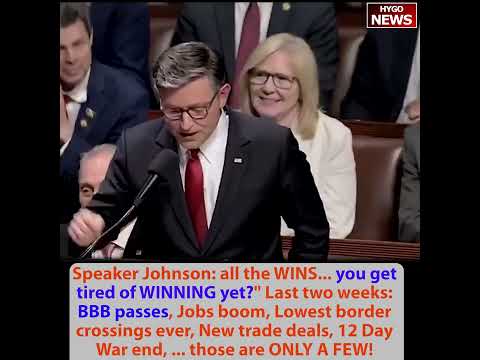
Speaker Johnson signs BBB, all the WINS, you get tired of WINNING yet? Melania 4th of July decorate
The House of Representatives passed the One Big Beautiful Bill on a 218-214 vote, sending it to Trump’s desk for the planned July 4 signing. Speaker Mike Johnson, after affixing his signature to the legislation, delivered a triumphant accounting of the administration’s recent accomplishments — a two-week stretch of wins that left Johnson asking his caucus “are you tired of winning yet?” The catalogue was substantial: the bill’s passage, successive strong jobs reports, lowest monthly border crossings in US history, new trade deals, the Iran strikes and ceasefire, NATO’s 5% GDP commitment, the Rwanda-Congo peace agreement, Supreme Court rulings on nationwide injunctions and third-country deportations, record stock market highs, and progress toward a China trade deal. First Lady Melania Trump spent the day decorating for July 4 with children at Children’s National Hospital.
The Final Tally
The roll call vote. “On this vote, the Yays are 218, the Nays are 214, the motion is adopted.”
The 218-214 margin is narrow. Four votes separate yea from nay. Given that House Republicans hold a narrow majority, every Republican vote is consequential. Several Republicans who had expressed reservations — Chip Roy, Ralph Norman, and others — must have ultimately voted yes for the bill to pass.
The narrow margin tells a story about the negotiation process. Conservative dissenters extracted specific concessions. Leadership provided those concessions. Some conservatives still voted no. Enough voted yes to produce passage. The process was messy but effective.
”All The Wins”
Speaker Johnson then delivered the recap. “How about all the wins for the president in this party? Here’s just a sample from the last two weeks. The headline today will be, The One Big Beautiful Bill Passes the Congress.”
“The last two weeks” is the specific time frame. Major political accomplishments typically do not cluster so tightly. Johnson is deliberately compressing the calendar to demonstrate the cumulative magnitude of the recent run of wins.
“The headline today” — the One Big Beautiful Bill passing Congress — is the lead item. It will dominate news coverage. Other major wins will get less attention because the bill’s passage is such a major story.
”Too Many Wins”
Johnson then delivered his signature framing. “You gotta hold your applause, there’s too many wins. Are you tired of winning yet? No!”
“Too many wins” and “Are you tired of winning yet?” echo Trump’s campaign framing. During the 2016 campaign, Trump had famously promised that Americans would “win so much you’ll get tired of winning.” The phrase became a cultural touchstone of the first Trump term and has been revived in the second term.
Johnson’s adoption of the phrase signals his alignment with Trump’s rhetorical framework. The speaker of the House, operating from within the institutional space of Congress, is using presidential campaign language to characterize congressional accomplishments. That alignment is part of what has made the narrow majority effective — legislative leadership operating in continuous coordination with executive leadership.
The Catalogue Of Wins
Johnson then ran through the specific accomplishments of the past two weeks.
“Last jobs report in a row exceeds expectations.” The employment data has continued to beat expectations. Successive positive jobs reports support the administration’s claim that its policy framework produces economic acceleration.
“Lowest monthly border encounters in U.S. history.” Border crossings have reached historic lows. The May 2025 figure — zero releases compared to 64,000 in May 2024 — captures the magnitude of the change.
“We closed the border.” The framing is that border security is no longer a policy objective being pursued — it is an achievement that has been delivered. The continuing enforcement operation is maintaining the result rather than trying to achieve it.
“New trade deal with Vietnam and all the countries around the world lining up for that.” Vietnam represents one of the Asian economies that has been the subject of American trade attention. A deal with Vietnam would reshape specific supply chains. The broader claim — “all the countries around the world lining up” — captures the administration’s framing that trade partners are competing for American deals rather than resisting them.
”U-Penn Agrees To Ban Biological Men”
Johnson included a cultural-policy victory. “U-Pen agrees to ban biological men from women’s sports and they ought to give a personal apology to every female athlete impacted by that nonsense.”
The University of Pennsylvania — which had been the subject of Title IX controversy because of its handling of swimmer Lia Thomas — has apparently agreed to policies that restrict biological males from women’s sports. The administration’s position on the broader issue had been public. The University of Pennsylvania’s acceptance of the administration’s framework is a specific policy victory.
“Personal apology to every female athlete impacted” is Johnson’s pointed critique. Female athletes who lost titles, scholarships, and recognition to biologically-male competitors deserve, in Johnson’s view, personal apologies from the institutions that made those outcomes possible.
”Prices At A Four-Year Low”
Johnson continued. “This price is at a four year low, my friends.”
“Four-year low” in prices captures the inflation moderation that has occurred under the second Trump administration. Americans who remember the elevated inflation of 2022-2023 — when cost of living increases dominated economic news — now see pricing that has returned to more moderate levels.
Military Recruiting
Johnson added a national security data point. “The Air Force and Space Force both hit their 2025 recruiting goals three months early.”
Military recruiting had been a persistent problem during the Biden administration. Services had repeatedly missed their recruitment targets. The recovery — both services hitting their 2025 goals three months early — reflects the changed recruiting environment under the current administration.
Whether the change reflects specific administration policies or broader cultural shifts is debated. The administration’s focus on traditional military culture, explicit rejection of DEI programs, and restored emphasis on warrior ethos plausibly contributes to the recruiting recovery. Other factors may also contribute.
”Israel Agreeing To A 60-Day Ceasefire With Hamas”
The Gaza situation update. “Israel is agreeing to a 60 day ceasefire with Hamas.”
The Israel-Hamas ceasefire, if formalized, is the diplomatic breakthrough on Gaza that Trump had been predicting. A 60-day ceasefire period would allow for hostage exchanges, humanitarian access, and the beginning of post-war reconstruction discussions.
”Successful Strike On Iranian Nuclear Sites”
Johnson included Iran. “Successful strike on Iranian nuclear sites handles that problem. That’s exactly right. Strength is back. America is back. It’s resulted now in a ceasefire deal between Iran and Israel.”
“Handles that problem” is Johnson’s compressed characterization of the Iran strikes’ effect. The Iranian nuclear program — which had been a looming problem for decades — has been, for the foreseeable term, addressed.
“Strength is back. America is back.” The framing places the Iran operation in the broader context of American strategic resurgence. The country has, in Johnson’s characterization, recovered its willingness and capability to act decisively.
NATO 5%
Johnson referenced the NATO commitment. “The NATO countries are increasing their defense spending, not just 2%, 5% of GDP.”
The Hague defense commitment — 5% of GDP — is the historically significant NATO outcome. Johnson’s mention in the catalogue reflects its political weight.
Rwanda-Congo Peace
Johnson included the African peace. “President got in charge and got a Rwanda-Kong-O peace deal.”
“Got a Rwanda-Congo peace deal” compresses one of the most substantive diplomatic achievements of the administration. A three-decade conflict resolved through American mediation.
Supreme Court Rulings
Johnson addressed the judicial dimension. “The Supreme Court ended nationwide injunctions. How about that? That conservative majority on the Supreme Court also allows third country deportations.”
Two Supreme Court rulings. The nationwide injunctions ruling from the previous week. And a third-country deportations ruling that allows the administration to deport individuals to countries other than their country of origin — expanding the practical options for executing removal orders.
The combination produces substantial policy flexibility for the administration. Nationwide injunctions no longer block policy implementation. Third-country deportations allow removal even when origin-country receipt is complicated.
Economic Data And Trade
Johnson closed the catalogue. “We’ve had a record high stock market and we’re signing a China trade deal. It’s just the last two weeks. It’s the last two weeks.”
“Record high stock market” reflects the financial market performance. The S&P and NASDAQ reached all-time highs during the covered period.
“Signing a China trade deal” is the pending trade achievement. A deal with China would be the most consequential trade outcome of the administration. Whether the deal materializes and on what terms will be revealed in the signing.
“It’s just the last two weeks” — the repetition emphasizes the compressed timeline. Two weeks of wins that would normally be distributed across quarters or years.
”Maybe In The Evening When It’s A Little Bit Cooler”
The video closes with a transition to the outdoor bill signing preparation. “I think we have to come out maybe in the evening when it’s a little bit cooler.”
The practical consideration about Washington weather captures the ceremonial planning. The July 4 bill signing will be outdoors — with the aircraft flyover. The weather must be manageable for the outdoor event. Evening timing addresses the daytime heat.
Melania At Children’s National
The video then pivoted to the First Lady’s activity. “FLOTUS Melania Trump First Lady of the United States sets up 4th of July decorations with the kids at Children’s National Hospital.”
The Melania visit continues from the previous day’s coverage. She is now decorating for the 4th of July with hospitalized children. Holiday decorations — red, white, and blue streamers, flag-themed items, patriotic imagery — create festive environments for children who are hospitalized over the holiday.
The hospital’s pediatric patients, many of whom have been hospitalized for significant conditions, benefit from these kinds of ceremonial visits. The holiday decorations add color and celebration to what would otherwise be clinical, sterile environments. The First Lady’s personal participation signals that the children matter enough to warrant presidential spousal attention.
Why The Two Threads Integrate
The video’s integration of the House passage and the Melania hospital visit captures something about how the administration presents itself. Serious policy accomplishments run in parallel with genuine personal warmth. The legislative work happens in the Capitol while the First Lady visits sick children.
Voters processing both images form composite impressions of the administration. Supporters see effective governance paired with genuine humanity. Critics see political theater paired with political theater. The specific viewer’s prior disposition shapes the interpretation.
The Historical Moment
The July 4 2025 bill signing will be a historical moment. A major bill signed on the country’s 249th birthday, with military flyovers including the aircraft that conducted the Iran operation, in the context of an administration that has accumulated substantial accomplishments in its first year.
Future historians studying the second Trump administration will look at this specific day as a pivot point. Before July 4, 2025: a year of legislative effort, uncertain outcomes, and sustained political conflict. After July 4, 2025: the bill is law, the administration’s signature first-year accomplishment is locked in, and the political environment shifts toward implementation.
”Too Many Wins” As Political Framing
The “too many wins” framing Johnson deployed is politically effective precisely because it captures voter sentiment among administration supporters. People who supported Trump in 2024 wanted to see specific outcomes. The catalogue of two weeks of wins provides concrete evidence that those outcomes are being delivered.
Whether the political benefit persists through 2026 midterms depends on whether additional wins continue to accumulate. A year of continuous wins builds political momentum. A year of wins followed by stagnation allows opposition to regain political traction.
The administration’s bet is that the cumulative weight of continuous wins will sustain political momentum through the midterms. Johnson’s catalogue is evidence-building for that bet.
Key Takeaways
- The House vote: “On this vote, the Yays are 218, the Nays are 214, the motion is adopted.”
- Speaker Johnson’s catalogue: “You gotta hold your applause, there’s too many wins. Are you tired of winning yet?”
- The two-week list: One Big Beautiful Bill passage, positive jobs reports, “lowest monthly border encounters in U.S. history,” Vietnam trade deal, U-Penn women’s sports policy, four-year low prices, military recruiting goals hit early, Israel-Hamas ceasefire, Iran strike, NATO 5% commitment, Rwanda-Congo peace, Supreme Court rulings, record stock market, China trade deal in progress.
- The bill signing preparation: “I think we have to come out maybe in the evening when it’s a little bit cooler.”
- Melania’s July 4 activity: decorating for Independence Day with children at Children’s National Hospital.