 HYGO News
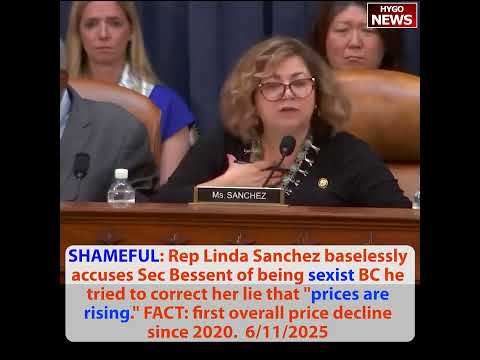
 SHAMEFUL: Rep Linda Sanchez baselessly accuses Sec Bessent sexist; inflation numbers much better
SHAMEFUL: Rep Linda Sanchez baselessly accuses Sec Bessent sexist; inflation numbers much better
A House Ways and Means hearing that was meant to examine the economic effects of the administration’s tariff posture and the pending One Big Beautiful Bill instead produced one of the more revealing political moments of the week. Representative Linda Sanchez opened her round of questioning by asserting that “prices are rising on many everyday goods.” Treasury Secretary Scott Bessent moved to respond. Sanchez cut him off, and what followed was a confrontation that managed to compress, in under a minute, the Democratic theory of the current economy, the Republican counter-theory, and a real-time demonstration of how hearings become partisan theater when the underlying numbers inconvenience one side. The released inflation data for May, meanwhile, and the administration’s closing argument for the One Big Beautiful Bill Act — what Bessent playfully called “O-Triple-B” — filled in the rest of the picture.
The Sanchez Opening: “Prices Are Rising On Many Everyday Goods”
Sanchez began with a declarative economic claim. “In fact, we’ve already seen that prices are rising on many everyday goods.” It is the Democratic framing in a single sentence — that the administration’s trade and fiscal policies are translating into higher costs at the checkout counter. The claim was meant to set the table for a line of questioning that would put Bessent on the defensive about tariffs.
But the framing ran headlong into the morning’s inflation release, which showed the opposite of what Sanchez had just asserted. And Bessent, the nation’s top economic officer, was not going to let the statement stand unchallenged.
Bessent’s Attempt To Respond, Cut Off
The Treasury Secretary began to push back. Sanchez shut him down immediately. “No, Congresswoman, today we had a 1.1 interview. The time is mine. Please don’t interrupt me. I will ask you questions and I will grant you an opportunity to answer them, but please don’t interrupt me during my time.”
The invocation of “my time” is procedurally accurate — each House member does control their five-minute questioning window. But the practical effect of using that prerogative to prevent a witness from correcting a factual assertion is to convert the hearing from oversight into broadcast. Sanchez had said prices were rising. Bessent had data suggesting otherwise. The committee format, invoked in its strictest form, kept the viewer from hearing the correction in real time.
”With Pleasure”
Bessent’s two-word acknowledgment — “With pleasure” — became the hinge of the exchange. It was a polite concession of procedural ground. But Sanchez read it, or chose to read it, as something else.
“Okay, I know I’m a woman, but please try to limit yourself to answering my questions.” The line took what had been a procedural dispute about interruptions and converted it into an allegation of gender bias. The receipts for Bessent’s alleged sexism, in this telling, consisted of him trying to respond to a factual claim about prices — a topic on which he is the nation’s principal authority.
Sanchez doubled down: “No, I’m sorry, but we get talked over all the time and I don’t want that to happen at this hearing.” She is situating the exchange within a broader claim — that women in politics are routinely talked over — and treating her specific encounter with Bessent as an instance of that pattern. The critique transforms a procedural skirmish into a gender narrative whether or not the facts of this particular exchange warrant it.
What The Inflation Data Actually Shows
Outside the hearing room, the numbers told a different story than the one Sanchez had used to open. “Well, John, look, we got another month of positive inflation news. Despite these historic tariffs, the latest numbers do show that inflation remained relatively tame in May.” The “despite these historic tariffs” construction is the key editorial move — acknowledging what skeptics predicted, and noting that the predicted acceleration has not materialized.
The specifics are what make the story. “So the big number is the annual rate that came in at 2.4%. That is a slight acceleration from 2.3% in April, but this was better than expected.” A tenth of a point acceleration is a meaningful decimal for economists and a rounding error for consumers, and “better than expected” is the phrase that matters. Markets, economists, and the Federal Reserve had priced in a larger jump; the jump did not arrive.
Month-Over-Month: Deceleration, Not Acceleration
“Month over month, prices were up by just 0.1%. Again, that’s better than expected and that’s actually a deceleration from what we saw in April.” For anyone watching month-to-month price movement, this is the core finding. April had been hotter. May decelerated. The path is the opposite of the one Sanchez described in her opening claim.
Energy Prices As The Driver
The report identified the mechanism behind the surprise. “Now, one reason why these inflation numbers came in much better than expected is because we did see a drop in energy prices. In particular, gas prices were low.” That one sentence links the inflation print to the administration’s energy strategy in a way that is difficult for critics to dispute. If gas prices are low, the pass-through to transportation, manufacturing, food distribution, and retail is real. Energy is an input to almost everything.
The administration’s political argument rides on that observation. The One Big Beautiful Bill’s energy provisions, in their telling, are designed to institutionalize the current low-price environment — to make it a feature of the economy rather than a temporary dip.
Core Inflation Also Cooperates
Skeptics often argue that energy-driven headline inflation obscures what is really happening under the hood. The May report addressed that objection head on. “Now, economists like to look at core inflation because that excludes food and energy, but that also came in better than expected.”
The “also” is load-bearing. Core inflation, stripped of the volatile categories, came in better than expected too. That means the improvement is not just a gas-price illusion. There is something broader happening in the price series that is tracking in the direction the administration has predicted.
Eggs As A Symbol
Few commodities became as politically weaponized in recent years as eggs. The report took note. “I’m digging into some of the categories. We did see that egg prices, they did fall on a month over month basis again, so that is a good sign.” Egg prices are the kind of data point that ordinary consumers feel directly in their grocery budget, and two consecutive months of declines reverses a narrative that had been used to argue the administration was losing control of grocery inflation.
”O-Triple-B”: The Administration’s Closing Pitch
Bessent then pivoted to the pending legislation, using a shorthand of his own invention. “The One Big Beautiful Bill Act, or as I will call it today, O-Triple-B.” The labeling matters because this is the bill the administration is trying to convert from a legislative slog into a political win, and a memorable name helps the pitch.
“The One Big Beautiful Bill will make the 2017 tax cuts permanent. This will provide individuals and businesses with certainty and build economic momentum.” Permanence is the argument. The temporary nature of portions of the 2017 cuts has forced businesses and households into repeated speculation about what happens at each scheduled expiration. Making them permanent, Bessent argues, removes that drag and converts uncertainty into planning horizon.
The Numbers: Take-Home Pay And Wages
Bessent delivered the administration’s core affordability claim. “According to the Council of Economic Advisers, the One Big Beautiful Bill will raise take-home pay between $7,800, $13,300 for the average family of four. It will increase wages between $6,100 to $11,600 for the average worker, and it will cement no tax on tips, no tax on overtime, and tax cuts for seniors.”
The ranges matter. The CEA is presenting an ambit — low-end and high-end estimates. The low end alone is a meaningful shift in take-home pay for a median household. The high end approaches what most families would describe as a structural change in financial trajectory. Critics will argue the high end is optimistic; supporters will argue the low end is conservative. Either way, the administration has committed to a number, and that commitment is falsifiable.
No Tax On Tips, Overtime, Seniors
The three specific carve-outs — tips, overtime, and seniors — form the populist core of the bill’s retail pitch. Each targets a discrete working-class constituency. Service workers who rely on tips have long argued that tip income is already taxed to a degree that undermines its purpose. Overtime workers, particularly in manufacturing and construction, have argued that premium pay for extra hours loses much of its incentive effect when taxed at ordinary rates. Seniors, particularly those on fixed incomes, have been caught between stagnant benefits and compounding cost-of-living pressure.
The Manufacturing Incentive: 100% Expensing
Bessent then turned to the supply side. “The One Big Beautiful Bill will also incentivize unprecedented investment in U.S. manufacturing. The legislation will provide 100% expensing for new factories, as well as existing factories that expand operations and support made in America.”
Full expensing in the year of the investment — rather than requiring depreciation over years or decades — changes the economics of building a factory. Cash-flow modeling becomes dramatically more favorable. For companies on the fence about whether to build domestically or abroad, full expensing can tip the calculation.
Permitting: The Hidden Variable
“It will streamline burdensome permitting processes that often stand in the way of new manufacturing projects. It is time for this country to start building things again, and the O-Triple-B makes this possible.” Permitting reform is the kind of provision that reads like a footnote but functions like an engine. Many planned factories never get built because the permitting timeline — often measured in years — kills the project’s return on investment. Shortening the clock is, in practical terms, a form of subsidy.
The Senate Push
Bessent closed with a status update on where the bill sits in the legislative pipeline. “The administration is grateful for the leadership of this committee in shepherding the One Big Beautiful Bill through the House. We are working closely with members of the Senate to get this legislation to the President’s desk.”
The Ways and Means Committee is the House’s chief tax-writing body. Getting a bill through it is a substantive victory. The Senate, with its 60-vote threshold and narrower margins, is the heavier lift. Bessent’s phrasing — “working closely with members of the Senate” — acknowledges the challenge without conceding it.
Two Moments, One Political Week
The hearing’s two threads — Sanchez’s accusation and the inflation data — are not unrelated. They occurred in the same room, in the same hour, and on the same subject. Sanchez said prices were rising. The morning’s official inflation release said they were not. Bessent tried to say so. Sanchez cut him off and then suggested the interruption was sexist. The underlying economic news, meanwhile, was the best the administration had received in weeks.
Key Takeaways
- Rep. Linda Sanchez told Bessent “prices are rising on many everyday goods” — a claim contradicted by the same day’s inflation release.
- When Bessent tried to respond, Sanchez said “please don’t interrupt me” and then “I know I’m a woman, but please try to limit yourself to answering my questions.”
- May CPI: annual rate at 2.4%, month-over-month at 0.1%, both “better than expected” — a deceleration from April.
- Core inflation “also came in better than expected,” with egg prices falling month-over-month again.
- Bessent’s pitch for O-Triple-B: $7,800–$13,300 take-home pay increase for a family of four, $6,100–$11,600 wage increase for the average worker, 100% expensing for manufacturing, and streamlined permitting.