 HYGO News
 Senate FINISH reading BBB 16 HRS; Dem Socialist Mamdani sanctuary city; Trump fed tough financially
Senate FINISH reading BBB 16 HRS; Dem Socialist Mamdani sanctuary city; Trump fed tough financially
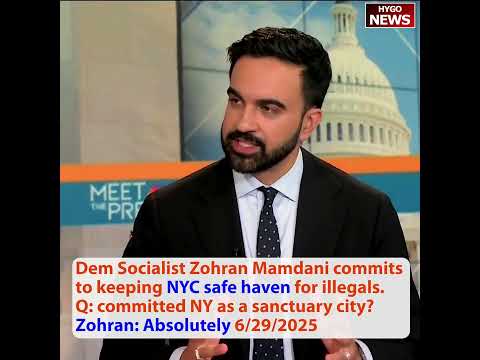
The Senate clerks finished reading the One Big Beautiful Bill after a 16-hour procedural marathon forced by Senate Minority Leader Chuck Schumer. Democrat socialist candidate Zohran Mamdani, who had recently won the New York City Democratic mayoral primary, committed publicly to keeping New York City as a sanctuary for undocumented immigrants. Senator Chris Murphy gushed about Mamdani’s campaign and said Democrats “should learn” from Mamdani’s approach. Trump, responding to Mamdani’s primary win, warned that whoever serves as New York mayor “is going to have to behave themselves, or the federal government is just coming down very tough on them financially.” Representative Jeffries, in a striking moment, criticized the Trump administration’s Iran policy for “abandoning the aggressive diplomacy” of the Obama administration — the approach that included sending pallets of cash to Iran.
The Senate Reading
The Senate clerks’ marathon reading session demonstrates both the perverseness and the futility of Schumer’s procedural tactic. Schumer forced the reading under Senate rules. The clerks dutifully read the entire text across 16 hours. Most of the reading occurred overnight, when the chamber was essentially empty.
“I would like to start by just taking a moment to thank the clerks who stayed up all night reading the amendment and getting us to this point. I know it was a long night that we’re not finished yet, but I want them to know that the Senate appreciates their dedication, their stamina, and their service.”
The acknowledgment of the clerks’ work captures the practical reality. The clerks, regardless of their political views, had to execute the reading because Senate rules required it. Their professionalism is what allowed the procedure to function.
Why The Reading Tactic Mattered Less Than Expected
Schumer’s tactic was intended to slow the bill’s passage and focus attention on its provisions. In practice, neither effect materialized as Schumer may have hoped.
The delay was modest. Sixteen hours is significant in a compressed legislative calendar but is not enough to fundamentally alter the trajectory. The bill’s passage proceeded on roughly the expected timeline.
The attention was negligible. Most Americans did not watch the reading. Most major media outlets did not cover it. The reading happened to a largely empty chamber. The bill’s content, which Schumer hoped to expose, was exposed to almost no one through the reading process.
The administration’s earlier framing — that the Democratic page-by-page reading would actually help communicate the bill’s provisions — assumed that significant media attention would be drawn. When that attention did not materialize, the Democratic tactic neither gained political advantage nor produced the informational exposure it was designed to produce.
Mamdani’s Sanctuary Commitment
The video then pivoted to Zohran Mamdani. Mamdani had won the New York City Democratic mayoral primary, making him the front-runner for the November general election given New York’s Democratic lean.
Mamdani’s sanctuary commitment was direct. “If immigration deportation, are you committed to keeping New York as a sanctuary city?”
“Absolutely, because ultimately we’ve seen that this is a policy that has kept New Yorkers safe for decades.”
“Absolutely” is the categorical commitment. Mamdani is pledging to continue New York’s sanctuary policies if elected mayor. That continuation would maintain the friction between municipal and federal authorities that has defined New York’s immigration policy posture.
”Kept New Yorkers Safe For Decades”
Mamdani’s justification — that sanctuary policies have “kept New Yorkers safe for decades” — is the progressive argument. The theory: when immigrant communities trust local police, they cooperate with public safety investigations. When sanctuary policies protect that trust, crime reporting increases and overall safety improves.
The counter-argument, which the Trump administration has consistently made, is that sanctuary policies protect specific criminals. Individuals who are deportable under federal immigration law include many with criminal histories. Sanctuary policies that prevent federal cooperation allow those individuals to remain in communities where they may reoffend.
Whether sanctuary policies net out to increased or decreased public safety is empirically contested. Academic studies have produced conflicting results. Both sides can cite evidence supporting their position.
Mamdani On ICE
Mamdani’s anti-ICE framing was explicit. “Well, you know, the Borders are, Tom Homan has said that he is planning to deploy ice agents to New York, work site enforcement to essentially increase and enhance the number of ice agents here. If that happens on your watch, how do you plan to handle it? We have to stand up and fight back, and we haven’t seen that from our current mayor, who has instead been working with the Trump administration to assist in their goal of building the single largest deportation force in American history.”
“Stand up and fight back” is the language of confrontation. Mamdani is pledging, if elected, to resist federal immigration enforcement operations in New York City. The resistance would take forms that have been employed by other sanctuary jurisdictions — refusing local cooperation, requiring judicial warrants for specific actions, potentially deploying local police to interfere with federal operations.
”NYPD Officers Arresting A Pastor”
Mamdani then provided a specific case. “I mean, we saw ice agents arrest a migrant at Federal Plaza, and then we saw NYPD officers arresting a pastor who was peacefully observing that arrest.”
The arrest of a pastor who was “peacefully observing” federal operations raises questions. If the pastor was merely observing, the arrest may have been unjustified. If the pastor was interfering with the operation, the arrest may have been appropriate. The specific facts would determine which characterization is accurate.
Mamdani’s framing presents the pastor as a victim of inappropriate policing. That framing serves his political argument. Whether the facts support the framing is a question for investigation.
”Those Days Are Going To Come To An End”
Mamdani closed with his commitment. “Those days are going to come to an end when I’m the mayor. The NYPD’s job is to create public safety in the city, not to assist ice agents in their mission to attack the very fabric of the city.”
“Attack the very fabric of the city” is the escalating rhetoric. Federal immigration enforcement, in Mamdani’s framing, is not law enforcement. It is an attack on the city’s fabric. That characterization represents the progressive framework taken to its maximum extent.
The counter-framing, which the administration has made consistently, is that federal immigration law is simply the law. Enforcing it is not an attack on any city’s fabric — it is the fulfillment of the federal government’s constitutional duty.
Trump’s Warning
Trump’s response to Mamdani’s primary win was blunt. “I can tell you this, whoever’s mayor of New York is going to have to behave themselves, or the federal government is just coming down very tough on them financially. You can’t become about this.”
“Coming down very tough on them financially” is the leverage. The federal government provides substantial funding to major American cities. That funding can be conditioned on cooperation with federal priorities. Sanctuary cities that refuse cooperation can face reduced federal funding as a consequence.
The mechanism is specifically designed into federal grant programs. Many federal programs condition funding on compliance with federal requirements. Cities that refuse compliance face funding reductions. The Supreme Court has generally upheld such conditions as long as they are clear and proportionate.
Murphy On “Mainstream”
Senator Chris Murphy offered the Democratic Party’s reading of Mamdani’s victory. “What lessons do you think Democrats should take from his win? Well, I think it was a really important win, and I hope Democrats do take some lessons from it. He was laser-like focused on the issue of costs. He was laser-like focused on the issue of transferring power from people who have way too much of it, like the big real estate companies that jack up everybody’s rent in New York.”
Murphy’s framing positions Mamdani’s victory as a template for Democratic messaging. Focus on costs. Focus on power concentration. Focus on specific culprits — in Mamdani’s telling, big real estate companies.
”A Little Bit Out Of The Conventional Mainstream”
Murphy’s acknowledgment of Mamdani’s positioning. “Yeah, he’s got some views that are a little bit out of the conventional mainstream, but you know what? The traditional political opponents have no idea what’s actually mainstream in this country.”
“A little bit out of the conventional mainstream” is substantial understatement. Mamdani’s positions include support for defunding the police by $1 billion, government price controls, raising taxes on specifically named racial categories, abolishing jails, and taxpayer-funded drug injection sites. Those positions are not at the edge of the mainstream — they are well outside of it by any conventional measure.
Murphy’s framing — that the “traditional political opponents” misunderstand what is mainstream — assumes that Mamdani’s positions represent genuinely widespread views that critics merely fail to recognize. Whether that assumption holds up depends on whether Mamdani’s positions actually represent majority American preferences.
The general election will test the proposition. Mamdani will face Republican and possibly independent opposition in November. Voters in New York City will decide whether his positions match their preferences. If he wins in November, the Murphy framing is validated. If he loses, Murphy’s characterization of mainstream views needs revision.
Jeffries On Obama’s Iran Approach
The video closed with one of the more remarkable Democratic statements on Iran. Representative Hakeem Jeffries criticized the Trump administration’s Iran approach by invoking Barack Obama. “Why did they abandon the aggressive diplomacy that was successful under the Obama administration?”
The “aggressive diplomacy” Jeffries is referencing is the Joint Comprehensive Plan of Action — the 2015 nuclear agreement that the Obama administration negotiated with Iran. The agreement provided Iran sanctions relief in exchange for constraints on its nuclear program.
The Pallets Of Cash
The administration’s response captures the specific controversy. “You can’t make this up” was the response framing. The Obama-era Iran approach included, famously, the delivery of approximately $1.7 billion in cash pallets to Iran as part of the settlement of various financial claims. That cash transfer — physical cash on wooden pallets delivered to Iran — became a defining image of the Obama administration’s Iran policy.
Jeffries’s invocation of “aggressive diplomacy” that “was successful” elides the fact that the same diplomacy required cash pallets to move forward, and that Iran used the subsequent period to advance its nuclear program to threshold-weapon capability. Whether the Obama approach was “successful” depends on what success means. If it delayed Iran’s program, it was partially successful. If it prevented Iran’s program, it was unsuccessful — because Iran ended up at threshold capability before the current administration’s strikes.
”Promises Made, Promises Kept”
Trump closed the video with his standard framing. “The day I signed this bill into law, almost every major promise made in the 2024 campaign already will have become a promise kept. That’s very important. Promises made, promises made.”
“Promises made, promises kept” is the campaign slogan the administration has consistently deployed. The framing is that Trump is delivering on specific campaign commitments — not on vague aspirations but on specific named policies voters can evaluate against what they were told during the campaign.
Whether the framing holds up depends on which specific promises are counted. Border security (delivered). Tax cuts (pending Senate passage of One Big Beautiful Bill). Iran nuclear program (destroyed). NATO burden-sharing (5% commitment secured). The list of delivered promises is substantial even if not exhaustive.
The Biden Debate Flashback
The video included a flashback to the previous year’s Biden-Trump debate. “FLASHBACK: One year ago, a lost and defeated Joe Biden stood confused as Jill Biden, Ed.D. oddly congratulated him for what would soon go down as the worst debate performance in history. ‘Joe, you did SUCH a great job. You answered EVERY question.’”
The flashback serves political messaging. It reminds viewers of the Biden debate performance that became the pivot point toward his eventual withdrawal from the race. Jill Biden’s congratulations, delivered to an obviously struggling husband, captured the cognitive dissonance that defined the late-Biden period.
Why The Flashback Matters
One year after that debate, the political environment has transformed. Biden is out of office. Harris lost to Trump. Trump has been in office for six months and has accumulated the cumulative record of accomplishments the week’s summary captured.
The contrast is what the administration wants voters to notice. One year ago, Biden and Harris were presiding over a country the Gulf leaders described as “dead.” One year later, Trump is presiding over what those same leaders call “the hottest country in the world.” The specific changes — border enforcement, Iran action, NATO commitments, Supreme Court rulings, legislative progress — all occurred in that twelve-month period.
Key Takeaways
- Senate clerks finished reading the One Big Beautiful Bill after 16 hours of marathon reading forced by Schumer, with “the room basically empty and nobody listened to the whole thing.”
- Mamdani’s sanctuary commitment: “Absolutely, because ultimately we’ve seen that this is a policy that has kept New Yorkers safe for decades.”
- Mamdani on ICE: “We have to stand up and fight back…The NYPD’s job is to create public safety in the city, not to assist ice agents in their mission to attack the very fabric of the city.”
- Trump’s warning: “Whoever’s mayor of New York is going to have to behave themselves, or the federal government is just coming down very tough on them financially.”
- Jeffries invoking Obama: “Why did they abandon the aggressive diplomacy that was successful under the Obama administration?” — the Iran approach that included pallets of cash.