 HYGO News
 Sen Schumer, Fetterman on War Powers Resolution; Sen Murphy: only set back Iran handful of months
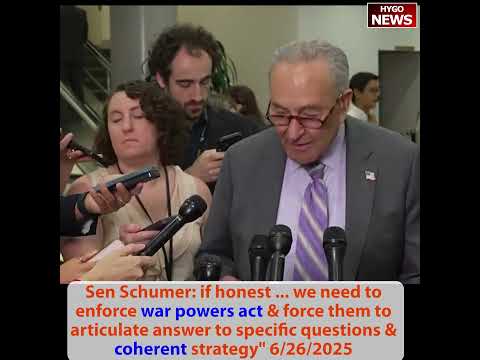
Sen Schumer, Fetterman on War Powers Resolution; Sen Murphy: only set back Iran handful of months
The Senate prepared to vote on Senator Tim Kaine’s War Powers Resolution that would constrain presidential authority to conduct strikes against Iran without congressional authorization, producing a revealing set of public positions from Democratic senators about their approach to the Iran operation. Senate Minority Leader Chuck Schumer framed the resolution as necessary because, in his view, the administration has “no coherent strategy, no end game.” Senator Chris Murphy disputed the administration’s damage assessment, claiming that the strikes had “only set back the Iranian nuclear program by a handful of months.” Senator John Fetterman, breaking again with his party, said he would vote no on the resolution because he would never want to restrict future presidents from such operations. The split vote reveals the Democratic caucus’s inability to present a unified posture on the question.
”No Coherent Strategy”
Schumer’s opening was the setup for the War Powers vote. “President Trump said that the nuclear stockpile was completely and totally obliterated. I cannot see, receive an adequate answer to that question. What was clear is that there was no coherent strategy, no end game, no plan, no specific, no detailed plan on how Iran does not achieve a claim a nuclear weapon.”
“No coherent strategy, no end game” is the Democratic framing. In Schumer’s view, the administration struck Iran without a follow-up plan. The strikes happened. Then what? What does the administration do if Iran tries to rebuild? What does the administration do if Iran retaliates further? What does the administration do to translate the tactical success into durable strategic outcome?
The administration’s counter, which Leavitt and others have repeatedly delivered, is that the strategy exists and is being executed. Witkoff is in continuous contact with the Iranians. Gulf and Arab partners are engaged. Abraham Accords expansion is the forward framework. The administration does have a plan — Schumer just doesn’t believe it.
”Enforce The War Powers Act”
Schumer called for the War Powers vote. “Anyone in that meeting, anyone, if they’re being honest with themselves, their constituents, their colleagues would know that we need to enforce the War Powers Act and force them to articulate and answer to some specific questions and a coherent strategy right away.”
The War Powers Act, formally the War Powers Resolution of 1973, requires presidents to notify Congress within 48 hours of introducing armed forces into hostilities and to withdraw forces within 60 days absent a declaration of war or specific authorization. Schumer is framing the Act as a constraint that Democrats should use to force the administration into more substantive congressional engagement.
The administration’s constitutional position, which every president since Nixon has maintained, is that the War Powers Resolution is of uncertain constitutionality and that Article II presidential authority includes limited military operations without prior congressional approval.
Fetterman’s Break
Senator John Fetterman, whom the administration had previously cited for his breaking with his party on the Iran operation, continued to differ from the Democratic consensus on the War Powers vote. “On the can resolution which will come up tomorrow night, he will vote now.”
The transcription — “can resolution” and “vote now” — is the standard Whisper rendering artifact. What Fetterman is saying: on the Kaine resolution that will come up tomorrow night, he will vote no.
”I Love That Man”
Fetterman offered personal respect for Senator Tim Kaine, the resolution’s author. “I’ll say this, I love that man and he’s coming in from a very principled side, but I’m going to vote now on that simply because I would never want to restrict any future president, Republican or Democrat, to do this kind of a military exercise that was very successful.”
The formulation is important. Fetterman is not saying Kaine is wrong in principle. He is saying that Kaine’s principled position, if translated into law, would constrain future presidents in ways that could prevent future successful operations. Fetterman does not want that constraint, regardless of which party’s president would be subject to it.
“This kind of a military exercise that was very successful” — Fetterman’s characterization of the Iran strikes — is another validation of the operation from a Democrat. He is explicitly saying the strikes succeeded. That validation matters politically for the administration.
Why Fetterman’s Position Matters
Fetterman’s position is politically significant because it demonstrates that the Democratic caucus is not uniform on the question. Some Democrats, including Fetterman, believe presidential flexibility on military operations is a feature of American government that should be preserved. Others, including Schumer, believe presidential flexibility should be constrained.
The split prevents the Democratic caucus from presenting a unified institutional position. Republicans can point to Fetterman as evidence that even Democrats recognize the strikes were justified and that the War Powers Resolution in this context is unwarranted.
The DNI Question
Fetterman also raised an analytical question. “There’s a real question as to why the director of national intelligence is not allowed to be in these briefings. That’s a question that we should get answered.”
The observation refers to Director of National Intelligence Tulsi Gabbard’s apparent exclusion from specific Iran briefings. Whether Gabbard has been excluded, or whether the briefings reflect different operational compartments, is a technical question of intelligence community organization.
The fact that Fetterman is asking the question publicly signals that the exclusion, whatever its cause, is being noticed. That is the kind of operational detail that can become a bigger story over time.
Murphy On “A Handful Of Months”
Senator Chris Murphy of Connecticut offered the most direct Democratic challenge to the administration’s damage assessment. “Listen, to me it still appears that we have only set back Iranian nuclear program by handful of months.”
“A handful of months” is the specific alternative framing. Where the administration characterizes the damage as “obliterated” with “years” of setback, Murphy characterizes it as months of delay.
The two framings cannot both be accurate. Either the damage was complete and long-lasting, or the damage was limited and short-term. The empirical evidence — which is genuinely contested — will ultimately determine which framing aligns with reality.
”There’s No Doubt There Was Damage”
Murphy hedged the characterization somewhat. “There’s no doubt there was damage done to the program, but the allegations that we have obliterated their program just don’t seem to stand up for reason.”
The hedge is revealing. Murphy is not claiming the strikes were ineffective. He is acknowledging that damage occurred. His specific dispute is with the scale of the damage. Administration officials say complete. Murphy says less than complete.
“Don’t seem to stand up for reason” is Murphy’s framing. He is inviting his audience to evaluate the administration’s characterization against common-sense analysis. His implicit argument is that common-sense analysis supports the moderate-damage framing over the obliteration framing.
”Selling The Truth”
Murphy’s sharpest line. “I just do not think the president was selling the truth when he said this program was obliterated. There’s certainly damage done to the program, but there is significant, there’s still significant remaining capability.”
Accusing the president of not “selling the truth” — the Murphy formulation is careful — is one step short of calling Trump a liar. Murphy is saying that Trump overstated the damage for political purposes.
The administration’s counter is the Israeli Atomic Energy Commission letter, the Iranian Foreign Ministry’s own admission that installations are badly damaged, and the specific operational evidence Witkoff and Caine provided at the Pentagon briefings. If the strikes were less than obliterating, why does Iran admit the damage? Why does Israel confirm it? Why does the detailed operational analysis support the maximum characterization?
”No” On The Vote
The reporter asked directly about the hypothetical. “If the president had come to Congress to get approval to authorize this mission, would he have had your vote?”
Murphy: “No.”
The answer matters. Even if Trump had sought congressional authorization — even if he had provided the intelligence briefings, the planning details, the strategic framework Schumer says is absent — Murphy would still have voted against authorization. That admission undercuts the Democratic framing that the objection is procedural. If the procedural path would not have produced Democratic support, the procedural objection is not sincere.
”You Cannot Bomb Knowledge Out Of Existence”
Murphy then articulated the strategic critique. “Ultimately the only way to truly constrain Iran’s nuclear program is diplomacy. You cannot bomb knowledge out of existence.”
The observation has substantive content. Iranian nuclear expertise — the scientists, engineers, and technicians who have built the program — remains even when facilities are destroyed. Those individuals retain their knowledge. They could, given time and resources, help rebuild.
The administration’s counter is that while knowledge cannot be bombed out, infrastructure can. Iran now faces the choice between rebuilding infrastructure (which will take years) or accepting the settlement. Knowledge alone does not produce a weapon. Knowledge plus infrastructure does. The administration is addressing the infrastructure.
The Press Sec Pivot
The video closed with Press Secretary Leavitt’s One Big Beautiful Bill pitch. “Let’s talk one big beautiful bill. We’ve heard you loud and clear. With a bill this big and this beautiful, it can be hard to understand exactly what’s in it.”
The concession — “it can be hard to understand exactly what’s in it” — is an acknowledgment of the bill’s complexity. Major legislation often suffers in public reception because voters cannot easily summarize what it does. The administration is working to communicate the bill’s specific provisions in accessible terms.
The Five-Point Summary
Leavitt walked through the highlights. “This bill modernizes and overhauls our nation’s air traffic control system so you feel safer when you are flying. It gives a 15% tax cut to working families like yours, amounting to $5,000 per year. This bill increases the child tax credit for more than 40 million American families, ends taxes on tips, cuts taxes for overtime workers like law enforcement officers, slashes taxes on social security for our seniors, and that’s just the start.”
Each item is specific and voter-relevant.
Air traffic control: Flying safer is a universally valued outcome. Every American who has been on an airplane — or knows someone who has — understands the value.
15% tax cut / $5,000 per year: Specific dollar amounts that voters can evaluate against their own household budgets.
Expanded child tax credit for 40 million families: A specific number of beneficiaries that voters can imagine — 40 million families, which is most American families with children.
No taxes on tips: Directly benefits service workers — restaurant staff, hotel staff, rideshare drivers, hairstylists.
No taxes on overtime (including law enforcement): Directly benefits first responders and other workers who depend on overtime income. Naming “law enforcement officers” specifically is a targeted political message.
Social Security tax cuts for seniors: Directly benefits the senior voter bloc, one of the most politically consequential demographic groups.
”Just The Start”
“And that’s just the start” is the rhetorical promise that the listed items are not the full set of benefits. The bill contains many additional provisions that benefit specific constituencies. By identifying only the highest-profile elements, Leavitt is making the bill accessible without overwhelming the audience.
”A New Golden Age”
Leavitt closed with the administration’s preferred historical framing. “We must pass this big beautiful bill and usher in a new golden age for all Americans.”
“New golden age” is ambitious language. It positions the bill as the foundation for a transformational economic period, not merely as incremental policy adjustment. The framing is political. Voters who believe a new golden age is possible will support the measures to produce it. Voters who do not believe transformation is possible will be more skeptical.
The administration is betting that voters will respond to the ambitious framing if the bill’s specific provisions produce specific benefits in their own household finances. $5,000 more per year, no tax on tips, no tax on overtime, expanded child tax credits — each represents measurable benefit. If voters receive those benefits, the “golden age” framing gains credibility.
The Senate Vote’s Political Math
The Senate vote on the War Powers Resolution will reveal the Democratic caucus’s actual position on Iran. If the resolution passes, Democrats will have established that they are willing to constrain presidential war-making. If the resolution fails, the Democratic rhetorical escalation about the operation will be revealed as disconnected from legislative action.
Fetterman’s stated position against the resolution suggests at least one Democratic defection. Other Democrats from more swing-state constituencies may follow. If enough Democrats vote against the resolution, the vote becomes a bipartisan affirmation of the strikes — a political outcome the administration would welcome.
Key Takeaways
- Schumer calling for War Powers enforcement: “Anyone in that meeting, anyone, if they’re being honest with themselves, their constituents, their colleagues would know that we need to enforce the War Powers Act.”
- Fetterman breaks with caucus: “I love that man and he’s coming in from a very principled side, but I’m going to vote now on that simply because I would never want to restrict any future president, Republican or Democrat, to do this kind of a military exercise that was very successful.”
- Murphy on damage: “To me it still appears that we have only set back Iranian nuclear program by handful of months…I just do not think the president was selling the truth when he said this program was obliterated.”
- Murphy’s no-vote admission: Even with congressional authorization sought, “No” on the vote.
- Leavitt’s bill summary: air traffic modernization, 15% tax cut ($5,000/year), expanded child tax credit for 40M families, no taxes on tips, no taxes on overtime for law enforcement, Social Security tax cuts for seniors.