 HYGO News
 Sen Rochester: BBB= bad puts 100K jobs at risk; Bessent: Art Laffer expert PhD economist; add debt?
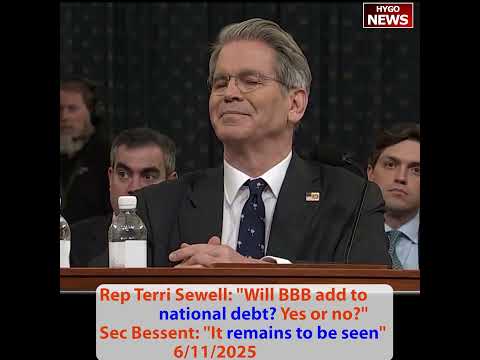
Sen Rochester: BBB= bad puts 100K jobs at risk; Bessent: Art Laffer expert PhD economist; add debt?
Treasury Secretary Scott Bessent’s appearance before congressional Democrats turned into one of the most revealing fiscal hearings of the year. Senator Lisa Blunt Rochester opened with a categorical denunciation of the One Big Beautiful Bill, framing it as a threat to jobs and to working families. Representatives Mike Thompson and Terri Sewell pressed Bessent on whether the bill would add to the national debt and demanded the name of any independent PhD economist who agreed the bill would not. Bessent’s one-word answer — “Art Laffer” — became the most-clipped moment of the session and the hinge of a larger debate about which economic models get to count as legitimate when trillions of dollars are on the line. What emerged across the hearing was less a policy debate than a battle over which authorities the American public should trust.
Rochester’s Opening: “This Bill Is Bad For People”
Rochester did not mince words. “This bill is bad for people. This bill is bad for people who are trying to live their purpose and who are working incredible jobs. Labor. Jobs. Delaware is in the house. That’s right. Matter of fact, my name is Lisa Blunt Rochester. Matter of fact, we always say you can’t spell labor without LBR. Labor.”
The personal branding — the reference to her own initials, the invocation of her home state — is the signature of a senator performing for the hometown audience. But the substantive claim underneath the performance is the one the administration must rebut. Rochester is asserting that the One Big Beautiful Bill damages the interests of working people, and she is asserting it with the rhetorical weight of a senator standing at the center of the Democratic labor alliance.
”Hundreds Of Thousands Of Jobs Are At Risk”
Rochester then delivered the claim that will get quoted. “This is about jobs. Hundreds of thousands of jobs are at risk because of this big bad bill.”
The number is striking. “Hundreds of thousands” is a large figure by any measure, and Rochester’s framing implies direct causation — that the bill, if enacted, would produce those job losses.
The administration’s response, drawn from the CEA and supportive economic modeling, is that the bill is not projected to cost hundreds of thousands of jobs. It is projected to create millions. The range cited in the administration’s own materials — 6.6 to 7.4 million jobs saved or created in the short run — is an order of magnitude larger than Rochester’s warning. If the administration’s estimates are right, Rochester is not just wrong about the direction; she is wrong about the scale.
”Hell-Bent On Ignoring The Warnings”
Rochester’s sharpest line carried institutional weight. “Unfortunately, it strikes me that you are hell-bent on ignoring the warnings of any independent expert whose opinions may not serve your goals. I would submit that in the position that you have now, it is even worse. It’s more wrong. It’s more irresponsible, and it’s more dangerous.”
The accusation is not just that Bessent is wrong. It is that he is deliberately ignoring expertise that might contradict him. In Rochester’s framing, Bessent is not a Treasury Secretary trying to build the strongest case for legislation; he is an operator cherry-picking analysis.
The sequence — “more wrong. It’s more irresponsible, and it’s more dangerous” — escalates from intellectual error to moral failing to public risk. It is the kind of language that is meant to leave a mark, and it set the stage for Thompson’s subsequent interrogation.
Thompson’s Challenge: One Independent Study
Representative Thompson picked up where Rochester left off and sharpened the challenge to its point. “Mr. Secretary, can you point to one independent study? One study performed by an expert PhD economist who is not on the payroll of this administration that says that this legislation will not add to our national debt.”
The demand was specific. Thompson was not asking for a defense of the bill. He was asking for one — just one — credentialed outside expert whose analysis supported the administration’s claim that the bill would not add to the debt. The implicit argument: if no such expert exists, the administration’s fiscal claim is unsupported by the profession and should be dismissed.
”Yes. Art Laffer.”
Bessent tried to pivot to the Congressional Budget Office. Thompson cut him off. “No, I’m asking you. Is there an independent expert that you can point to that says that this bill will not add to our national debt? Yes or no?”
“Yes.”
“There is? Yes. What are they? Art Laffer.”
“Pardon me?”
“Art Laffer.”
“Art Laffer? Great. I don’t think that one counts.”
The exchange is a masterclass in the politics of credentials. Art Laffer is a real economist with a real PhD who has held real academic appointments and received the Presidential Medal of Freedom. Bessent’s answer is, on its face, responsive to Thompson’s question. Thompson’s dismissal — “I don’t think that one counts” — is an argument about reputation, not credentials.
Why The Laffer Citation Is A Statement
To understand why Bessent chose Laffer and why Thompson dismissed him, you have to understand what Laffer represents in the ideological topography of American economic policy. Laffer is the architect of the Laffer Curve, the model that describes the theoretical point at which tax rate increases begin to reduce rather than raise revenue. He is the intellectual godfather of supply-side economics. For Democrats, Laffer is associated with the Reagan-era tax cuts and what they view as a half-century of debt accumulation fueled by supply-side assumptions.
By naming Laffer, Bessent was not just answering Thompson’s question. He was telling the room exactly which school of economic thought the administration is aligning itself with. Supply-siders believe that well-designed tax cuts can generate sufficient growth to partially or fully offset revenue losses. Keynesian and neo-Keynesian economists believe that the multipliers required for that offset are implausibly large under current conditions.
Sewell’s “Yes Or No” Trap
Representative Terri Sewell tried a different approach. “Will the big beautiful bill add to the national debt? Yes or no?”
Bessent’s answer was careful. “It remains to be seen.”
Sewell pressed. “Is that a yes or a no? That’s a no? Yes.”
“Sorry? What did you say?”
“I’m sorry. It remains to be seen.”
The repetition of “it remains to be seen” is the defensible Treasury Secretary line. The bill has not been implemented. Its dynamic effects on growth, revenue, and behavior have not been observed in real-world data. Any honest statement about whether it will or will not add to the debt requires an acknowledgment that the answer depends on assumptions — assumptions the CBO makes one way and Laffer makes another.
Sewell wanted a binary answer. Bessent refused to give one. Democrats framed his refusal as evasion. Bessent’s framing is that it is intellectual honesty.
The CBO Number: $2.4 Trillion
The CBO’s scoring is the empirical reference point every Democrat in the hearing cited. “The Congressional Budget Office official score of this bill says that it increases the federal deficit by $2.4 trillion.” That is a large number, delivered with the authority of an independent analytical institution, and it is the Democratic case in one sentence.
Bessent’s Tariff Offset
Bessent’s response showed how the administration is modeling the bill’s net fiscal impact. “Sorry to interrupt, Congresswoman, but the CBO also said that tariff income over the 10-year window would be $2.8 trillion. So that would be $400 billion. You want to talk about dynamic scoring and all that.”
The argument: if you score the tax cuts at $2.4 trillion in additional deficit, you also have to score the tariff revenue at $2.8 trillion on the revenue side. Net that together, and Bessent is arguing, the bill’s fiscal impact is a $400 billion surplus, not a deficit of trillions.
The Democratic rejoinder, contained in Sewell’s response — “There’s nothing dynamic about that. You’re quoting the CBO. I’m quoting the CBO” — is that Bessent has not employed any exotic dynamic scoring. He has simply added a column the CBO itself produced. Whether that inclusion is appropriate depends on whether the tariff revenue estimate will hold.
Constituent Fear
Sewell then shifted registers from budget arithmetic to constituent experience. “But the reality is that I have constituents back home who are really scared. They’re scared that prices have gone up. This administration has promised that prices will go down. That absolutely has not occurred for them.”
The political logic of this move is clear. No voter in Sewell’s district is going to work through the CBO’s dynamic scoring methodology. But every voter feels grocery prices. By grounding the critique in constituent fear, Sewell turns a budget debate into a cost-of-living argument.
Bessent’s implicit counter — shown in his reference to tariff revenue and the overall architecture of the bill — is that the low-income voters Sewell describes would benefit from the bill’s wage and take-home pay increases. But that counter requires the audience to trust that the benefits will materialize, and constituents who are scared now are unlikely to give the benefit of the doubt.
”Another Tax On Them”
Sewell closed with the line Democrats will deploy on every tariff debate this cycle. “And every time they hear the word tariff, they think of the fact that it’s another tax on them that will be passed on to them for goods and services.”
Whether tariff costs are fully, partially, or barely passed through to consumers is an empirical question that economists have debated for generations. The May inflation print — with its “downside surprise” on core goods — is one data point suggesting the pass-through is smaller than critics predicted. But one month does not settle the question, and Sewell is betting that the political intuition that tariffs are just taxes in disguise will hold whether or not the data supports it.
The Debt Estimates Pile Up
Sewell closed with a stack of estimates from outside the CBO. “At any rate, not only do the CBOs say that this bill will increase the deficit by $2.4 trillion, the Committee for Responsible Federal Budget said $2.5 trillion, the Yale Budget Lab, $2.4 trillion. The point I’m trying to make is that you will add to the national debt over the span of this time.”
The convergence of the three estimates — $2.4 trillion, $2.5 trillion, $2.4 trillion — is meant to demonstrate that the CBO is not an outlier. Three independent analytical organizations came to essentially the same number. Bessent’s counter, rooted in the Laffer view, is that all three are using the same assumptions and none are modeling the growth dynamics the administration expects.
Two Economic Universes
The hearing, in the end, is a window into the reality that there are two coherent economic universes in Washington right now. One universe scores the bill at $2.4 trillion in additional debt, predicts tariff pass-through to consumers, warns of job losses, and treats the CBO as canonical. The other universe scores the bill with tariff revenue included, expects supply-side growth effects to offset static losses, predicts millions of jobs created, and cites Laffer as a legitimate counterweight to CBO methodology. Americans are being asked to choose between those universes in a fiscal debate they did not ask for, and the choice will define the trajectory of federal budgeting for a decade.
Key Takeaways
- Rochester: “This bill is bad for people…Hundreds of thousands of jobs are at risk because of this big bad bill.”
- Thompson demanded “one study performed by an expert PhD economist who is not on the payroll of this administration that says that this legislation will not add to our national debt.” Bessent: “Yes. Art Laffer.”
- Thompson’s response: “Art Laffer? Great. I don’t think that one counts.”
- Bessent’s tariff offset argument: “the CBO also said that tariff income over the 10-year window would be $2.8 trillion. So that would be $400 billion” surplus against the $2.4T CBO score.
- Debt estimates stack up: “the CBOs say that this bill will increase the deficit by $2.4 trillion, the Committee for Responsible Federal Budget said $2.5 trillion, the Yale Budget Lab, $2.4 trillion.”