 HYGO News
 Sen. Rand Paul calls on Dr. Fauci to resign over gain-of-function research 11/4/2021
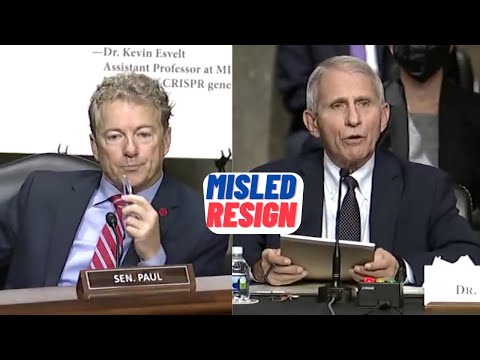
Sen. Rand Paul Calls on Dr. Fauci to Resign Over Gain-of-Function Research
On November 4, 2021, Senator Rand Paul (R-KY) confronted Dr. Anthony Fauci at a Senate Health Committee hearing over the National Institutes of Health’s funding of gain-of-function research at the Wuhan Institute of Virology. The exchange, which came two weeks after the NIH admitted to funding gain-of-function research on bat coronaviruses at the Chinese lab, culminated in Paul publicly calling on Fauci to resign. The confrontation marked one of the most heated exchanges between the two men in a series of clashes that had played out over multiple congressional hearings.
Paul’s Central Accusation: NIH Funded Dangerous Research
Paul opened his line of questioning by asserting that NIH-funded scientists had engaged in experiments that crossed the line into gain-of-function research. He claimed that scientists working with the Wuhan Institute of Virology had “created viruses not found in nature” through experiments funded by the American government, and that Fauci had personally “misled” the public by denying it.
The senator cited specific research in which the nonprofit EcoHealth Alliance took the bat coronavirus known as SHC014 and combined it with a backbone virus called WIV1, creating a recombinant virus that does not exist in nature. Paul argued that the resulting virus made mice with humanized cells sicker, which by any reasonable definition constituted a gain in lethality and therefore gain-of-function research.
Paul delivered a direct warning about the stakes: “Your repeated denials have worn thin and the majority of Americans, frankly, don’t believe you.” He escalated further: “Your persistent denials are not just a stain on your reputation but are a clear and present danger to the country and to the world.”
The Definition Dispute: Gain-of-Function or P3CO?
At the heart of the confrontation was a semantic battle over what qualifies as gain-of-function research. Paul accused Fauci and the NIH of changing the definition of the term on their website to avoid admitting that the Wuhan-funded research qualified.
Paul alleged that on the same day the NIH acknowledged that gain-of-function work had occurred at the Wuhan lab, the agency updated its website with a new definition designed to exclude the very experiments in question. “You’ve changed the definition on your website to cover your ass,” Paul said bluntly, drawing gasps from some in the hearing room.
Paul pointed to what he described as an obvious logical problem: if the Chinese researchers themselves admitted in their published papers that they had created viruses not found in nature, and those viruses gained in infectivity and lethality, then the only way to deny it was gain-of-function research was to redefine the term itself.
Fauci pushed back on this framing, arguing that the term “gain of function” was imprecise and that the NIH operated under a more specific regulatory framework. He cited the P3CO (Potential Pandemic Pathogen Care and Oversight) policy as the operative standard, not the broader colloquial understanding of gain-of-function.
Fauci defended the existing framework by pointing to its development process, noting that it had been created over a two- to three-year period involving outside bodies including the National Science Advisory Board for Biosecurity, two conferences by the National Academy of Sciences, Engineering, and Medicine in December 2014 and March 2016, an external risk-benefit assessment, and a final policy issued by the White House Office of Science and Technology Policy in January 2017.
Fauci’s Defense: “Egregiously Incorrect”
Fauci responded to Paul’s accusations with characteristic directness, telling the committee that the senator was “egregiously incorrect in what he says.” He rejected Paul’s characterization of the research and his role in it.
“Senator, with all due respect, I disagree with so many of the things you’ve said,” Fauci responded. “First of all, gain of function is a very nebulous term.”
On the question of whether the pandemic originated from a lab leak, Fauci maintained his position that a natural origin remained the most likely explanation. “It’s much more likely that this was a natural occurrence,” Fauci said, pushing back against Paul’s assertion that the preponderance of evidence pointed to a laboratory origin.
Fauci also denied that the NIH continued to support research at the Wuhan Institute of Virology, contradicting Paul’s claim. When Paul pressed him on having expressed trust in Chinese scientists during a committee hearing the previous month, the exchange grew increasingly heated, with the committee chair intervening to maintain order.
Paul’s Call for Resignation
Paul concluded his questioning with a formal call for Fauci to step down from his position as director of the National Institute of Allergy and Infectious Diseases.
“You appear to have learned nothing from this pandemic,” Paul said. “I think it’s time you resign.”
Paul framed his demand not merely as a response to the gain-of-function question but as a broader critique of Fauci’s willingness to acknowledge the risks associated with the type of research that may have contributed to the pandemic. He argued that without an honest accounting of what went wrong, the scientific community could not take the steps necessary to prevent a future lab leak.
“We’re not going to get anywhere close to trying to prevent another lab leak of this dangerous sort of experiment,” Paul warned. “You won’t admit that it’s dangerous and for that lack of judgment I think it’s time that you resign.”
Paul also emphasized that even the Chinese authors of the relevant research papers had acknowledged in their own publications that they created viruses not found in nature that gained in infectivity. He argued that Fauci’s position required ignoring evidence that the scientists themselves had documented.
The NIH Admission That Changed the Debate
The November 4 hearing took place in a significantly different context than earlier Paul-Fauci confrontations. Just two weeks prior, the NIH had sent a letter to Congress acknowledging that EcoHealth Alliance had conducted experiments in Wuhan that met the definition of gain-of-function research, a reversal of months of denials.
The NIH letter confirmed that EcoHealth Alliance had performed experiments that created bat coronaviruses capable of infecting humanized mice at rates greater than the original viruses. The admission directly contradicted Fauci’s earlier testimony in which he repeatedly assured Congress that no NIH funds had supported gain-of-function research at the Wuhan lab.
Paul characterized the NIH admission as vindication of his position and used it to argue that Fauci’s continued denials were no longer credible. He noted that the facts were now “clear” and that “the NIH did fund gain of function research in Wuhan, despite your protestations.”
The exchange also highlighted a broader tension within the scientific community over how to regulate research that could produce more dangerous pathogens. Paul argued that gain-of-function experiments “could endanger civilization as we know it” and that the failure to honestly assess the risks made another pandemic-scale event more likely.
Key Takeaways
- Senator Rand Paul publicly called on Dr. Fauci to resign during a November 4, 2021, Senate Health Committee hearing, accusing him of misleading the public about NIH-funded gain-of-function research at the Wuhan Institute of Virology.
- Paul accused the NIH of changing the definition of gain-of-function on its website to exclude experiments that created recombinant bat coronaviruses not found in nature, telling Fauci directly, “You’ve changed the definition on your website to cover your ass.”
- Fauci called Paul’s allegations “egregiously incorrect” and defended the NIH’s regulatory framework, but the exchange came just two weeks after the NIH admitted in a letter to Congress that EcoHealth Alliance had conducted experiments in Wuhan that met the gain-of-function definition.