 HYGO News
 Sen Paul OBJECTS TWICE to Sen Kennedy’s Proposal to STOP Congressional Pay During Schumer Shutdown
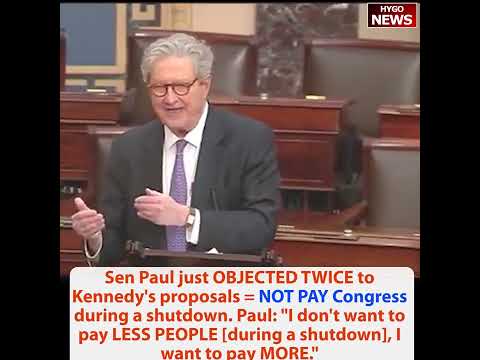
Sen Paul OBJECTS TWICE to Sen Kennedy’s Proposal to STOP Congressional Pay During Schumer Shutdown
Sen. John Kennedy (R-LA) introduced two bills designed to stop congressional pay during the ongoing shutdown — but fellow Republican Sen. Rand Paul (R-KY) objected to both of them. Kennedy’s first bill, the “No Shutdown Paychecks to Politicians Act,” would halt congressional pay during shutdowns with no back pay after reopening. Paul’s objection: the focus should be paying federal workers who are working, not punishing Congress. Paul offered his own alternative — the “Shutdown Prevention and Pay Workers Act” — that would pay essential government workers including military during any shutdown. Kennedy refused to substitute his bill, arguing Paul’s approach wouldn’t pass the House or be signed by Trump. Kennedy then introduced a second bill, the “Withhold Member Pay During Shutdowns Act,” that would merely escrow congressional pay rather than eliminate it — releasing the held money after the shutdown ends. Paul objected to this version too. Paul used his floor time to argue that Obamacare subsidies are actually going to people earning $100,000-$225,000 per year (“$13,000” subsidy for $100K earners), while actual working poor on food stamps would lose benefits. Kennedy cited 2013 Obama-era precedent. Paul emphasized: “I don’t want to pay less people. I want to pay more.” Kennedy: “My bill will pass the House of Representatives. And my bill will be signed by the president. Senator Paul’s bill, I can assure you, will not pass the House of Representatives.” Paul: “If you make $100,000 a year, the Democrats want to give you $13,000.”
Kennedy Introduces First Bill
Sen. Kennedy opened the exchange. “Starting with my first bill, which would say members of Congress can’t be paid and don’t get back pay even after we end the shutdown. Is there an objection?”
The bill’s key features:
- No pay for Congress during shutdown
- No back pay after shutdown ends
- Members of Congress would permanently lose those paychecks
The logic: federal workers are not being paid; air traffic controllers are missing paychecks; SNAP recipients face partial benefits; military has partial pay. Congress — the body causing and prolonging the shutdown — should face the same financial reality.
Paul’s Objection
“Right to object. I think it’s time that instead of closing the government down further that we begin to open up government, what I will offer is legislation that instead of closing government down further begins to pay those who are working.”
Paul’s framework: don’t pile up more people not being paid. Instead, pay people who are working — federal workers, military, air traffic controllers. The shutdown-prevention focus should be on expanding pay, not contracting it.
“I ask that the senator modify his request.”
Paul asked Kennedy to substitute Paul’s bill for Kennedy’s.
Kennedy’s Refusal
“I will not, Mr. President, and I’d like to explain why. I understand Senator Paul is making a good point. I think what Senator Paul is saying, let’s pay everybody. That’s what I understand to be saying. And he wants me to agree to that instead of my bill.”
Kennedy acknowledged Paul’s point is reasonable in isolation. But Kennedy had specific strategic reasons for not substituting.
“Here’s the problem I have with Senator Paul’s proposal of pulling down my bill. There’s several reasons. Number one, I’m interested in passing something. I’m not interested in just putting on a show.”
Kennedy’s framework: he wants legislation that actually passes. Paul’s proposal would die in House or at Trump’s desk. Kennedy’s would pass both.
”Dead as Fried Chicken”
“My bill will pass the House of Representatives. And my bill will be signed by the president. Senator Paul’s bill, I can assure you, will not pass the House of Representatives. President Trump will not sign it.”
Kennedy’s assessment of Paul’s bill: it won’t pass. Why? House Republicans won’t expand federal worker pay during a Democratic-caused shutdown because it removes leverage on Democrats to end the shutdown. Trump won’t sign it for similar reasons.
“I’m not saying someone’s right or somebody’s wrong. President Trump is not considered to be Senator Paul to be part of his MAGA agenda, and he will veto it.”
Kennedy acknowledged Paul’s policy position isn’t necessarily wrong. But it’s not politically viable. Trump would veto; House would fail to override.
“Then we’ll write back to square one. So for that reason, I can’t substitute his for mine, because his is going to be as dead as fried chicken here in a few days, and mine has a chance to pass.”
“Dead as fried chicken” — Kennedy’s folksy Louisiana idiom for politically doomed. His bill, targeting Congress alone, could pass because it’s hard for senators to object to Congress losing pay that they themselves are still receiving while workers suffer.
Parliamentary Procedure
“Now, I need some clarification, Mr. President, Parliamentary Encore, if you will. Do I understand that Senator Paul has objected to my bill?”
Kennedy sought procedural clarity. Paul’s technical objection was to modification, but the modification was to substitute Paul’s entire bill for Kennedy’s — effectively rejecting Kennedy’s bill.
“Does Senator from Kentucky ask if you would modify your request? And his modification, if I might ask, is to substitute his bill for mine. That is the understanding of the chair.”
The chair confirmed: Paul’s request was to substitute his bill for Kennedy’s. That’s effectively objecting to Kennedy’s bill.
“Okay. I have said I will not substitute his bill for mine. Objection to the modification is heard.”
Kennedy refused substitution. Paul’s modification request was rejected.
“Okay. Is there an objection to the original request?”
The chair moved to Paul’s direct objection to Kennedy’s bill.
Paul’s Second Intervention
“Reserving the right to object, I think it’s actually not clear at all that the president wouldn’t sign a bill to continue paying federal workers.”
Paul pushed back on Kennedy’s assessment. Paul believed Trump might sign a federal worker pay bill.
“Now, I probably would not hire new people, and I would probably let the federal government shrink gradually through attrition, because I think we need to be smaller. But if you work for government, you’re doing your job, and you have a contract, I think you ought to be paid.”
Paul’s government-shrinking framework: reduce federal workforce through attrition, but pay current workers. The libertarian approach — fewer employees overall but fair treatment of those still employed.
”Quite Confusing”
“So I don’t think it’s not clear that the president wouldn’t support this. I think it’s actually quite confusing that this is being objected by the Democrats, and I think actually it’d be nice to let the Democrats, you know, have a round at this, and explain to us why they don’t want to pay their traffic controllers.”
Paul redirected to Democratic objections. Democrats had blocked similar pay-workers bills. Why? Paul found it confusing.
“I think it’s actually an untenable position of Democrats to come before this body and say, oh, we want to give subsidies to people who make $225,000 a year. That’s what they’re arguing for.”
Paul’s specific critique: Democrats want Obamacare subsidies for people earning $225,000/year. This is not working-class advocacy; it’s upper-middle-class subsidy.
”$13,000 for $100K Earners”
“The Obamacare subsidies are not the basic subsidies. These are add-on subsidies that started two years ago. If you make $100,000 a year, the Democrats want to give you $13,000.”
The specifics:
- Original ACA (Obamacare) subsidies had income caps
- 2021 COVID-era enhancements removed the income cap
- Subsidies at higher incomes are the specific “add-on” Democrats want to extend
- Household earning $100K gets approximately $13K subsidy
“Meanwhile, people who make $20,000 and are on food stamps are not going to get food stamps, but somebody making $100,000 is going to get $13,000.”
Paul’s contrast: SNAP recipients at $20K income face reduced benefits due to the shutdown. But Democrats’ priority is $13K subsidies for households at $100K.
“That doesn’t sound like the Democrats are for the working class or for the poor. It sounds like the Democrats are for people making $200,000 a year to get a subsidy.”
Paul’s inversion of Democratic rhetoric: Democrats claim to represent working class and poor. Their actual priorities: subsidize upper-middle-class households.
“And I don’t see the president objecting to this. I think the president would sign this in a heartbeat. So I object.”
Paul’s conclusion: Trump would sign a pay-workers bill. The only reason Kennedy’s approach is being forced is political strategy, not substantive necessity.
“Objection is heard.”
Kennedy’s Second Bill
“Mr. President, can I ask for clarification? I have offered a bill to say that Congress does not get paid like everyone else is not being paid during the set-down. There’s been a little bit back and forth.”
Kennedy wanted procedural clarity again on status.
“As I understand it, Senator Paul has objected to that bill. Is that correct? Is Senator from Kentucky objected to your unanimous consent request?”
“To my bill to say Congress isn’t paid during the set-down. Is that correct?”
“To the bill you ask unanimous consent to pass, he objected to the unanimous consent.”
Procedural confirmation: Paul’s objection blocked Kennedy’s bill from unanimous consent passage.
”Withhold Member Pay During Shutdowns Act”
“I want to bring up my second bill. It’s called the withhold member pay during shut-downs act. Remember my first bill that Senator Paul objected to? We don’t get paid until the shutdown is lifted and we don’t get our money in arrears. In other words, we don’t recoup our money once the shutdown is lifted.”
The first bill was permanent pay loss. Kennedy’s second bill is temporary withholding with recovery.
“Perhaps Senator Paul will find my second bill to be more palatable to him and his pocketbook.”
Kennedy directly noted Paul’s personal financial interest. Both senators (and all members of Congress) would be affected by these bills. Kennedy’s second bill preserves the money — just delays it.
”Escrow” Approach
“The withhold member pay during shut-downs act would say, while we’re in the shutdown, everyone else is not being paid, Congress would not be paid. But members of Congress, including Senator Paul, including me, including all members of Congress, would have the right to get the money back to be paid after they’re out of the shutdown.”
The revised framework:
- Pay withheld during shutdown
- Money placed in escrow
- Released after shutdown ends
- No permanent loss to members
This removes the “cruel punishment” framework Paul’s objection implied. Members still get all their pay — just after the shutdown.
“In other words, the money would be escrowed and they would get it once we came out of the shutdown.”
“Again, there is precedent for that. I talked about what Senator Obama did back in 2013.”
Kennedy invoked the 2013 precedent. Obama had supported similar legislation during the Boehner-era shutdown over ACA funding. The approach was tested and worked politically.
“And for that reason, Mr. President, I’m going to ask unanimous consent on that one.”
Second Objection
“I further ask that the bill be considered red a third time in past and that the motion to be considered made and laid upon the table. Is there objection? Mr. President, Chair recognizes the Center from Kentucky.”
Paul objected again. The “Chair recognizes the Center from Kentucky” (meaning Senator from Kentucky) indicates Paul was about to explain his second objection.
Significance
The exchange highlighted several dynamics:
-
Republican internal division: Kennedy (traditional Republican) vs Paul (libertarian-leaning) on shutdown tactics. Both Republicans, same party, very different approaches.
-
Strategic vs ideological framing: Kennedy wants legislation that passes. Paul wants legislation that’s philosophically pure. These goals conflict.
-
Personal financial interest: Both senators are personally affected by the bills. Kennedy acknowledged this openly when referencing Paul’s “pocketbook.”
-
Democratic pressure tactics: Paul’s critique of Democrats demanding $13K subsidies for $100K earners while SNAP recipients lose benefits is politically powerful. It inverts Democratic class-warfare rhetoric.
-
Obama 2013 precedent: Kennedy’s repeated invocation of 2013 matters because Democrats can’t easily reject what they supported 12 years ago.
Paul’s principled libertarian position — pay workers, don’t punish Congress — conflicts with Kennedy’s tactical position — create consequences for Congress to force quick resolution. Both have merit; the question is which approach actually ends the shutdown faster.
Key Takeaways
- Kennedy’s first bill: “Members of Congress can’t be paid and don’t get back pay even after we end the shutdown.”
- Paul’s objection: “Instead of closing the government down further that we begin to open up government … begins to pay those who are working.”
- Kennedy on viability: “My bill will pass the House of Representatives. And my bill will be signed by the president. Senator Paul’s bill, I can assure you, will not pass the House of Representatives … his is going to be as dead as fried chicken here in a few days, and mine has a chance to pass.”
- Paul on Democratic subsidies: “The Obamacare subsidies are not the basic subsidies. These are add-on subsidies that started two years ago. If you make $100,000 a year, the Democrats want to give you $13,000. Meanwhile, people who make $20,000 and are on food stamps are not going to get food stamps, but somebody making $100,000 is going to get $13,000. That doesn’t sound like the Democrats are for the working class or for the poor.”
- Kennedy’s second bill (Withhold Member Pay During Shutdowns Act): “Members of Congress … would have the right to get the money back to be paid after they’re out of the shutdown. In other words, the money would be escrowed and they would get it once we came out of the shutdown. Again, there is precedent for that. I talked about what Senator Obama did back in 2013.”