 HYGO News
 Sen Fetterman: I actually support that; Sec Noem, Jeffries, Merkley on BBB funding; regime change
Sen Fetterman: I actually support that; Sec Noem, Jeffries, Merkley on BBB funding; regime change
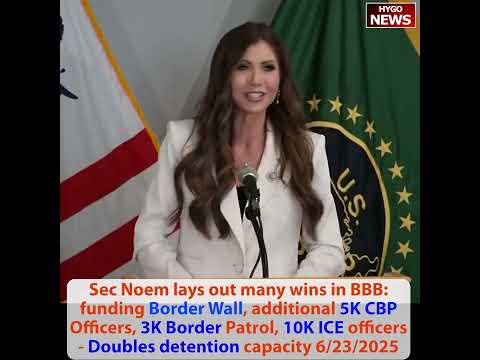
Senator John Fetterman of Pennsylvania delivered a bipartisan moment that likely caught his own party off guard: public support for the Iran strikes. The self-identified Democrat called the operation “entirely appropriate” and framed it as a limited military exercise rather than a war, breaking with most of his caucus. Secretary of Homeland Security Kristi Noem detailed the specific border-security provisions in the One Big Beautiful Bill — $46 billion for border infrastructure, $4.1 billion to hire 5,000 new CBP officers and 3,000 Border Patrol agents, $2.7 billion for surveillance technology, and funding to let ICE hire 10,000 new officers. House Minority Leader Hakeem Jeffries called the bill the “largest cut to Medicaid in American history,” a characterization that misrepresents the bill’s actual provisions. Senator Jeff Merkley echoed the Democratic framing that the bill does not help low and middle income Americans despite its 15% tax cut for that exact demographic.
Fetterman’s Break With His Party
Senator John Fetterman, representing Pennsylvania as a Democrat, opened with a statement that the administration is happy to quote back to his caucus. “There’s going to be a lot of people in my party that are going to disagree with the strike in Iran. And I actually support that. I’ve been always calling for that thing. I think it was entirely appropriate.”
The statement is unusual in contemporary American politics. Senators routinely support or oppose legislation based on their party’s position. Breaking with the party on a major foreign policy question — particularly one as charged as a military strike against Iran — is politically costly. Fetterman’s willingness to do so reflects his longstanding hawkish posture on Iran specifically.
”Always Been Calling For That Thing”
Fetterman’s “always been calling for that thing” is accurate to the record. He has publicly argued for years that Iran cannot have a nuclear weapon and that American action should be on the table if diplomatic efforts fail. His support for the strikes is therefore not a sudden adjustment. It is the consistent continuation of a position he has held throughout his political career.
”Entirely Appropriate”
The characterization — “entirely appropriate” — is unambiguous. Fetterman is not expressing reservations, not offering mixed views, not saying “on balance I support.” He is saying the strikes were fully appropriate given the circumstances. That is as clean an endorsement as the administration could hope to receive from a Democratic senator.
”Not A War. Very Limited Military Exercise”
Fetterman then addressed the framing question. “So for me, that’s not a war. That was a very limited military exercise. And it struck that. And then that’s where we’re at. Really wasn’t about, once the constitutional or it’s anything like that. It was like a very, very limited military engagement. And it took them out, damaged them severely.”
The distinction between “war” and “limited military exercise” is important legally and politically. A war implicates Congress’s Article I power to declare war. A limited military exercise implicates the president’s Article II power as commander-in-chief. Fetterman is placing the Iran action in the second category, which means the constitutional debate about presidential authority does not arise in the way it would if this were a declared war.
“It took them out, damaged them severely” is the outcome Fetterman is validating. The operation worked. The damage was significant. The result is a safer world.
”Constitutional Or Anything Like That”
Fetterman’s casual dismissal of the constitutional objection is particularly significant coming from a Democrat. The Democratic caucus, by and large, has been raising constitutional objections to the strikes — arguing that Trump exceeded presidential authority by acting without congressional authorization. Fetterman is saying, in effect, that those objections are not serious. The operation was limited. The president has the authority to conduct limited operations. The constitutional argument does not apply.
Leavitt On Regime Change
Press Secretary Karoline Leavitt was then asked about the administration’s regime change posture. “Caroline, when the president is floating the idea of regime change, how does he believe that should be accomplished through the Iranians, the Israelis or the Americans?”
Leavitt’s response maintained the administration’s position. “The president’s posture and our military posture has not changed. The president was just simply raising a question that I think many people around the world are asking."
"Why Shouldn’t The Iranian People Rise Up”
Leavitt then delivered the formulation that will travel. “If the Iranian regime refuses to give up their nuclear program or engage in talks, we just took out their nuclear program on Saturday night, as you all know. But if they refuse to engage in diplomacy moving forward, why shouldn’t the Iranian people rise up against this brutal terrorist regime? That’s a question the president raised last night.”
The formulation is careful. The United States is not calling for regime change. The United States is not supporting a specific opposition movement. The United States is simply asking whether the Iranian people — the millions of Iranians who have been suppressed by the regime for decades — might consider whether the regime serves their interests.
“Brutal terrorist regime” is the characterization Leavitt uses. Whether Iranian citizens would describe their own government in those terms is a separate question. What Leavitt is doing is creating rhetorical space for Iranian domestic opposition.
”As Far As Our Military Posture, It Hasn’t Changed”
Leavitt closed the regime change discussion with a clarification. “But as far as our military posture, it hasn’t changed.”
American military posture is not directed at regime change. American military posture is directed at preventing Iranian nuclear weapons and protecting American personnel. Those objectives remain the same. If the Iranian people change their own government, that is a separate matter that American forces are not engaged in producing.
Noem On The One Big Beautiful Bill
Secretary of Homeland Security Kristi Noem then walked through the border-security provisions of the One Big Beautiful Bill. “Now we do have a bill that’s coming before Congress. I hope everybody will support. That will be a necessary resource for CBP.”
The framing is clear. The bill is the vehicle for implementing the border-security agenda. Without the bill, the agenda stalls for lack of funding. With the bill, the agenda accelerates.
$46 Billion For Border Infrastructure
Noem laid out the first tranche. “That bill doesn’t just have dollars in it to build a wall, which it will. It’ll have over $46 billion in it, not just to continue building infrastructure wall, but to give us the surveillance and technology that we need to truly secure the border and every border, not just our southern but our northern, our maritime borders as well.”
The $46 billion figure is substantial. To put it in context, the entire CBP annual budget runs around $18 billion. The bill provides roughly 2.5 years of additional CBP budget for infrastructure and technology. The money will go to wall construction, sensors, cameras, communications infrastructure, and the surveillance systems that allow CBP to monitor stretches of border where wall alone is not sufficient.
”Every Border”
The phrase “every border” is important. American border security discussions often focus exclusively on the U.S.-Mexico border. Noem is expanding the scope. The northern border with Canada and the maritime borders along both coasts and across the Gulf of Mexico all receive attention in the bill.
Border enforcement has, historically, prioritized the southern border because that is where most illegal crossings have occurred. But smuggling, trafficking, and irregular entry affect all borders. The bill’s broader scope reflects the reality that truly securing the country requires attention to every entry point.
5,000 New CBP Officers, 3,000 Border Agents
Noem continued with personnel. “It also will provide $4.1 billion so that we can hire 5,000 new CBP officers as well, as well as 3,000 new CBP border agents.”
The personnel additions are meaningful. 5,000 new CBP officers is roughly a 20% increase in the current CBP workforce. 3,000 new Border Patrol agents is roughly a 15% increase in that specific cadre. The combined additions produce substantial additional operational capacity for border enforcement.
The political value of these hires is that they are measurable. Unlike abstract budget increases, personnel numbers translate directly into presence at specific locations. Every new officer and agent is a deployable asset that will be visible in border communities.
The $2.7 Billion Surveillance Technology Allocation
“It also gives us $2.7 billion to CBP so that we can have the surveillance technologies that we need and another billion dollars for our vehicle fleet.”
The $2.7 billion for surveillance technology is the investment in the force-multiplier infrastructure. Drones, ground sensors, communications systems, biometric processing, and the analytical capabilities that make raw data useful — all are funded in this line.
The billion dollars for vehicle fleet is the practical complement. Border enforcement requires vehicles — for patrols, for transport, for response. An aging vehicle fleet reduces effectiveness. The billion dollars modernizes the capability.
ICE: 10,000 New Officers
Noem then addressed ICE specifically. “It allows ICE to hire 10,000 new officers, which we cooperate every single day to secure our country.”
The ICE expansion is the other significant personnel addition. 10,000 new ICE officers will allow expansion of the deportation operation that is currently ongoing. More officers mean more simultaneous operations, faster processing, and broader geographic coverage.
Doubling Detention Capacity
Noem closed the border section. “And it will also allow us to double our detention capabilities that may be necessary as we do our work.”
Doubling detention capacity is the administrative complement to the enforcement expansion. More arrests produce more individuals who need to be held pending processing and removal. Without adequate detention capacity, the system either releases people prematurely or backs up. Doubling the capacity addresses the bottleneck.
Jeffries’s Counter-Framing
House Minority Leader Hakeem Jeffries delivered the Democratic counter. “Donald Trump and House Republicans have not done a single thing to lower the high cost of living in the United States of America. Not a single thing.”
The claim is falsifiable. The May CPI came in at 2.4% annualized, 0.1% for the month. Egg prices fell. Gas prices fell. Core inflation came in below expectations. These are not “nothing” in terms of cost of living. They are the direct data points that contradict Jeffries’s claim.
”One Big, Ugly Bill”
Jeffries then applied the Democratic nickname. “Instead, Republicans are trying to jam this one big, ugly bill down the throats of the American people.”
The rhetorical strategy is to convert the administration’s “Big Beautiful” into “Big Ugly.” Whether voters accept the rebrand is an empirical question. The administration’s polling on specific provisions — no tax on tips, no tax on overtime, Trump Accounts — suggests that the underlying policies are popular regardless of the party’s framing of the overall bill.
”Largest Cut To Medicaid In American History”
Jeffries delivered the Medicaid charge. “The GOP tax scam represents the largest cut to Medicaid in American history. It’s an all-out assault on the healthcare of the American people.”
The “largest cut” characterization is the one Warren and others have repeated. The bill’s specific changes — work requirements for able-bodied adults, restrictions on eligibility for noncitizens — produce fiscal savings that Democrats characterize as cuts. The administration characterizes them as reforms that redirect funds toward the populations Medicaid was designed to serve.
Merkley On The Middle Class
Senator Jeff Merkley took the Democratic framing on income effects. The reporter framed the question. “With a big benefit to low and middle income people. I’m sure there’s some folks out there saying, that’s pretty enticing. If I’m low, middle income, what do you say to that?”
Merkley: “It’s not true. At the end of the tax period, you will see the richest gain a lot of benefits, some $80,000 per person. And because of the increased costs of healthcare and other costs driven up by this bill, actually lower income folks come out behind not ahead. So again, this is family’s lose, billionaires win.”
The 15% Tax Cut Fact
The administration’s counter to Merkley is specific. The One Big Beautiful Bill provides a 15% tax cut for Americans earning between $30,000 and $80,000. That bracket is squarely “low and middle income” by any definition. The claim that the bill does not benefit low and middle income Americans requires ignoring the 15% cut that goes directly to them.
The administration’s bet is that voters earning in that bracket will read their own tax returns and see the difference. Rhetorical framing does not survive when it contradicts what taxpayers observe on their W-2s.
”Billionaires Win”
Merkley’s “billionaires win” closing is the Democratic messaging strategy for the entire bill. Whatever the specific provisions, whatever the tax effects at each income bracket, the framing is that the rich benefit most. The framing works as political rhetoric because “billionaire” is a politically charged word that produces emotional response regardless of the underlying policy analysis.
Whether the framing holds up to scrutiny depends on the specific provisions. The extensions of 2017 tax cuts benefit taxpayers at all brackets, which means the highest earners do benefit. But the bill’s new provisions — no tax on tips, no tax on overtime, expanded child tax credit, Trump Accounts — target lower and middle income taxpayers specifically.
Key Takeaways
- Sen. Fetterman breaks with his party: “I actually support that. I’ve been always calling for that thing. I think it was entirely appropriate.”
- Fetterman on the framing: “that’s not a war. That was a very limited military exercise…Really wasn’t about, once the constitutional or it’s anything like that.”
- Leavitt on regime change: “Why shouldn’t the Iranian people rise up against this brutal terrorist regime? That’s a question the president raised…But as far as our military posture, it hasn’t changed.”
- Sec. Noem on BBB border provisions: “$46 billion” for infrastructure, “$4.1 billion” for 5,000 new CBP officers and 3,000 Border Patrol agents, “$2.7 billion” for surveillance technology, “10,000 new officers” for ICE, and doubled detention capacity.
- Sen. Merkley: “It’s not true” that BBB helps low and middle income; administration counter: the bill provides a 15% tax cut for Americans earning $30K-$80K.