 HYGO News
 Sen Banks: 5M able-bodied no kid Medicaid don't work; Hassett: If 3% instead of 1.8% growth then $4T
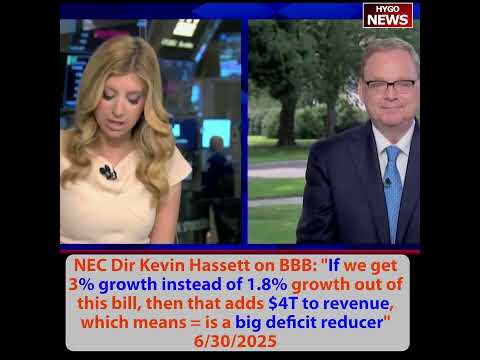
Sen Banks: 5M able-bodied no kid Medicaid don’t work; Hassett: If 3% instead of 1.8% growth then $4T
Senator Jim Banks of Indiana articulated the specific demographic math behind the administration’s Medicaid reform case — 5 million Americans receiving Medicaid benefits who are able-bodied and not working or caring for dependents. National Economic Council Director Kevin Hassett disputed the CBO’s $3.3 trillion deficit projection for the Senate bill, arguing that if growth reaches 3% rather than CBO’s assumed 1.8%, the bill produces $4 trillion in additional revenue and becomes a substantial deficit reducer. Senator Jeff Merkley and Senator Bernie Sanders continued the Democratic messaging that the bill will cause children to “go hungry” — the administration’s response was that SNAP remains protected for children and the needy, but the program’s enormous fraud rate and able-bodied-adult exploitation are being addressed.
The 5 Million Figure
Banks opened with the specific demographic. “So you think about people who go to work every day and pay taxes, and then there are five million Americans who get Medicaid who are able-bodied. They sit at home, they don’t work, they’re not taking care of a sick kid or a sick mom and they’re still on Medicaid.”
The 5 million figure captures the specific population the Medicaid reform is targeting. Able-bodied adults without dependents who are not working and are not providing care. That population, under current Medicaid rules, receives benefits that were originally designed for traditional Medicaid beneficiary groups — children, pregnant women, disabled adults, seniors.
The Affordable Care Act’s Medicaid expansion allowed states to extend Medicaid to able-bodied adults up to 138% of the federal poverty line. Many states took the expansion. The result was a significant increase in Medicaid enrollment among able-bodied adults without dependents.
”Save It For Those People Who Need It”
Banks framed the reform goal. “So let’s reform Medicaid and save it for those people who need it. Let’s make sure that people who are able-bodied go to work every day and don’t get things for free.”
The “save Medicaid” framing is important. Democrats characterize the reform as “cutting” Medicaid. Banks characterizes it as “saving” Medicaid — preserving the program for its core intended beneficiaries rather than allowing it to expand to populations for which it was not designed.
“Don’t get things for free” is the work-requirement principle. Able-bodied adults should work as a condition of public support. Work is both a principle — that able-bodied people should contribute — and a practical consideration. Working individuals qualify for employer-provided healthcare, maintaining continuous insurance coverage while participating in the economy.
Hassett’s Response
National Economic Council Director Kevin Hassett then addressed the specific reform case. “The bottom line is that we’re just- we’re not taking away anybody’s Medicaid. We’re definitely not taking away anybody’s Medicare. What we’re doing is we’re going off after waste, fraud, and abuse, and there’s a heck of a lot of it out there.”
“Not taking away anybody’s Medicaid” is the direct denial of the Democratic characterization. The reform adjusts who qualifies for the expansion category. Individuals currently receiving Medicaid who meet the traditional eligibility criteria — children, pregnant women, seniors, disabled adults — continue to receive it. Individuals in the expansion category who are able-bodied and not working face new work requirements.
“Waste, fraud, and abuse” captures what the reform addresses. Some portion of current Medicaid spending flows to fraudulent claims. Some flows to ineligible beneficiaries. Some flows to beneficiaries who could work but choose not to. Each category can be addressed through reform without affecting beneficiaries who genuinely need the support.
”Moderate Agree”
Hassett noted the bipartisan nature of the analysis. “A lot of budget savings have been found by people really in the house in the Senate, not just conservatives, moderates agree that there’s a lot of money that can be saved.”
The claim is important. The Medicaid reform case is not purely a conservative position. Moderate Republicans — and some moderate Democrats — have agreed that Medicaid waste is real and should be addressed. Whether the specific reforms in the bill reflect bipartisan consensus or are closer to the conservative position is a separate question.
”$4 Trillion In Revenue”
Hassett then addressed the fiscal math. “We’ve also got all this revenue coming in from the 3% growth, which will be an extra $4 trillion in revenue. We’ve got $2.8 trillion in tariff revenue coming in as well.”
The $4 trillion growth-revenue claim is critical. CBO scoring assumes 1.8% average annual GDP growth. The administration’s policy framework targets 3% growth. The difference between those two assumptions, compounded over the 10-year budget window, produces approximately $4 trillion in additional federal revenue.
If growth reaches 3%, the bill’s fiscal math is dramatically better than CBO’s characterization. If growth stays at 1.8%, the CBO characterization holds. The central question becomes whether the administration’s growth assumption is credible.
The Growth Target Question
Achieving 3% average GDP growth across a decade would be unusual for the recent American economy. Growth rates have averaged closer to 2% for much of the past two decades. The 3% target requires sustained productivity improvements, labor force expansion, or investment increases that exceed recent patterns.
The administration’s case is that its policies will produce exactly those patterns. Full expensing encourages investment. Tariffs encourage domestic production. Immigration enforcement reduces labor cost suppression. Deregulation reduces compliance costs. Each element contributes to the growth case.
Whether the cumulative effect reaches 3% is the empirical question. The answer will be revealed in actual economic performance over the next 10 years. For the purposes of current fiscal debates, each side assumes its preferred growth rate.
$2.8 Trillion Tariff Revenue
Hassett then added the tariff revenue. “We’ve got $2.8 trillion in tariff revenue coming in as well. So the idea that this is physically irresponsible is also important.”
$2.8 trillion over 10 years is the CBO’s own estimate of tariff revenue. That is a concession — CBO acknowledges tariff revenue is real and substantial. If the tariffs remain in place, the revenue flows to the Treasury.
Whether CBO credits the tariff revenue against the bill’s deficit is procedural. Tariff revenue from existing policies may not count toward the bill’s specific fiscal score. But the overall fiscal picture includes the tariff revenue regardless of whether it appears in the bill’s specific scoring.
Merkley On “Hungry Children”
The video pivoted to Democratic critiques. Senator Jeff Merkley framed the bill as causing hunger. “4 million children go hungry to fund tax breaks for billionaires. It’s incredible.”
The framing is emotional. Hungry children is an image no American wants to contemplate. Connecting the bill to children’s hunger creates a moral argument against it that politicians across the spectrum would have trouble dismissing.
The administration’s counter is empirical. SNAP (food stamps) remains protected for children under the bill. The specific SNAP changes target able-bodied adults without dependents who are not working — the same population targeted by the Medicaid reform. Children, pregnant women, the disabled, and seniors continue to receive full SNAP benefits.
Why The Hungry Children Framing Is Problematic
“4 million children go hungry” requires the existence of 4 million children who would lose access to food under the bill. The bill’s specific provisions do not produce that outcome. The reforms target adult beneficiaries, not children.
Merkley’s framing therefore either (a) relies on a theory that adult beneficiaries provide food to children who would otherwise lose it, or (b) conflates able-bodied adult SNAP recipients with children.
If the theory is that adult work requirements indirectly reduce food access for children, it depends on the specific family structures of affected households. If the conflation simply treats adult beneficiaries as proxies for children, it is rhetorical rather than analytical.
Sanders On Billionaires
Senator Bernie Sanders offered his standard framing. “The future of America rests with our children. And yet, in a nation which now has the highest rate of childhood poverty of almost any major country on earth, this bill wipes out nutrition assistance for millions of hungry kids in America. We are literally taking food out of the mouths of hungry kids to give tax breaks to Mr. Bezos and Mr. Musk and Mr. Zuckerberg and the other multi-billionaires.”
Sanders’s framing is the most concentrated version of the Democratic argument. The bill takes food from hungry children to benefit billionaires. Bezos, Musk, Zuckerberg — named billionaires whose wealth is already astronomical — are characterized as the beneficiaries of the bill’s tax cuts.
Why The Billionaire Framing Struggles
The bill’s tax cuts, in their actual provisions, do not flow primarily to billionaires. The 15% tax cut for Americans earning $30,000-$80,000 benefits working-class households, not billionaires. The no-tax-on-tips provision benefits service workers, not billionaires. The child tax credit expansion benefits families with children, not billionaires.
The bill does include provisions that affect high-income earners — primarily the extension of 2017 tax cuts that had been scheduled to expire. Without the extension, all taxpayers including high-income earners would have faced scheduled tax increases. Preventing those increases is, in Democratic framing, a “tax cut for billionaires.”
Sanders’s framing requires treating the prevention of a scheduled tax increase as equivalent to a new tax cut. That equivalence is rhetorical rather than analytical.
Hassett On The CBO Numbers
The reporter then asked Hassett directly about CBO scoring. “CBO says that the Senate bill increases the deficit by $3.3 trillion from 2025 to 2034, and that is a trillion dollars more than the House bill. There were already concerns about the deficit in this bill. Do you disagree with those numbers?”
Hassett’s response. “Oh, I 100% disagree with those numbers. You remember that in the House bill, there were a bunch of things that were temporary. We’re there for the first four or five years, but then looked like they raised money in the out years. But of course, a big tax hike in the fifth year is going to cause a recession that reduce growth and increase the deficit.”
The technical point is important. The House version had included several “temporary” provisions — tax cuts or benefits that would expire after several years. Those expirations, under standard CBO scoring, produce revenue in the “out years” because the expiration means higher taxes in those years.
But Hassett is pointing out that such scheduled tax hikes, if they actually occurred, would likely produce recession. A recession would reduce growth and revenue. The CBO scoring, which assumes the tax hikes occur and produce revenue without producing recession, is not realistic.
”Best Number To Think About”
Hassett offered his preferred metric. “The number that I think is the best number to think about when you’re looking at that $3.3 trillion is that if we get 3% growth instead of 1.8% growth out of this bill, then that adds $4 trillion to revenue, which means that this thing is a big deficit reducer.”
The framing is that CBO’s $3.3 trillion deficit increase is conditional on CBO’s 1.8% growth assumption. Change the growth assumption to 3% — consistent with the administration’s policy targets — and the deficit picture inverts. The bill becomes a deficit reducer rather than a deficit increaser.
”The Biggest Spending Cut In History”
Hassett’s summary. “This is the biggest spending cut in history, the biggest tax cut in history, and with a little bit of growth, it’s going to be incredibly positive for the budget.”
Both claims are substantial. “Biggest spending cut in history” references the cumulative reductions across Medicaid, SNAP, federal programs, and various rescissions. “Biggest tax cut in history” references the cumulative impact of 2017 extension plus new provisions.
Whether either claim holds up to historical comparison depends on the specific measurement used. Some claims about prior tax cuts (Reagan 1981, Bush 2001) would arguably be larger on various metrics. But the current bill is in the category of major fiscal legislation.
The Rescissions Multiplier
Hassett closed with a specific forward reference. “And finally, don’t forget, this isn’t the only bite of the apple that we’ve got lots of discretionary spending that we’re planning to send up to the Senate to rescind. Russ Vote, the OMB director, suggests that maybe that’s going to amount to about $160 billion this year. If you get the $160 billion of rescissions, then multiply that by 10 to think about what the deficit impact is.”
The $160 billion annual rescissions, multiplied by 10 years, would add $1.6 trillion to fiscal improvement over the budget window. That is additional to the bill’s specific provisions. The combined effect — bill plus rescissions plus growth differential — could substantially improve the fiscal picture relative to CBO’s static projection.
”A Very Fiscally Responsible Bill”
Hassett’s conclusion. “So this is a very fiscally responsible bill.”
The claim is contested. Democrats argue the bill is fiscally irresponsible because it increases the deficit under standard scoring. The administration argues the bill is fiscally responsible because it will increase growth, produce additional revenue, and permit further spending reductions through rescissions.
Whichever framework is correct will be revealed in actual economic performance over the coming years. The political competition between the two framings will shape voter perception in the interim.
The Competing Framings
The day’s exchange captures the core fiscal debate. Democrats argue:
- The bill increases the deficit by $3.3 trillion (CBO).
- It takes food from hungry children.
- It benefits billionaires.
Republicans argue:
- The bill produces massive deficit reduction when growth effects are included.
- Medicaid and SNAP remain protected for the truly needy.
- The tax cuts benefit working-class households primarily.
Each side has specific numbers and specific arguments. Voters will decide which framing matches their experience.
Key Takeaways
- Sen. Banks: “Five million Americans who get Medicaid who are able-bodied. They sit at home, they don’t work, they’re not taking care of a sick kid or a sick mom and they’re still on Medicaid.”
- Hassett: “We’re not taking away anybody’s Medicaid. We’re definitely not taking away anybody’s Medicare. What we’re doing is we’re going after waste, fraud, and abuse.”
- The $3.3T CBO figure disputed: Hassett: “If we get 3% growth instead of 1.8% growth out of this bill, then that adds $4 trillion to revenue.”
- Sanders: “We are literally taking food out of the mouths of hungry kids to give tax breaks to Mr. Bezos and Mr. Musk and Mr. Zuckerberg.”
- The rescissions multiplier: “$160 billion of rescissions…multiply that by 10 to think about what the deficit impact is.”