 HYGO News
 Kennedy: '38% of Kids Diabetic -- SNAP Is Supplemental Nutrition'; DEA Confirms Garcia MS-13 Tattoos; Trump Praises Democrat Whitmer
Kennedy: “38% of Kids Diabetic — SNAP Is Supplemental Nutrition”; DEA Confirms Garcia MS-13 Tattoos; Trump Praises Democrat Whitmer
A wide-ranging compilation from April 2025 captured three distinct moments. HHS Secretary Kennedy confronted the soda industry: “38% of our kids are diabetic or pre-diabetic. We’re paying for the food-like substances that make them diabetic, then paying a trillion dollars a year on medical dysfunction. The program is Supplemental Nutrition — it is about nutrition.” At a Senate hearing, DEA Administrator nominee Terrance Cole confirmed to Sen. Lindsey Graham that Kilmar Abrego Garcia’s tattoos were “consistent with MS-13 associations.” And at a Michigan event announcing F-15EX fighter jets, Trump surprised the room by praising Democratic Governor Gretchen Whitmer: “I’m not supposed to do that — she’s a Democrat. They say don’t have her here. I said, no, she’s going to be here. She’s done a very good job.”
Kennedy vs. the Soda Industry
Kennedy recounted a confrontation between the soda industry and Agriculture Secretary Rollins over the SNAP program.
“I want to thank you for your courage,” Kennedy said to Trump. “You are a business-friendly president — probably the most business-friendly in our history — but you’re also willing to stand up to very, very powerful businesses, and you’ve shown that again and again.”
He described the meeting: “Secretary Rollins had the soda industry come in. They came in very loudly, and they said to her, ‘Well, the SNAP program is not supposed to be about nutrition.’”
Kennedy recounted Rollins’s response: “She pointed out to them that there is no nutrition in a soda.”
The industry persisted: “And they said, ‘Well, it’s not supposed to be about nutrition.’”
Rollins delivered the rebuke: “And she said to them, ‘The name of the program is Supplemental Nutrition Assistance Program. It is about nutrition.’”
Kennedy provided the devastating context: “And we have 38% of our kids who are diabetic or pre-diabetic. And we are paying — we’re paying for the food, the food-like substances that make them diabetic. And then we’re paying a trillion dollars a year on medical dysfunction.”
He stated the conclusion: “It’s existential. It’s not sustainable.”
The SNAP confrontation captured the MAHA movement’s core argument in a single exchange. The federal government was spending billions on a “nutrition assistance” program that funded the purchase of products with no nutritional value — soda, candy, chips — that directly contributed to the chronic disease epidemic that cost the healthcare system a trillion dollars annually.
The soda industry’s argument — that a program literally called “Supplemental Nutrition” wasn’t about nutrition — was so absurd that it functioned as its own rebuttal. The industry was essentially admitting that it had been using a nutrition program to sell products that made people sick, and that it wanted to continue doing so regardless of the consequences for children’s health.
Kennedy’s 38% statistic — that over a third of American children were diabetic or pre-diabetic — was the most alarming health figure any administration official had cited. If accurate, it meant that the pediatric diabetes crisis had reached epidemic proportions that threatened the future health and productivity of an entire generation.
DEA Confirms MS-13 Tattoos
At a Senate hearing, Sen. Lindsey Graham used his questioning time to establish Garcia’s gang affiliation through expert testimony.
“Based on your time as a DEA agent in the field, particularly in Mexico, these tattoos are consistent with MS-13 associations?” Graham asked DEA Administrator nominee Terrance Cole.
“Yes, sir. That’s correct,” Cole confirmed.
Graham pressed: “Do you know of any other set of combinations that would suggest some other organization this represents?”
“With this particular one, no, sir,” Cole answered.
The exchange was designed to establish, on the congressional record, that a trained law enforcement expert with field experience in gang identification confirmed that Garcia’s tattoos identified him as MS-13. This expert testimony supplemented the two judicial findings, the U.S. government classification, and the Salvadoran government confirmation that Garcia was a gang member.
The accumulating evidence made the Democratic defense of Garcia increasingly untenable. Two judges, the DEA, the State Department, and the Salvadoran government had all confirmed MS-13 membership. Van Hollen hadn’t even asked Garcia if he was a member. The case for “wrongful deportation” rested entirely on legal procedure, not on the factual question of whether Garcia was a dangerous gang member.
Trump Praises Whitmer
At a Michigan event announcing F-15EX fighter jets at Selfridge Air National Guard Base, Trump created an unexpected bipartisan moment.
After Whitmer gave impromptu remarks — “On behalf of all the military men and women, on behalf of the state of Michigan, I am really damn happy we’re here. This recapitalization is crucial for the Michigan economy” — Trump surprised the audience.
“Governor Gretchen Whitmer, for bringing it to our attention very strongly,” Trump said. “And you know, I’m not supposed to do that. She’s a Democrat. They say, don’t do that, don’t have her here.”
He overruled his advisers: “I said, no, she’s going to be here.”
He praised her work: “She’s done a very good job, frankly. And she was very much involved with the Republicans. They worked together on saving it, and it was not easy.”
He concluded: “So I want to thank you very much, Gretchen. Good job.”
The moment was remarkable for its violation of partisan norms. Trump — who had feuded publicly with Whitmer during his first term and who had been the target of her criticism throughout the 2024 campaign — was publicly praising a Democratic governor and thanking her by first name. He was doing so against the advice of his own team, who had counseled against inviting her.
The gesture demonstrated Trump’s transactional approach to governance. Whitmer had worked with Republicans to secure the F-15EX mission for Michigan — a project that benefited the state’s economy and military infrastructure regardless of party. Trump rewarded the cooperation by giving her public credit, sending a signal that Democrats who worked with the administration would be recognized.
The Protester
The event also featured a protester, whom Trump handled with characteristic humor.
“What’s the problem over there?” Trump said. “Is that a radical-left lunatic?”
He looked closer: “He’s just a child.”
Then corrected himself: “Oh, I’m sorry, ma’am. I thought it was a guy.”
He added: “And she now has to go home to a mother who’s a big Trump fan. Her mother’s watching.”
The exchange — Trump mistaking a female protester for a male, apologizing, and then noting that her mother was a Trump supporter — produced laughter from the crowd and illustrated Trump’s ability to defuse confrontational moments with humor rather than escalation.
Key Takeaways
- Kennedy confronted the soda industry: “38% of kids are diabetic or pre-diabetic. SNAP is Supplemental Nutrition — it IS about nutrition. A trillion dollars a year on medical dysfunction.”
- DEA nominee Cole confirmed to Graham that Garcia’s tattoos are “consistent with MS-13 associations” — no other organization matches.
- Trump praised Democrat Whitmer at Michigan event: “She’s done a very good job. They said don’t have her here. I said no, she’s going to be here.”
- Kennedy thanked Trump for being “most business-friendly president in history” while “willing to stand up to very powerful businesses.”
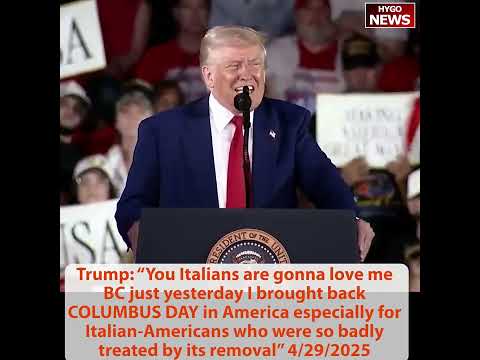
- Trump restored Columbus Day: “Just yesterday I brought back Columbus Day in America.”