 HYGO News
 Schumer Admits Dems Oppose OBBB Because It Kicks 1.4M Illegals Off Medicaid: 'Bottom Line Is This Overall Bill Is So Awful'; Commerce Sec Lutnick Catches Biden-Era Fraud: '$672M Hurricane Hunter Planes -- Two Planes? Show Me. A 1955 Plane. These Things Have to Stop'; Sen. Reed Inexplicably Criticizes: 'You're Wasting Your Time'
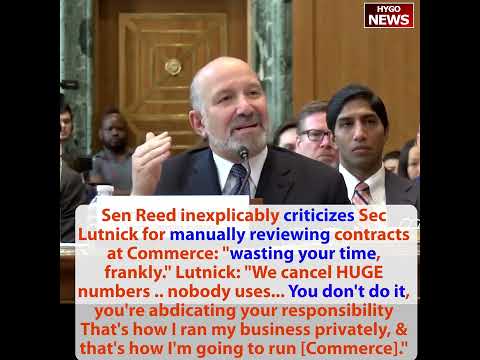
Schumer Admits Dems Oppose OBBB Because It Kicks 1.4M Illegals Off Medicaid: “Bottom Line Is This Overall Bill Is So Awful”; Commerce Sec Lutnick Catches Biden-Era Fraud: “$672M Hurricane Hunter Planes — Two Planes? Show Me. A 1955 Plane. These Things Have to Stop”; Sen. Reed Inexplicably Criticizes: “You’re Wasting Your Time”
Two remarkable exchanges exposed both Democratic political positioning and administration reform work. Sen. Chuck Schumer’s interview: “GOP lawmakers have defended some of their budget bills, Medicaid reforms, by highlighting preliminary CBO projections of roughly 1.4 million illegal immigrants losing their coverage under state-funded health programs. Is reducing federal Medicaid payments to states that provide coverage to undocumented immigrants a reform that you would support?” Schumer’s response effectively confirmed Democratic opposition was specifically to removing illegal immigrants: “The bottom line is this overall bill is so awful… Don’t just do a meat axe or a chainsaw across the board and cut everything, everything, everything. I don’t know if their numbers are accurate… but it doesn’t matter.” Commerce Secretary Howard Lutnick was challenged by Sen. Jack Reed (D-RI) for personally reviewing $100K+ contracts. Lutnick described a specific catch: “They come to me with planes, hurricane hunters. They said they were $672 million. How many planes do we get? Two planes. Show me a picture. They show me old planes. When was this plane new? 1955. Excuse me, Secretary. These things have to stop.” Reed: “I think you’re wasting your time, frankly.” Lutnick: “How many CEOs are reviewing $100,000 contracts? The first year you’re there, if you don’t do it, you should be fired.”
The Schumer Admission
The interviewer asked a pointed question.
“GOP lawmakers have defended some of their budget bills, Medicaid reforms, by highlighting preliminary CBO projections of roughly 1.4 million illegal immigrants losing their coverage under state-funded health programs,” the interviewer said.
The key question: “Is reducing federal Medicaid payments to states that provide coverage to undocumented immigrants a reform that you would support?”
Schumer’s response was politically damaging: “The bottom line is this overall bill is so awful.”
He deflected from the specific reform: “If they want to aim, if they got some specific issues, aim it.”
He criticized the scope: “Don’t just do a meat axe or a chainsaw across the board and cut everything, everything, everything.”
He dismissed the numbers: “I don’t know if their numbers are accurate. These are GOP numbers, but it doesn’t matter.”
The Schumer Problem
Schumer’s response was politically revealing for multiple reasons:
Failure to endorse specific reform: When asked directly whether he would support removing illegal immigrants from Medicaid, Schumer:
- Did not say yes
- Did not explicitly say no
- Diverted to general attack on the bill
- Avoided the substantive policy question
- Left ambiguous what Democrats specifically opposed
What this revealed:
- Democrats couldn’t openly support illegal immigrant Medicaid benefits
- Democrats also couldn’t clearly oppose them
- The political calculation was clear: the policy was unpopular
- But Democratic constituencies demanded support for illegal immigrants
- The result was political incoherence
The “meat axe” framing:
- Was factually wrong (OBBB included specific targeted reforms)
- Was politically convenient (vague opposition)
- Allowed opposition without specific substantive engagement
- Avoided acknowledging that Democrats opposed specific reasonable provisions
“These are GOP numbers but it doesn’t matter”:
- Dismissing the 1.4 million figure without substantive rebuttal
- Not providing alternative estimate
- Acknowledging opposition doesn’t depend on specific number
- Reveals that opposition is principled rather than analytical
The Schumer interview effectively confirmed what Republicans had been saying: Democratic opposition to OBBB was substantially about protecting benefits for illegal immigrants, not about protecting legitimate American beneficiaries.
The Implicit Democratic Position
Schumer’s evasion illustrated the Democratic dilemma:
Option A: Explicitly support illegal immigrant Medicaid benefits
- Politically unpopular with base voters
- Contradicts American law
- Incentivizes illegal immigration
- Violates traditional Democratic positions
- Politically untenable
Option B: Explicitly oppose the 1.4M Medicaid removal
- Effectively the same as Option A but more awkward
- Requires defending specific unpopular position
- Creates political vulnerability
- Forces acknowledgment of real policy stakes
Option C: Deflect to general attacks
- What Schumer did
- Maintains plausible deniability
- Allows continued opposition
- Avoids specific policy engagement
- Politically cowardly but survivable
Schumer chose Option C. But the choice itself exposed the Democratic Party’s position. If Democrats could have embraced the reform while opposing OBBB generally, they would have. Their inability to do so revealed that they actually opposed the specific reform.
The Lutnick Exchange
Sen. Jack Reed (D-RI) criticized Commerce Secretary Howard Lutnick.
“You are insisting on personally reviewing every commerce contract over $100,000?” Reed asked.
Lutnick confirmed: “That is true.”
Reed’s critique: “That seems to be something that is not particularly efficient.”
Reed elaborated: “At results in the 5,700 contracts, just to know it. If you can’t find reliable support to do those reviews, I think you’re wasting your time, frankly.”
Lutnick’s Response
Lutnick’s response was substantive.
“Contracts over $100,000 should be reviewed by the secretary,” Lutnick said.
He described his work ethic: “I may have more energy and more time. If you drive by the Department of Commerce late at night, you’re going to see our lights on because I’m going through it.”
He described the methodology: “I do it with my team. I do it with the people who run the bureaus and I teach them how to analyze contracts, not to push forward what was done before.”
The Hurricane Hunter Example
Lutnick provided a specific case study.
“I’ll give you one quick example,” Lutnick said.
He set up the proposal: “They come to me with planes, hurricane hunters. They said they were $672 million.”
He asked the obvious question: “I said, wow, how many planes do we get?”
The answer was revealing: “We get two.”
Lutnick’s reaction: “Two planes? Wow. Can I see the plane, please? Just show me a picture of the plane we’re going to.”
He described what he saw: “They show me this picture of a plane. You remember old planes? They had like mullions in the windscreen. They show me that three propellers on each side.”
He asked the critical question: “I said, my God, when was this plane new?”
The response dodged: “They said, no, no, no. You’re buying a new plane.”
Lutnick pressed: “I said, no, when was the first one?”
The answer was remarkable: “1955.”
Lutnick’s reaction: “Excuse me, Secretary. These things have to stop. You’re talking about a $600 million acquisition.”
The Hurricane Hunter Reality
The hurricane hunter case revealed specific waste patterns:
What was being proposed:
- $672 million for two aircraft
- Design based on 1955 specifications
- New manufacturing of 70-year-old design
- Essentially replicating ancient technology
Why this was problematic:
- Modern aircraft design had evolved dramatically since 1955
- Current commercial and military aircraft were vastly more capable
- Better technology existed for weather monitoring
- The 1955 design was chosen for bureaucratic convenience, not performance
- $336 million per plane was extraordinary for what was being delivered
The broader pattern:
- Federal agencies had been accumulating outdated specifications
- Defense of traditional designs prevented modernization
- Incumbent contractors benefited from maintaining outdated designs
- Agencies didn’t question why old designs were being maintained
- Accountability was limited without senior leadership engagement
What Lutnick caught:
- By asking simple questions
- By requiring visual evidence
- By pressing on historical context
- By exercising fundamental business judgment
- By refusing to approve without understanding
This was exactly what senior leadership was supposed to do. Ask questions. Require evidence. Make informed judgments. Refuse inadequate proposals. The fact that none of this had been happening before Lutnick’s arrival illustrated institutional dysfunction.
The Software and Cleaning Example
Lutnick continued with additional examples.
“It’s a lot more than $100,000 contract to do something like cleaning in the buildings that you occupy,” Lutnick said.
He described the pattern: “We end up, we cancel huge numbers of absurd contracts for software nobody uses.”
He quantified: “I said, how many people use this software? Zero.”
He categorized: “These are waste. These are fraud or these are abuse.”
The Specific Waste Categories
Lutnick’s examples illustrated three categories of government waste:
Waste: Resources spent on low-value activities
- 1955-design aircraft at $336M each
- Duplicative software licenses
- Redundant cleaning contracts
- Unused office space
- Unnecessary consulting services
Fraud: Specific improprieties
- Misrepresented capabilities
- Inflated costs
- False claims about necessity
- Inappropriate beneficiaries
- Kickback arrangements
Abuse: Inappropriate use of resources
- Personal benefits from government contracts
- Political patronage through contracting
- Ideological programming through procurement
- Unnecessary activities supporting specific groups
- Gaming of contracting rules
Combined, these three categories represented massive opportunities for savings. DOGE’s approach had been:
- Systematic identification of each category
- Clear documentation of waste
- Elimination without political compromise
- Transfer of savings back to taxpayers
- Cultural change throughout government
”How Many CEOs?”
Lutnick made the fundamental comparison.
“How many CEOs of companies, major companies in the United States, are reviewing contracts at the $100,000 level?” Lutnick asked.
He answered his own question: “If they would, what would the board of directors say to them?”
He delivered the judgment: “The first year you’re there, if you don’t do it, you should be fired.”
He articulated the principle: “You should know everything that’s going through. You should do it with your staff. You should teach your staff how to do it. And then you should delegate them to do it once you’ve taught them.”
He made the strong conclusion: “You don’t do it. You’re abdicating your responsibility. That’s how I view it. That’s how I ran my business.”
The Private Sector Comparison
Lutnick’s private-private sector experience gave him perspective.
At Cantor Fitzgerald:
- Lutnick had been CEO of major financial services firm
- Reviewed critical contracts personally
- Held staff accountable for every major decision
- Made efficiency an institutional priority
- Generated consistent profits
Federal government comparison:
- Cabinet secretaries often didn’t review contracts
- Signed off on decisions made at lower levels
- Relied on bureaucracy to filter decisions
- Accepted inefficiency as normal
- Generated consistent deficits
Why the difference mattered:
- Private sector accountability forces attention to details
- Government insulation allows abdication of responsibility
- CEO personal liability creates oversight incentives
- Secretary insulation reduces oversight incentives
- Results reflect these structural differences
Lutnick’s approach was applying private sector management discipline to federal government. This:
- Created personal accountability
- Generated substantive decisions
- Identified waste systematically
- Built team competence
- Transformed institutional culture
”How I Ran My Business Privately, That’s How I’m Going to Run Commerce”
Lutnick’s closing framing was important.
“That’s how I ran my business. Privately, and that’s how I’m going to run the government.”
This was the fundamental Trump administration approach:
- Bring private sector experience to government
- Apply business discipline to federal management
- Demand results rather than processes
- Personal accountability for major decisions
- Results-oriented rather than process-oriented
This contrasted with traditional government approaches:
- Career civil servants making decisions
- Political appointees as figureheads
- Process compliance as success metric
- Deference to bureaucratic procedures
- Institutional conservatism over results
The Trump administration’s cabinet selections reflected this approach:
- Lutnick (former CEO of major financial firm) at Commerce
- Bessent (former hedge fund manager) at Treasury
- Wright (former energy industry CEO) at Energy
- Hegseth (veteran and Fox News commentator) at Defense
- Kennedy (long-time environmental lawyer and advocate) at HHS
Each represented specific private sector or substantive background rather than traditional political connections.
Reed’s “Wasting Your Time” Critique
Sen. Reed’s position deserved analysis.
“I think you’re wasting your time, frankly,” Reed had said.
What Reed was implying:
- Cabinet secretaries shouldn’t review routine contracts
- Efficient delegation was the norm
- Senior leadership time was valuable
- Personal involvement was overkill
- Bureaucratic processes should handle details
What Reed missed:
- The existing “efficient” delegation had produced massive waste
- Bureaucratic processes had approved 1955-design planes
- Senior leadership disengagement had enabled waste
- Personal involvement revealed specific problems
- The opportunity cost of NOT reviewing was much larger than the time spent
The cost-benefit:
- Lutnick’s time reviewing contracts: Perhaps hundreds of hours
- Waste identified through those reviews: Potentially billions of dollars
- Ratio: One hour of Lutnick’s time for millions in savings
- Even if some decisions could be delegated, the reviews revealed patterns requiring attention
- Not reviewing meant continuing to approve wasteful contracts
Reed’s “wasting your time” framing was exactly backwards. Lutnick was the only person who WASN’T wasting his time. The people who had been approving these contracts without scrutiny had been wasting everyone’s time for years.
The Ideological Gap
The Lutnick-Reed exchange revealed fundamental philosophical differences.
Reed’s framework (traditional Democrat):
- Government should trust professional staff
- Cabinet secretaries should set policy, not review contracts
- Efficiency comes from delegation
- Institutional processes should be respected
- Results emerge from good processes
Lutnick’s framework (Trump administration):
- Government requires active leadership
- Cabinet secretaries bear ultimate accountability
- Efficiency comes from rigorous oversight
- Institutional processes often conceal waste
- Results require direct engagement
These were genuinely different philosophies of government. Both had legitimate elements:
- Reed’s approach worked when processes were sound
- Lutnick’s approach was necessary when processes had failed
- Traditional Democrat framework assumed competence throughout
- Republican framework assumed need for active management
Given that DOGE had documented massive waste throughout federal government, Lutnick’s framework was more responsive to actual conditions. Active management was necessary to correct accumulated dysfunction.
Key Takeaways
- Schumer effectively admits Dems oppose OBBB because it removes 1.4M illegals from Medicaid — “Bottom line is this bill is so awful.”
- Schumer’s evasion on specific illegal immigrant provision confirms Democratic political bind.
- Lutnick’s hurricane hunter discovery: $672M for two aircraft of 1955 design.
- Lutnick on CEO duty: “How many CEOs are reviewing $100,000 contracts? First year, if you don’t do it, you should be fired.”
- Reed’s “wasting your time” critique exactly backwards — Lutnick’s reviews identify billions in waste.