 HYGO News
 Scalise: stop flying Air Force One to Saudi Arabia, produce energy here cleaner, better, good jobs
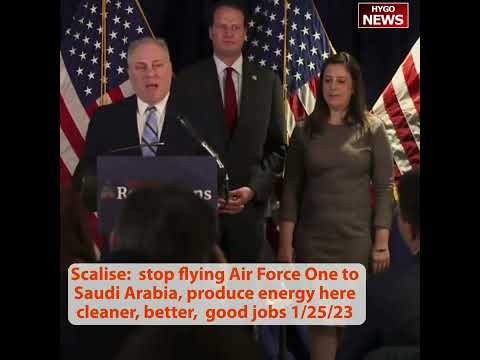
Scalise: “Stop Flying Air Force One to Saudi Arabia, Begging Russia” — Produce Energy Here “Cleaner, Better, Lower in Cost”
In January 2023, House Majority Leader Steve Scalise made pointed case for American energy production over foreign dependency. “Nobody makes energy in the world cleaner than the United States of America. So stop flying Air Force One to Saudi Arabia and other countries, begging Russia to produce energy when we can make it here cleaner, better, lower in the cost, and creating really good jobs in America,” Scalise said. On the SPR: “We’ve got a strategic petroleum reserve for a reason. It’s there for emergencies. It’s not there to mask the president’s bad energy policies. It’s there in times of need. And this president’s rated more than 40% of that reserve.” On the veto threat: “This bill just says, if you’re going to raid the reserve, show a plan on how you’re going to replenish it. And why the White House would issue a veto threat on that boggles, I think, the mind of most common sense people."
"Nobody Makes Energy Cleaner”
Scalise’s claim. “Nobody makes energy in the world cleaner than the United States of America,” Scalise said.
The claim:
U.S. leadership — Claimed.
Environmental standards — Implied.
Comparative framing — International.
Policy argument — For production.
Political framing — Positive.
The claim that U.S. produced cleaner energy than other countries had merit. U.S. environmental regulations were generally stronger than major oil-producing nations like Russia, Saudi Arabia, or Venezuela. This was factual basis for the political argument.
”Stop Flying Air Force One to Saudi Arabia”
Biden’s Saudi trip reference. “Stop flying Air Force One to Saudi Arabia,” Scalise said.
The reference:
Biden’s July 2022 trip — To Saudi Arabia.
Purpose — Oil production increase.
Fist bump — Infamous moment.
Policy failure — GOP framing.
Symbolic weakness — Claimed.
Biden’s 2022 Saudi Arabia trip had been politically controversial. Biden had previously called Saudi Arabia “pariah” state but had gone to request oil production increases. The trip had included controversial fist bump with MBS.
”Begging Russia”
The begging characterization. “Begging Russia to produce energy,” Scalise said.
The framing:
“Begging” — Dignity loss.
Russia — Adversary.
Energy request — From opponent.
Policy contradiction — Implied.
Diplomatic weakness — Framed.
The “begging Russia” framing was overstated — Biden hadn’t actually requested Russian energy production. But administration had been engaged with various foreign producers. The simplification was political rhetoric.
The Saudi Arabia Trip Context
Biden’s Saudi trip had specific context:
Gas prices high — Summer 2022.
OPEC+ decisions — Significant.
Biden campaign pledges — Contradicted.
Human rights concerns — Khashoggi.
Pragmatic policy — Chose.
The trip represented pragmatic policy choice over campaign rhetoric. Biden had criticized Saudis during campaign but needed their cooperation on oil. The political awkwardness was real.
”Cleaner, Better, Lower in the Cost”
The three benefits. “We can make it here cleaner, better, lower in the cost, and creating really good jobs in America,” Scalise said.
The benefits:
Environmental — Cleaner production.
Quality — Better.
Economic — Lower costs.
Employment — American jobs.
Comprehensive — Benefits.
This was complete positive framing of domestic production. Each benefit had some basis. The comprehensive list was more effective than single-issue focus.
”Good Jobs in America”
The jobs emphasis:
American employment — Primary.
Quality jobs — “Good.”
Energy sector — Historical.
Manufacturing — Connected.
Political appeal — Strong.
Energy sector jobs were real employment. Manufacturing jobs connected to energy were also significant. Jobs argument had bipartisan appeal, particularly in energy-producing states.
”Strategic Petroleum Reserve for a Reason”
Purpose framing. “We’ve got a strategic petroleum reserve for a reason. It’s there for emergencies,” Scalise said.
The framing:
Historical purpose — Reaffirmed.
Emergency use — Only.
Biden deviation — Implied.
Original intent — Honored.
Reform argument — For.
The emphasis on original SPR purpose was central to GOP argument. The reserve had been created for oil emergencies, not price management. Biden’s use was departure from original purpose.
”Not There to Mask the President’s Bad Energy Policies”
The mask framing. “It’s not there to mask the president’s bad energy policies. It’s there in times of need,” Scalise said.
The framing:
Mask metaphor — Hiding failures.
“Bad energy policies” — Direct attack.
Inappropriate use — Claimed.
Emergency vs. political — Distinguished.
Normative argument — Made.
By framing SPR use as masking bad policies, Scalise was making dual argument — both that Biden had bad policies and that SPR shouldn’t be used to hide them. This was two-front attack.
”More Than 40% of That Reserve”
The statistic again. “This president’s rated more than 40% of that reserve,” Scalise said.
The stat:
40% depletion — Consistent claim.
Across Biden term — Cumulative.
Historic — Scale.
Attack data — Strong.
Coordinated GOP — Messaging.
The 40% figure was consistent across GOP messaging. This was factually based and politically effective. Coordination across GOP leaders showed disciplined messaging.
The Bill’s Modest Request
Scalise framed bill as modest. “This bill just says, if you’re going to raid the reserve, show a plan on how you’re going to replenish it,” Scalise said.
The framing:
Modest request — Characterization.
“Just says” — Minimizing.
Plan required — Not ban.
Accountability — Simple.
Veto unreasonable — Framed.
By characterizing the bill as asking only for a plan, Scalise was making Biden’s veto look unreasonable. A plan wasn’t actually binding action — just documentation. Vetoing this was harder to defend.
”Boggles the Mind of Most Common Sense People”
The common sense framing. “Why the White House would issue a veto threat on that boggles, I think, the mind of most common sense people,” Scalise said.
The framing:
“Common sense” — Appeal.
Confusion — At administration.
Unreasonable — Veto implied.
Popular position — Claimed.
Administrative irrationality — Framed.
The “common sense” appeal positioned GOP position as reasonable and Biden’s as irrational. This was effective political framing that appealed to broader audience than partisan base.
”Commonplace From This Administration”
The pattern claim. “That’s what we’ve seen commonplace from this administration,” Scalise said.
The framing:
Pattern — Of irrationality.
Ongoing problem — With administration.
Not isolated — Incident.
Character assessment — Implied.
Attack continuation — Across issues.
By framing veto as typical administration behavior, Scalise was making broader character attack. This was sustained messaging across multiple policy areas.
The Debt Ceiling Mention
Scalise mentioned debt ceiling. “Obviously, there are a lot of other issues like the debt ceiling that the whip talked about, that we are deeply interested in solving,” Scalise said.
The transition:
Debt ceiling — Referenced.
Issue connection — To energy.
Broader agenda — Noted.
Whip reference — Leadership coordination.
Multiple priorities — Pursued.
The debt ceiling mention showed multiple issues being pursued simultaneously. Energy was one front; debt ceiling was another. GOP was engaging on multiple policy battles.
The Air Force One Imagery
Air Force One imagery:
Symbolic power — Of presidential aircraft.
Diplomatic usage — Normal.
Saudi destination — Specific.
Request implication — For oil.
Independence contrast — With begging.
Air Force One flying to foreign oil producers was visually striking imagery. It suggested American dependency rather than strength. This was effective political imagery.
The Begging Metaphor
Begging metaphor:
Dignity loss — Implied.
Power imbalance — Shown.
Strategic weakness — Framed.
Alternative needed — Domestic.
Political effectiveness — Strong.
“Begging” was strong word choice. It conveyed specific image of U.S. weakness. Whether diplomatically accurate or not, it was politically effective framing.
The Clean Energy Irony
Clean energy irony angle:
Administration advocates — Clean energy.
Buys from less clean — Foreign producers.
Environmental standards — Lower abroad.
Carbon intensity — Higher foreign.
Policy inconsistency — Implied.
The argument that domestic production would be cleaner than foreign imports was environmental argument, ironic for administration claiming environmental leadership. This was effective attack on policy coherence.
The Venezuela Context
Venezuela context:
Biden engagement — With Maduro regime.
Oil imports — Resumed some.
Human rights concerns — Major.
Policy contradiction — Obvious.
Political criticism — Effective.
Biden administration had engaged with Venezuelan regime for oil imports. This was arguably worse dependency than Saudi Arabia given regime character. GOP could use this for criticism.
The Domestic Production Arguments
Domestic production case:
Environmental standards — Higher.
Labor conditions — Better.
Economic benefits — Local.
Energy security — Enhanced.
Political stability — Improved.
The case for domestic production had multiple legitimate elements. Environmental, labor, economic, security, and political arguments all supported domestic production. These were substantive policy arguments.
The Regulatory Framework
Regulatory framework:
Biden restrictions — Various.
Permit processing — Continued.
Leasing restrictions — Some.
Environmental reviews — Longer.
Industry constraints — Real.
Biden administration had implemented various regulatory changes affecting production. Whether they substantially constrained production was debated. But policy direction was identifiable.
The Global Oil Market
Global oil market:
OPEC+ influence — Significant.
Russia factor — Major.
Middle East — Central.
Production decisions — Strategic.
Price volatility — Normal.
Global oil market was complex system. Various producers made decisions affecting prices. U.S. domestic production was significant factor but not dominant. The broader context mattered.
The Energy Transition Question
Energy transition:
Administration priority — Clean energy.
Fossil fuels — Continuing role.
Balance needed — Arguably.
Transition timing — Debated.
Policy tension — Real.
The energy transition created policy tensions. Supporting clean energy while maintaining fossil fuel production was balancing act. Administration was criticized from both sides on different issues.
The Political Positioning
Scalise political positioning:
Pro-production — Clear.
Environmental — Claims.
Job creation — Emphasized.
Energy security — Core.
2024 messaging — Developing.
The positioning was comprehensive pro-energy stance. It addressed multiple concerns simultaneously. This was sophisticated political positioning.
The Workforce Argument
Workforce dimension:
Energy jobs — Historically good.
Blue-collar appeal — Strong.
Union support — Some.
Geographic concentration — Political.
Democratic crossover — Possible.
Energy jobs had long been political target. Good-paying blue-collar jobs in energy production appealed to voters Republicans hoped to win. This was strategic economic positioning.
Key Takeaways
- Scalise asserted U.S. energy advantage: “Nobody makes energy in the world cleaner than the United States of America.”
- He called for ending foreign dependency: “Stop flying Air Force One to Saudi Arabia and other countries, begging Russia to produce energy.”
- He framed domestic production benefits: “We can make it here cleaner, better, lower in the cost, and creating really good jobs in America.”
- On SPR: “It’s not there to mask the president’s bad energy policies. It’s there in times of need.”
- The bill was modest: “This bill just says, if you’re going to raid the reserve, show a plan on how you’re going to replenish it.”
- He questioned veto rationality: “Why the White House would issue a veto threat on that boggles, I think, the mind of most common sense people.”
Transcript Highlights
The following is transcribed from the video audio (unverified — AI-generated from audio).
- Nobody makes energy in the world cleaner than the United States of America.
- So stop flying Air Force One to Saudi Arabia and other countries, begging Russia to produce energy when we can make it here cleaner, better, lower in the cost, and creating really good jobs in America.
- In the meantime, we’ve got a strategic petroleum reserve for a reason. It’s there for emergencies. It’s not there to mask the president’s bad energy policies.
- This president’s rated more than 40% of that reserve.
- This bill just says, if you’re going to raid the reserve, show a plan on how you’re going to replenish it.
- Why the White House would issue a veto threat on that boggles, I think, the mind of most common sense people.
Full transcript: 169 words transcribed via Whisper AI.