 HYGO News
 Scalise: increasing American energy production that will somehow raise gas prices?
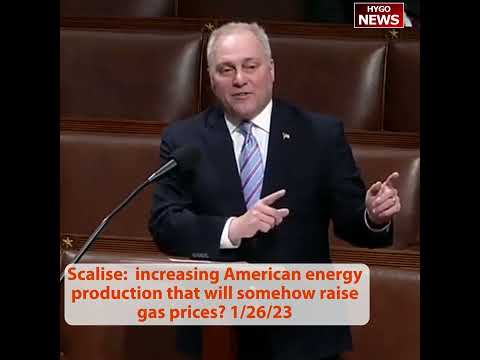
Scalise Mocks Biden Veto Logic: “Energy Experts” Say Increasing US Production Would Raise Gas Prices?
In late January 2023, House Majority Leader Steve Scalise continued critique of Biden’s SPR veto threat by mocking the logic that increasing American energy production would raise gas prices. “This might be the most perplexing part of the president’s veto threat. Probably explains the most why the president is so misguided on energy policy. He says, because HR 21 will jeopardize our energy security and increase gas prices for working families, the administration strongly opposes the bill. So somehow, some of the energy experts at the White House, again, some of the same people that fly around on private planes to Davos telling you not to use fossil fuels, they think that by increasing American energy production that will somehow raise gas prices,” Scalise said. He continued attack: “Well, guess what? We’ve checked the record. These are the same experts whose policies have increased gas prices, not a little 50%."
"The Most Perplexing Part”
Scalise’s setup. “This might be the most perplexing part of the president’s veto threat,” Scalise said.
The setup:
Perplexing — Framing.
Veto threat — Examined.
Most problematic — Claim.
Logical critique — Coming.
Target identified — Specific language.
Scalise was identifying specific passage in veto threat as exemplifying administration energy policy confusion. This was substantive policy critique technique.
The Biden Veto Claim
Biden claim quoted. “Because HR 21 will jeopardize our energy security and increase gas prices for working families, the administration strongly opposes the bill,” Scalise quoted.
The claim:
Energy security — Jeopardized.
Gas prices — Raised.
Working families — Affected.
Administration opposition — Strong.
Veto rationale — Explained.
The Biden claim was that requiring plan to refill SPR would both jeopardize energy security and raise gas prices. Scalise found this logically problematic.
The Logical Critique
Logical critique:
Increased production — Claim.
Raising prices — Counter-intuitive.
Economic theory — Typically opposite.
Logic problems — In Biden position.
Simple framing — Effective.
Scalise’s logical critique was that basic economics suggested more production typically lowered prices. Biden’s claim that production increase would raise prices required explanation.
The Actual Biden Argument
Actual Biden argument:
Not about production — Directly.
About SPR management — Specifically.
Price stabilization — SPR role.
Emergency tool — Value.
Complex argument — Actual.
The Biden argument was actually about SPR management preventing future price spikes, not directly about production. But Scalise’s framing oversimplified for rhetorical effect.
”Energy Experts at the White House”
Scalise mockery. “Some of the energy experts at the White House, again, some of the same people that fly around on private planes to Davos telling you not to use fossil fuels,” Scalise said.
The mockery:
“Experts” — Ironic.
Private planes — Hypocrisy.
Davos — Elite context.
Fossil fuels lecture — Hypocritical.
Combined attack — Effective.
The mockery combined multiple attack elements. Expert credentials ironized. Private jet usage invoked. Davos elite context deployed. Hypocrisy on fossil fuels highlighted.
The Davos Private Jets Callback
Davos callback:
Repeated theme — From earlier.
Consistent message — Discipline.
Memorable phrase — Reused.
Elite attack — Populist appeal.
Effective framing — Politically.
Scalise’s repeated invocation of Davos private jets showed message discipline. Same theme across speeches reinforced each iteration. The elite hypocrisy attack was politically effective.
”Increasing American Energy Production That Will Somehow Raise Gas Prices”
The mocked logic. “They think that by increasing American energy production that will somehow raise gas prices,” Scalise said.
The mocked logic:
Production up — Normally.
Prices down — Expected.
Biden claim — Opposite.
“Somehow” — Dismissive.
Mockery complete — Effective.
The “somehow” was key rhetorical word. It positioned Biden’s argument as nonsensical without engaging with its actual basis. This was effective simplification for political messaging.
”We’ve Checked the Record”
Data invocation. “Well, guess what? We’ve checked the record,” Scalise said.
The invocation:
Data grounding — For critique.
Record review — Suggested.
Evidence approach — Used.
Authority — Implied.
Not just opinion — Claim.
Claiming record was checked added credibility. Data-based critique was harder to dismiss than pure partisan attack. Scalise was framing argument as evidence-based.
”Increased Gas Prices, Not a Little 50%”
The data. “These are the same experts whose policies have increased gas prices, not a little 50%,” Scalise said.
The data:
50% increase — Specific.
“Not a little” — Emphasis.
Expert policies — Blamed.
Biden term — Implicit.
Strong attack — Made.
Repeating 50% gas price increase figure again reinforced the attack. Consistent use across speeches built political narrative through repetition.
The Expert Credibility Attack
Expert credibility:
“Experts” — Ironized.
Track record — Challenged.
Past predictions — Wrong.
Future predictions — Questioned.
Trust — Undermined.
By pointing to past “expert” failures (50% gas increase), Scalise was undermining current expert claims (increased production would raise prices). This was effective political argument.
The Bipartisan Vote Reference
Bipartisan vote:
Prior week — Vote.
Strong majority — Presumably.
Democrats joined — Some.
GOP success — Political.
Administration isolation — Shown.
Scalise referenced previous bipartisan vote on SPR-related bill. This showed administration position was isolated even within Democratic coalition. Bipartisan opposition was significant.
”Let’s Put Up Another Strong Bipartisan Vote”
The strategy. “Let’s put up another strong bipartisan vote and maybe wake the people up at the White House to win,” Scalise said.
The strategy:
Repeat vote — Strategy.
Bipartisan — Framed.
“Wake up White House” — Mockery.
Victory — Sought.
Pressure campaign — Legislative.
The strategy was to pass multiple bipartisan bills forcing administration to veto, creating political pressure. Each veto would add to narrative of Biden opposing popular bipartisan legislation.
The Veto Politics
Veto politics:
First veto — Symbolic.
Political cost — Real.
Message — Implied.
Strategy — Multiple bills.
Pressure — Building.
Multiple bipartisan bills being vetoed would build political narrative. Even if legislation didn’t become law, each veto was political moment favoring GOP.
The SPR Facts
SPR facts:
Historic drawdown — By Biden.
Refill stalled — Yes.
China sales — Occurred.
Record lows — Achieved.
Policy debate — Substantive.
The underlying policy debate about SPR was substantive. Biden’s historic drawdown raised legitimate policy questions. Different views on appropriate response were valid.
The Energy Policy Broader Context
Broader context:
Climate transition — Priority Biden.
Fossil fuel restraint — Some.
Current prices — Reality.
Consumer impact — Real.
Political tension — Genuine.
The broader energy policy context had genuine tensions. Climate transition required reducing fossil fuel dependence. Current prices affected consumers. Political tension reflected real policy difficulty.
The Industry Response
Industry response:
Slower growth — Than possible.
Capital discipline — Chosen.
Investor pressure — For returns.
Not policy fault — Arguably.
Complex factors — Many.
Oil and gas industry’s slower production growth reflected multiple factors including capital discipline, investor pressures, not just administration policy. But administration hadn’t helped.
The Scalise Rhetorical Pattern
Scalise pattern:
Quote Biden — Directly.
Mock logic — Clearly.
Add data — For evidence.
Invoke hypocrisy — Effectively.
Rally support — For alternative.
The rhetorical pattern was effective political communication. Each element built on previous. The combination was more powerful than any individual element.
The Political Strategy Evaluation
Strategy evaluation:
Effective — Clearly.
Message discipline — High.
Media coverage — Generated.
Voter resonance — Likely.
Campaign material — Built.
The overall political strategy was working in short term. Effective messaging, disciplined repetition, media coverage, voter resonance, campaign material accumulation.
The Administration Counter-Messaging
Administration counter:
Limited response — To specific attacks.
Generic defense — Typically.
Data dispute — Minimal.
Attack Republicans — Standard.
Coherence lacking — Sometimes.
Administration counter-messaging was often weaker than GOP attacks. Generic defenses, limited data engagement, standard Republican attacks. The specific Scalise critiques often went unanswered.
The Public Perception
Public perception:
Gas prices — Felt.
50% figure — Memorable.
Biden veto — Noted.
Political attacks — Consumed.
Overall — Negative for Biden.
Voters feeling high gas prices were receptive to 50% increase framing. Memorable statistics penetrated. Political attacks combined with personal experience. The overall effect was negative for Biden on energy.
The 2024 Campaign Building
Campaign building:
Narrative construction — Continuous.
Statistics deployed — Repeatedly.
Memorable phrases — Developed.
Coalition built — For attacks.
Ammunition accumulated — Over time.
The 2024 campaign narrative was being built through current speeches and attacks. Every effective Scalise speech added to future campaign ammunition. Accumulated effect mattered.
The Media Role
Media role:
Conservative amplification — Strong.
Mainstream coverage — Mixed.
Social media spread — Organic.
Clips shared — Widely.
Narrative shaping — Collective.
Media played important role in spreading Scalise’s messaging. Conservative outlets amplified. Social media spread clips. Mainstream coverage varied. Collective narrative shaped over time.
The Biden Coalition Strain
Coalition strain:
Progressive energy agenda — Vs practical politics.
Labor unions — Mixed views.
Climate activists — Strong views.
Working class voters — Concerned about prices.
Coalition balance — Difficult.
The Biden coalition had internal tensions on energy. Progressive environmental agenda versus working-class price concerns. Labor union views varied. Balance was difficult.
The Economic Theory
Economic theory:
Supply increase — Lowers prices typically.
All else equal — Assumption.
Real world — Complex.
Multiple factors — Operate.
Simple models — Limited.
Basic economic theory supported Scalise’s argument. Increased supply lowered prices ceteris paribus. Real world was more complex but basic intuition was sound. Biden’s counter-intuitive claim needed strong justification.
The Administrative Strategy Limits
Strategy limits:
Consistency over flexibility — Choice.
Politically costly — Becoming.
Data battles — Losing.
Narrative — Slipping.
Adjustment — Eventually needed.
The administrative strategy of consistent messaging was facing limits. Specific data critiques like Scalise’s were damaging. Narrative control was slipping. Strategic adjustment would eventually be needed.
The Political Environment
Political environment:
Inflation concern — Continuing.
Gas prices — Symbolic.
Voter dissatisfaction — Real.
Blame distribution — Partisan.
Election year — Approaching.
The broader political environment favored GOP attacks on Biden economic record. Real voter dissatisfaction with inflation and gas prices created audience for messaging.
The Speaker’s Platform
Speaker’s platform:
Majority Leader — Scalise’s role.
Regular floor speeches — Platform.
Media attention — Ensured.
Coordination — With leadership.
Consistent messaging — Across leaders.
Scalise’s position gave him regular floor speech platform. Media attention was ensured. Leadership coordinated messaging. This professional political communication operation was effective.
The Refill Plan Requirement
Refill plan requirement:
Reasonable — On face.
Biden veto — Hard to justify.
Transparency — Served.
Accountability — Created.
Political vulnerability — For Biden.
Requiring refill plan was reasonable legislative requirement. Biden’s veto of such minimal request was hard to justify. This was political vulnerability.
The Bipartisan Support
Bipartisan support:
Some Democrats — Joined.
Moderate positioning — Required.
Vulnerable members — Especially.
2024 considerations — Influenced.
Coalition complicating — For Biden.
Some Democratic members had joined Republicans on SPR-related votes. Moderate positioning in advance of 2024 was factor. This bipartisan coalition complicated Biden’s messaging.
The McCarthy-Scalise Coordination
Leadership coordination:
Speaker and Majority Leader — Together.
Consistent messaging — Professional.
Labor divided — Speeches.
Multiple platforms — Used.
Effective team — Appearance.
The Speaker-Majority Leader coordination was effective. Both delivered consistent messages from complementary platforms. Labor divided between them maximized coverage.
The Long-Term Narrative
Long-term narrative:
Biden bad on energy — Being built.
High gas prices — Symbol.
Policy failures — Documented.
GOP alternative — Implied.
Campaign ready — Increasingly.
The long-term narrative being built was that Biden was bad on energy policy. High gas prices as symbol. Specific policy failures documented. GOP alternative implied. This was campaign-ready narrative.
Key Takeaways
- House Majority Leader Scalise continued critique of Biden’s SPR veto threat.
- He identified specific claim as “the most perplexing part” — that requiring SPR refill plan would raise gas prices.
- Scalise mocked the logic: “Some of the energy experts at the White House… they think that by increasing American energy production that will somehow raise gas prices.”
- He invoked hypocrisy: “Some of the same people that fly around on private planes to Davos telling you not to use fossil fuels.”
- Data attack: “These are the same experts whose policies have increased gas prices, not a little 50%.”
- Strategy continued: “Let’s put up another strong bipartisan vote and maybe wake the people up at the White House to win.”
Transcript Highlights
The following is transcribed from the video audio (unverified — AI-generated from audio).
- President actually goes on to say this might be the most perplexing part of the president’s veto threat.
- Because HR 21 will jeopardize our energy security and increase gas prices for working families, the administration strongly opposes the bill.
- So somehow, some of the energy experts at the White House, again, some of the same people that fly around on private planes to Davos telling you not to use fossil fuels.
- They think that by increasing American energy production that will somehow raise gas prices.
- Well, guess what? We’ve checked the record. These are the same experts whose policies have increased gas prices, not a little 50%.
- Let’s put up another strong bipartisan vote and maybe wake the people up at the White House to win.
Full transcript: 168 words transcribed via Whisper AI.