 HYGO News
 Same Questions Answered by Zuckerberg, Pichai, Bezos & Cook at Antitrust Hearing
Same Questions Answered by Zuckerberg, Pichai, Bezos & Cook at Antitrust Hearing
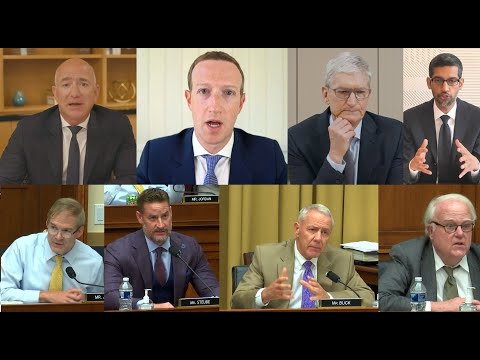
On July 29, 2020, the CEOs of Amazon, Apple, Facebook, and Google testified before the House Judiciary Committee in a landmark antitrust hearing that ran nearly six hours. Jeff Bezos, Tim Cook, Mark Zuckerberg, and Sundar Pichai faced a combined 217 questions from Democrats and Republicans. This video compiles the questions that were directed at all four CEOs simultaneously, revealing how each tech leader responded to the same prompts on American values, cancel culture, and their companies’ relationship with law enforcement.
The Oath and American Values
The hearing opened with all four executives taking the oath. “Do you swear or affirm under penalty of perjury that the testimony you are about to give is true and correct to the best of your knowledge, information, and belief, so help you God?” the committee asked, with the record showing all witnesses answered in the affirmative.
Rep. Matt Gaetz, R-Florida, set the tone early by referencing Zuckerberg’s written testimony claiming Facebook is “an American company with American values.” Gaetz then turned to the other three: “Do any of the rest of you take a different view, that is to say that your companies don’t embrace American values?” None of the CEOs distanced themselves from the characterization, but the question established a framework that Republican members would return to throughout the hearing.
Jim Jordan and the Cancel Culture Question
Rep. Jim Jordan, R-Ohio, delivered one of the most memorable exchanges of the hearing by asking all four CEOs whether they were concerned about “the cancel culture mob.” The question produced strikingly different responses that revealed the personality and communication style of each executive.
Tim Cook acknowledged he was “not all the way up to speed on” the concept but offered a measured response: “If you’re talking about where somebody with a different point of view talks and they’re canceled, I don’t think that’s good. I think it’s good for people to hear different points of view and decide for themselves.”
Sundar Pichai appeared to struggle with the question. “Congressman, I’m sorry, I had momentary difficulty hearing,” he said before pivoting to a broader statement: “We’ve built platforms which allow for freedom of expression, and we take pride in the fact that across our platforms, including YouTube, there are more diverse voices than ever before.” Jordan cut him off before he could finish.
Mark Zuckerberg offered the most detailed philosophical response: “I believe strongly in free expression, giving people a voice is an important part of what our services do. And I’m very worried about some of the forces of illiberalism that I see in this country that are pushing against free expression.”
Jeff Bezos delivered the sharpest line of the exchange: “I am concerned in general about that. And what I find, and I find a little discouraging is that it appears to me that social media is a nuance-destruction machine. And I don’t think that’s helpful for a democracy.” When Jordan asked if Bezos agreed with journalist Bari Weiss’s description of a “digital thunderdome,” Bezos confirmed: “I see that, yes.”
The Bari Weiss Letter and Free Expression
Jordan had framed his cancel culture question around the resignation letter of Bari Weiss, who had recently left the New York Times. He read three sentences from her letter to the four executives: “My own forays into wrongthink made me the subject of constant bullying by my colleagues who disagree with my views.” He also quoted Weiss writing that “everyone lives in fear of the digital thunderdome. The online venom is excused so long as it is directed at the proper targets.”
Jordan emphasized that Weiss was “actually center-left, she’s not conservative,” arguing that cancel culture targeted anyone who deviated from mob consensus. He cited several recent examples from the sports world: Drew Brees apologizing for suggesting people should stand for the national anthem, an Oklahoma State football coach facing backlash for wearing what Jordan called “the wrong t-shirt,” and James Harden being criticized for wearing a mask supporting police.
Jordan closed his line of questioning with a direct appeal: “You are four individuals who have so much influence. It would sure help if you’re out there criticizing what the cancel culture mob is doing to this country.”
Apple’s 1984 Ad and the Irony of Group Think
In one of the hearing’s most theatrical moments, Jordan invoked Apple’s iconic 1984 Super Bowl advertisement. He described the ad’s imagery of a Big Brother figure telling workers that “our unification of thoughts is more powerful a weapon than any fleet or army on the earth,” followed by a woman in color smashing the screen.
“Do you remember that ad, Mr. Cook?” Jordan asked.
“I remember it very well. It was Apple versus IBM at the time,” Cook confirmed.
Jordan used the ad to argue that the tech companies Apple had once positioned itself against were now themselves enabling the kind of conformist thinking the ad had attacked. “The point was mob think, cancel culture, group think is not what this country is about. And we are seeing it play out every single day,” Jordan said.
The Broader Antitrust Context
While this video focused on questions addressed to all four CEOs simultaneously, the full hearing covered far more ground. Democrats used their time primarily to probe anticompetitive behavior, examining how each company used its market dominance to crush competitors, copy features from smaller rivals, or leverage control over platforms to favor their own products and services.
Committee members directed most of their individual questions to Zuckerberg and Pichai, followed by Bezos, according to a tally by The New York Times. Cook received the fewest individual questions, though Apple’s App Store practices drew significant scrutiny.
The hearing represented the culmination of a 13-month investigation by the House Judiciary Committee’s antitrust subcommittee, which had collected over a million documents from the four companies. The investigation would ultimately lead to a 449-page report recommending significant changes to antitrust law.
Key Takeaways
- Jeff Bezos called social media “a nuance-destruction machine” harmful to democracy when all four tech CEOs were asked about cancel culture, while Zuckerberg warned of “forces of illiberalism” pushing against free expression and Cook said people should be able to hear different points of view.
- Rep. Jim Jordan used Apple’s iconic 1984 Super Bowl ad to argue that the same tech companies once positioned against conformist thinking were now enabling the mob mentality they had originally opposed.
- The nearly six-hour hearing saw Democrats focus on anticompetitive practices while Republicans pressed all four CEOs on conservative censorship, American values, and their willingness to cooperate with law enforcement.