 HYGO News
 Ron DeSantis asks relocate NASA HQ down to Florida; Elon Musk's Community Notes model far superior
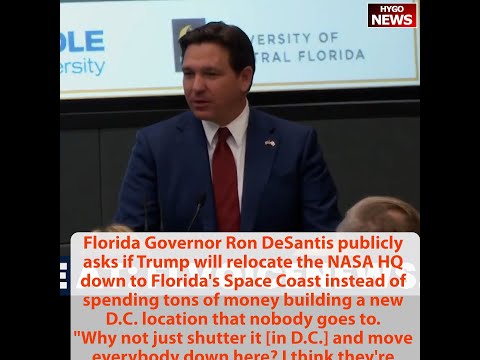
Ron DeSantis asks relocate NASA HQ down to Florida; Elon Musk’s Community Notes model far superior
In a series of developments capturing the breadth of the political landscape in early January 2025, Florida Governor Ron DeSantis made a public pitch to relocate NASA’s headquarters from Washington, D.C., to Florida’s Space Coast, commentators debated Meta’s decision to replace its fact-checking program with a Community Notes model inspired by Elon Musk’s approach on X, and retired General Keith Kellogg defended President Trump’s assertive foreign policy posture on the Panama Canal and Greenland.
DeSantis Proposes Moving NASA Headquarters to Florida
Governor DeSantis used a public appearance at Kennedy Space Center to make the case for relocating NASA’s headquarters from Washington, D.C., to Florida’s Space Coast. He framed the proposal as both a practical cost-saving measure and a logical alignment of the agency’s administrative center with its operational hub.
“I was talking to the director before we came out here. There is an interest in moving the headquarters of NASA right here to Kennedy Space Center, and I’m supportive of that,” DeSantis said.
He cited the wastefulness of maintaining a large administrative building in D.C. that he described as largely empty: “They have this massive building in Washington, D.C., and nobody goes to it. So why not just shutter it and move everybody down here?”
DeSantis then pointed to planned spending that he argued would compound the problem: “I think they’re planning on spending like a half a billion to build a new building up in D.C. that no one will ever go to either. So hopefully with the new administration coming in, they’ll see a great opportunity to just headquarter NASA here on the Space Coast of Florida. I think that would be very, very fitting.”
The governor outlined broader benefits beyond simple relocation: “We have an opportunity, of course, to bring down more federal resources. We also have an ability to fuel innovative research initiatives and allow for the development of national space policy right here in the Sunshine State. So the possibilities are significant.”
The proposal came at a time when the incoming Trump administration and the DOGE initiative led by Elon Musk were actively seeking to reduce federal spending and consolidate government operations. Moving NASA’s headquarters to where its primary launch facilities are located aligned with the broader push for efficiency in federal operations.
The Fact-Checker Debate: Community Notes as the Superior Model
Meta CEO Mark Zuckerberg’s announcement that Facebook and Instagram would replace their third-party fact-checking program with a Community Notes system similar to the one used on X sparked intense debate. Commentators supportive of the change argued that the existing fact-checking apparatus had become a tool of partisan censorship rather than an honest arbiter of truth.
One commentator delivered a blistering assessment of the fact-checkers: “These fact-checkers brought this on themselves. They’ve beclowned themselves. They’re not fact-checkers. They’re partisan sledgehammers. They’re partisan assassins. They’re not checking any facts.”
The criticism continued: “They exist not to check facts. They exist to try to screw Republicans. Let’s be honest, that is what they have become. And Facebook had entered into this situation where these people were effectively making things up to try to tilt the narrative in this country on a lot of different issues.”
The commentator endorsed the X model as a clear improvement: “He was right to get out of this, and he is also right to follow the X model of Community Notes. You’re going to get far better fact-checking, far better information by crowdsourcing this the way Elon Musk has done it. It’s going to be a lot more fair than it has been because the fact-checkers were” biased.
CNN’s Scott Jennings provided a more measured but still supportive analysis of the shift. He acknowledged legitimate concerns about misinformation while pointing to the underlying issue of who controls the boundaries of acceptable speech.
“I don’t disagree with you about the danger of outright misinformation or even hate,” Jennings said. “I am concerned about who and what kind of people get to set those boundaries. And what conservatives have become concerned about over the years is that full institutional control of information distribution hubs seems to have been on the left.”
Jennings contextualized Zuckerberg’s decision as a correction: “The liberals are howling about what Zuckerberg has done today because there’s been a bit of a bounce back or a pullback from the left having full control of the boundaries of the discourse.”
He made a broader point about the track record of institutional gatekeepers: “You have to admit some of the things that we were told was misinformation over the years turned out not to be, and you got in big trouble if you decided to go outside those boundaries when the institutional elites were telling you to stop, or worse.”
General Kellogg Defends Trump’s Panama Canal and Greenland Strategy
Retired General Keith Kellogg, who served in senior national security roles during Trump’s first term, provided a defense of the president-elect’s provocative statements about the Panama Canal and Greenland. Kellogg framed Trump’s approach as strategic rather than impulsive.
“When you look at what the president’s doing, he’s really kind of thinking out of the box,” Kellogg said. “He’s trying to engage, and he’s putting the United States in a position of global leadership.”
Kellogg argued that Trump’s statements were historically grounded: “When you look at it historically, there’s a lot of things he is saying that is very, very accurate historically, and it makes a lot of sense internationally for what it looks like for the future.”
On the Panama Canal specifically, Kellogg drew on his personal military experience: “When it comes to Panama, I was an assault brigade commander during Just Cause, the invasion of Panama. We actually did take the Panama Canal back in the late ’80s during Operation Just Cause, and three weeks later we gave it back to them. So we’ve taken it before. It’s happened before.”
Kellogg then addressed the strategic concern driving Trump’s rhetoric: “I think his point about the Chinese running the canal is a good point, because over 70% of the commerce that goes through the Panama Canal is in fact American. So it is in our vital interest, in our vital national interest, that that canal stays sovereign.”
Additional Context
The convergence of these three topics in a single news cycle illustrated the range of issues the incoming Trump administration was engaging with simultaneously. DeSantis’s NASA proposal represented the efficiency and relocation agenda that would be a hallmark of the new administration’s approach to the federal government. The fact-checking debate touched on free speech, social media governance, and the information ecosystem. And the Panama Canal and Greenland discussions reflected the ambitious foreign policy posture that Trump was establishing before even taking office.
Each topic carried implications that would extend well beyond the transition period, setting the stage for policy battles and strategic decisions that would define the early months of Trump’s second term.
Key Takeaways
- Governor DeSantis proposed relocating NASA headquarters from Washington, D.C., to Kennedy Space Center on Florida’s Space Coast, citing a half-billion dollars planned for a new D.C. building “that no one will ever go to.”
- Commentators praised Meta’s decision to replace fact-checkers with Community Notes, calling the existing fact-checkers “partisan sledgehammers” and “partisan assassins” who “exist to try to screw Republicans.”
- CNN’s Jennings acknowledged the danger of misinformation but argued conservatives were right to be concerned about the left having “full institutional control of information distribution hubs.”
- General Kellogg defended Trump’s Panama Canal stance, noting that as a brigade commander during Operation Just Cause he personally participated in taking the canal back, and that 70% of canal commerce is American.
- DeSantis framed the NASA relocation as an opportunity to “fuel innovative research initiatives and allow for the development of national space policy” on the Space Coast.