 HYGO News
 Rep. Pressley: 'US Owes Us a Debt -- We Need Reparations NOW'; Jeffries Denies ICE Videos Exist; Wholesale Prices Biggest Drop in 5 Years
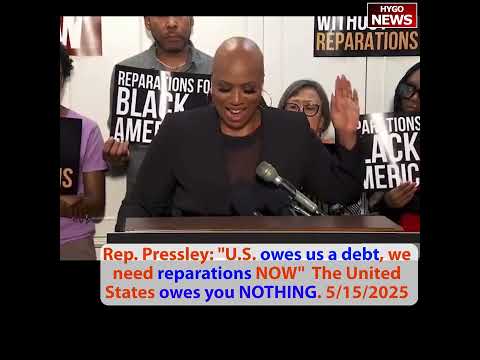
Rep. Pressley: “US Owes Us a Debt — We Need Reparations NOW”; Jeffries Denies ICE Videos Exist; Wholesale Prices Biggest Drop in 5 Years
Multiple stories converged in May 2025. Rep. Ayanna Pressley led a House Democrat push for reparations: “We are in a moment of anti-blackness on steroids. The antidote to anti-blackness is to be pro-black. The United States government owes us a debt and we need reparations.” Minority Leader Hakeem Jeffries denied that any videos existed showing Democrats acting inappropriately at Delaney Hall: “No videos have been produced suggesting they’ve engaged in any inappropriate activity.” Wholesale prices showed the biggest monthly decline in 5+ years — PPI down 0.5% versus expected gain of 0.2%. Trump responded to BBC on Putin’s delegation: “Nothing’s going to happen until Putin and I get together. He wasn’t going to go if I wasn’t there.”
Pressley’s Reparations Push
Rep. Ayanna Pressley (D-MA) introduced the multi-trillion-dollar reparations bill.
“We are in a moment of anti-blackness on steroids, and we refuse to be silent,” Pressley said. “We will not back down in our pursuit of racial justice.”
She delivered the framing: “The antidote to anti-blackness is to be pro-black. And we will do it unapologetically.”
She made the demand: “The United States government owes us a debt, and we need reparations. No. A duty to repair. So let’s make it clear. There is a debt that does exist.”
She laid out the historical argument: “This country has taken so much from Black folks and has a debt it owes. Because for over 400 years, into this very day, this country has stolen Black labor, Black lives, Black futures.”
She extended to current policy: “Industries were built and maintained through the subjugation of Black people in this country. Wealth was built and maintained through the discriminatory policies that still plague us to this day.”
She assigned beneficiaries: “To be clear, some people directly benefited from it or are direct beneficiaries of it. We have systems that create and perpetuate imbalances in our society, and you either benefit from it or you are disenfranchised by it.”
She finished the argument: “Black people continue to be disenfranchised and harmed by these systems. Others receive advantages from it.”
The reparations proposal — which had been introduced repeatedly in various forms over the years — proposed trillion-dollar payments to eliminate the wealth gap between Black and white Americans. The 2025 version made explicit what earlier versions had sometimes obscured: direct cash transfers from the federal government to Black Americans as compensation for historical injustices.
The proposal faced several fundamental challenges beyond the political reality of zero Republican support:
Identifying beneficiaries: Who qualified for reparations? Descendants of American slaves? All Black Americans including recent immigrants? People with partial African ancestry? Each answer created different constitutional and practical problems.
Identifying funders: Who paid? Current taxpayers, most of whom had no ancestors involved in slavery? White Americans specifically, based on race? Americans whose ancestors owned slaves? Each answer created its own constitutional problems.
Setting amounts: How much? Proposed figures ranged from individual payments in the tens of thousands to trillion-dollar wealth redistribution programs. No methodology for calculating appropriate amounts commanded consensus.
The “pro-black” framing was itself controversial. Traditional civil rights thinking had argued for equal treatment regardless of race — the colorblind ideal Kennedy had invoked in response to Rep. Coleman. The “pro-black” framing explicitly endorsed race-based preferences, creating the kind of government racial discrimination that civil rights laws had been designed to prohibit.
Jeffries Denies Videos Exist
Minority Leader Hakeem Jeffries doubled down on his defense of the Delaney Hall protestors.
“There is no evidence to suggest that any member of Congress who was in Newark, visiting the detention facility in connection with their oversight authority, has done anything wrong,” Jeffries said.
He made the specific claim: “No videos have been produced suggesting that they’ve engaged in any inappropriate activity.”
He added the tautology: “And if those videos existed, certainly they would have been put into the public domain by now.”
The problem was that the videos did exist and had been put into the public domain. DHS had released body camera footage showing Reps. Bonnie Watson Coleman, Rob Menendez, and LaMonica McIver physically confronting federal law enforcement officers — pushing, shouting, and in McIver’s case, striking officers. Secretary Noem had specifically described the assaults in her congressional testimony. The footage had been widely distributed on social media and covered by news outlets.
For Jeffries to claim no such videos existed was either:
- A claim that he hadn’t seen the videos (implausible given their extensive coverage)
- A claim that the videos didn’t show “inappropriate activity” (contradicted by the videos themselves)
- A deliberate falsehood for political purposes
Whatever the explanation, the denial created a credibility problem for Jeffries. When the House Minority Leader made statements that could be fact-checked against publicly available video evidence, his credibility as a political communicator suffered.
Wholesale Prices Drop
The May PPI report delivered strong economic news.
A reporter summarized: “Month over month, we actually saw a fall, negative 0.5. Month over month for April PPI. That’s the headline number. And yes, that’s a pretty big difference. The estimate was for a jump of 0.2. So you saw a much bigger cooling of inflation at the producer price level month to month.”
The year-over-year number was less dramatic: “2.4, the gain year over year. The estimate was 2.5. That’s not as substantial.”
The core number was the key figure: “Then you go down to the core number — that also came in negative 0.4 on core PPI month over month. The street was looking for a gain of 0.3.”
The PPI (Producer Price Index) measured wholesale prices paid by businesses. A 0.5% monthly decline — versus an expected 0.2% increase — was one of the largest negative surprises in years. The core number (excluding volatile food and energy prices) also declined 0.4% versus an expected 0.3% gain.
These numbers had major implications. Wholesale price declines typically preceded consumer price declines — if businesses were paying less for inputs, they would eventually charge consumers less. The April PPI data suggested that inflation was cooling far more rapidly than expected, potentially creating space for interest rate cuts that Trump had been demanding from the Federal Reserve.
Despite this data, Jeffries continued to attack Republican economic policy.
“We will continue to make clear to the American people that Republicans promised to lower the high cost of living and improve the economy,” Jeffries said. “And in fact, promised that costs would go down on day one.”
He delivered the attack: “Costs aren’t going down, they are going up. And Republicans continue to crash the economy in real time and are driving America toward a painful recession.”
The statement directly contradicted the wholesale price data being released that day. Costs at the wholesale level were going down — by the largest amount in years — exactly as Republicans had promised. Jeffries’ claim that “costs aren’t going down” was either ignorant of the data or dishonest in characterizing it.
The “painful recession” prediction was similarly problematic. Declining wholesale prices, rising employment, and record investment flows were not consistent with recession conditions. Jeffries was asserting economic conditions that did not match observed data.
Putin and Turkey
Trump addressed a BBC reporter’s question about Russia’s Turkey delegation.
“Are you disappointed in the level of the delegation that the Russians sent to Turkey?” the reporter asked.
Trump was dismissive: “I don’t know anything about it. I’m not disappointed in anything.”
He pressed the reporter: “Where are you from?”
“BBC News.”
Trump was unapologetic: “I’m not disappointed. What would I be? I just took in $4 trillion and he says, are you disappointed about a delegation? I know nothing about a delegation. I haven’t even checked.”
He delivered the substantive assessment: “Look, nothing’s going to happen until Putin and I get together. Okay? And obviously he wasn’t going to go. He was going to go, but he thought I was going to go. He wasn’t going if I wasn’t there.”
He explained the dynamic: “And I don’t believe anything’s going to happen with you like it or not until he and I get together. But we’re going to have to get it solved because too many people are dying.”
The “$4 trillion” reference pointed to the investment commitments from the Middle East trip — a comment that contrasted Trump’s focus on major policy wins with the BBC’s focus on Russian diplomatic protocol. Trump’s point was that whether Putin sent a senior or junior delegation to Istanbul mattered far less than the fundamental reality of the peace process: no agreement would happen without direct Trump-Putin engagement.
The candid admission — “he wasn’t going to go if I wasn’t there” — revealed the psychological dynamics of the negotiation. Putin viewed Trump as the only American principal worth meeting directly. Trump was willing to meet, but only when there was substantive business to conduct. The two sides were maneuvering to create the conditions for a summit that could end the war.
Key Takeaways
- Rep. Pressley led reparations push: “The United States owes us a debt. We need reparations. The antidote to anti-blackness is to be pro-black.”
- Jeffries denied Delaney Hall videos existed — despite DHS having released extensive footage of Democrat members physically confronting officers.
- April PPI: biggest monthly decline in 5+ years. Headline -0.5% vs. expected +0.2%. Core -0.4% vs. expected +0.3%.
- Jeffries still claimed “costs aren’t going down” — directly contradicted by the same-day data release.
- Trump on Putin: “Nothing’s going to happen until Putin and I get together. He wasn’t going to go if I wasn’t there.”