 HYGO News
 Democrat Rep. Casar: 'Trump Must Fire Elon Musk in 50 Days'; 76 House Democrats Demand DOGE Chief's Removal
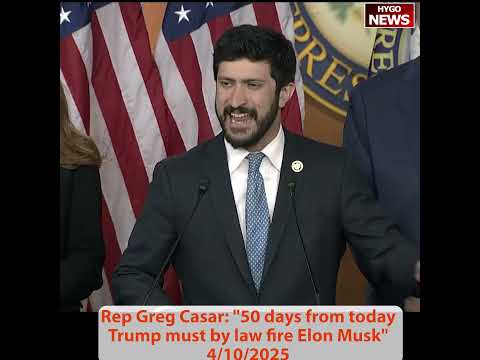
Democrat Rep. Casar: “Trump Must Fire Elon Musk in 50 Days”; 76 House Democrats Demand DOGE Chief’s Removal
Rep. Greg Casar (D-TX) held a press conference in April 2025 declaring that “50 days from today, Donald Trump must, by law, fire Elon Musk,” citing a federal statute limiting special government employees to 130 days. Casar said 76 House Democrats had sent “a clear message” to Trump demanding Musk’s removal by May 30. He accused Musk of receiving “$8 million a day in federal government contracts and subsidies while ignoring conflict of interest rules,” firing “more veterans from the federal government than anyone else in history,” and dismissing “independent watchdogs that were investigating his own companies.” The effort came as DOGE had just announced $150 billion in projected savings.
”The Clock Is Ticking”
Casar opened with the legal argument.
“Here’s the big news that people across the country haven’t heard but need to know,” he said. “50 days from today, Donald Trump must, by law, fire Elon Musk.”
He described the legislative action: “Last night, 76 House Democrats sent a clear message to President Trump. The clock is ticking.”
Casar laid out the legal basis: “Since the beginning of this administration, Trump and Musk have exploited Musk’s designation as a so-called special government employee to allow Musk to receive over $8 million a day in federal government contracts and subsidies while ignoring our conflict of interest rules and while funneling more and more money to himself and to his companies.”
He cited the statute: “But the law is crystal clear. A special government employee like Musk must leave the federal government after 130 days. That means that Musk must leave office by May 30th.”
He repeated for emphasis: “That means that 50 days from today, Donald Trump must fire Musk. 50 days from today, Musk’s reign of terror must end.”
The 130-day rule was a provision in the federal code designed to limit the influence of temporary government employees. Casar’s argument was that Musk had been designated as a “special government employee” — a classification that carried a maximum service period — and that the clock had been running since inauguration day on January 20. By Casar’s calculation, the 130-day limit would expire on May 30, 2025.
The legal argument raised a genuine question about Musk’s employment classification. If he was indeed a special government employee subject to the 130-day limit, the administration would need to either reclassify him, have him formally leave government while continuing to advise informally, or comply with the statute. The Democrats’ strategy was to use the legal constraint to force Musk out of the position that had given him access to government systems and the authority to identify and terminate wasteful contracts.
The Accusations
Casar cataloged his charges against Musk.
“We would be here for hours if I tried to recount every single one of Musk’s illegal actions or abuses or attacks on working Americans,” he said, “but let me give you just a few.”
The first: “In his 80 days in power, Elon Musk has fired more veterans from the federal government than anyone else in history.”
The second: “Elon Musk has fired independent watchdogs that were investigating his own companies for corruption and for breaking the law.”
The third: “Elon Musk called Social Security a Ponzi scheme, tried to shut down — this must end.”
Casar predicted public support: “If it were up to the American people, I think Elon Musk would be fired tomorrow.”
He drew a comparison: “A typical government employee would have been gone weeks and weeks ago. A typical government employee would have been held accountable for these crimes and for this corruption. But Musk relies on his so-called special government employee status. That gravy train runs out in 50 days.”
The Real Target: DOGE’s Work
The timing of the Democratic campaign was revealing. The press conference came the same week that Musk had announced $150 billion in projected DOGE savings for fiscal year 2026. EPA Administrator Zeldin had canceled $22 billion in grants. Interior Secretary Burgum had stopped an $830 million survey contract. Agriculture Secretary Rollins had terminated contracts for “queer farmer food justice” and transgender menstrual cycle studies.
In the administration’s framing, the Democratic effort to remove Musk was not about legal compliance — it was about protecting the spending pipeline that DOGE was dismantling. Every canceled contract represented money that had been flowing to organizations, consultants, and NGOs aligned with the Democratic Party’s priorities. Removing Musk would slow or stop the process of identifying and terminating those expenditures.
The “$8 million a day in federal contracts and subsidies” that Casar cited was a reference to Musk’s companies — Tesla, SpaceX, and others — which had federal contracts that predated the Trump administration. The conflict of interest argument was that Musk was in a position to influence government decisions that affected his own companies. The administration’s counter-argument was that Musk was not personally involved in decisions affecting his companies and that DOGE’s cost-cutting mandate actually reduced government spending across the board.
”Reign of Terror”
Casar’s use of “reign of terror” to describe DOGE’s work revealed the emotional intensity of the Democratic opposition.
From the administration’s perspective, what Casar called a “reign of terror” was the most basic function of government accountability: ensuring that taxpayer money was spent for its intended purpose. DOGE had identified payments to people who hadn’t been born, contracts for surveys that cost $830 million, and grants to organizations that received $100 one year and $2 billion the next. Stopping these expenditures was, in the administration’s view, not terrorism but common sense.
From the Democratic perspective, DOGE’s cuts were dismantling programs that served important constituencies, reducing the federal workforce in ways that harmed public services, and concentrating power in the hands of an unelected billionaire with massive conflicts of interest. The 130-day rule provided a legal mechanism to address what Democrats viewed as an unprecedented expansion of executive power.
The Legal Question
Casar specified what compliance meant in his view.
“When I say fire Elon Musk, I’m not talking about Trump and Musk hiding the ball and letting Musk continue to do what he’s doing without his title,” he said. “This is what I mean: follow the law. No more going around cabinet secretaries to slash key programs starting in 50 days. No more privileged access to government information.”
The distinction was important. Casar was anticipating that the administration might reclassify Musk or have him “leave” government in name while continuing to advise through informal channels. He was demanding a genuine separation — no access to government systems, no authority over agencies, no ability to direct cost-cutting operations.
Whether the administration would comply, reclassify, or challenge the 130-day interpretation in court remained to be seen. But the Democratic demand had established May 30 as a date that would force a resolution one way or another.
The Political Context
The Democratic effort to remove Musk highlighted the party’s strategic dilemma. Polls consistently showed that Americans supported reducing government waste — the core DOGE mission. By targeting Musk personally rather than the mission, Democrats risked appearing to defend the very waste that voters wanted eliminated.
Casar’s claim that “if it were up to the American people, Musk would be fired tomorrow” was contradicted by the administration’s argument — supported by the $150 billion in identified savings — that DOGE was doing exactly what voters had demanded when they elected Trump on a platform of government reform.
The 76 House Democrats who signed the letter represented a minority of the House. With Republicans controlling the majority, the letter had no legislative force. Its power was entirely legal — if the 130-day rule was genuinely applicable and enforceable, the courts might compel compliance regardless of congressional politics.
Key Takeaways
- Rep. Casar (D-TX) declared “50 days from today, Trump must by law fire Elon Musk” under the 130-day special government employee rule.
- 76 House Democrats signed a letter demanding Musk’s removal by May 30, 2025.
- Casar accused Musk of receiving “$8 million a day” in federal contracts, firing “more veterans than anyone in history,” and dismissing watchdogs investigating his companies.
- The effort came the same week DOGE announced $150 billion in projected savings — Democrats were targeting Musk as DOGE’s cost-cutting accelerated.
- Casar demanded genuine separation: “No more going around cabinet secretaries. No more privileged access to government information.”