 HYGO News
 Removed Alex Padilla: Adam Schiff horror & shock; Speaker: min level censure; Dem Khanna: horrified
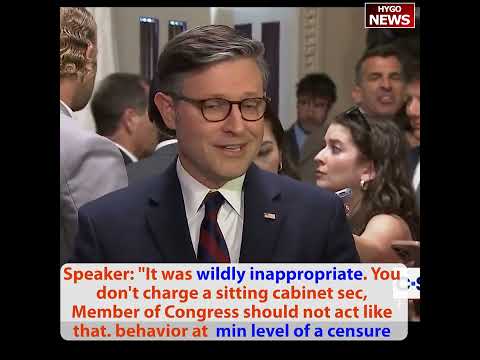
Removed Alex Padilla: Adam Schiff horror & shock; Speaker: min level censure; Dem Khanna: horrified
The Padilla press-conference incident extended into its second full news cycle with a cascade of reactions that revealed how the political establishment on each side of the aisle is processing what happened. Senator Adam Schiff of California watched footage of his junior colleague being removed and used two specific words — “horror” and “shock” — to describe his reaction. Representative Ro Khanna, another California Democrat, said he was “horrified” by the video. Speaker of the House Mike Johnson took the opposite position, describing Padilla’s behavior as “wildly inappropriate” and arguing that the conduct rose “at a minimum” to the level of a censure. Beneath the theater of dueling reactions is a genuinely consequential institutional question: when a sitting United States senator charges a cabinet press conference and refuses to follow protective-officer directions, what should the response be, and who gets to decide the political meaning of that response?
Schiff’s Opening: “I Just Watched Footage”
Senator Schiff opened his floor statement with the kind of deliberate framing senators use when they intend their words to be quoted. “I just watched footage of our colleague, my California colleague, Senator Alex Badiah, being forcibly removed from a briefing by the Secretary of Homeland Security’s staff.”
The construction — “forcibly removed from a briefing by the Secretary of Homeland Security’s staff” — is crafted to emphasize force and to attribute that force to DHS personnel. Schiff could have said “a press conference.” He chose “briefing.” The semantic difference matters because a briefing implies a space where questioning is expected, while a press conference implies an event where the press, not senators, does the questioning. Schiff is doing rhetorical work with word choice.
”He Went There To Observe And To Ask Questions”
Schiff then offered his characterization of Padilla’s purpose. “He went there to observe and to ask questions, and I watched with horror on this video seeing these agents grab my colleague, my fellow Senator from California, grab him, push him out of the hearing as he was identifying himself as a U.S. Senator, bringing him into a hallway, bringing him down to the ground, bringing his arms behind his back.”
The framing treats Padilla’s entry as routine senatorial oversight — observation and questioning. The administration’s counter-framing is that senatorial observation and questioning do not typically involve physically approaching a cabinet secretary’s podium during an active press conference. Senators have formal mechanisms for oversight: hearings, written questions, bilateral meetings, committee work. Entering a press conference and approaching the podium is not one of those mechanisms.
Schiff’s description of the physical sequence — “grab him, push him out of the hearing…bringing him down to the ground, bringing his arms behind his back” — is vivid and accurate as to what occurred on the video. The interpretation of that sequence is where Democrats and the administration diverge. Democrats read it as excessive force against a member of Congress. The administration reads it as appropriate protective response to an individual who charged a cabinet principal without identifying himself in advance.
”How Far We Have Descended In 140 Days”
Schiff’s emotional conclusion framed the incident as symptomatic of a broader slide. “I saw this happen to my colleague, and I am shocked by how far we have descended in the first 140 days of this administration. I was horrified.”
The “140 days” anchor is a signal that Schiff is grading the administration’s entire early tenure, not just the single incident. The use of “horrified” in addition to “shocked” is the rhetorical equivalent of turning up the volume. Both words are meant to register extreme emotional response.
The administration’s counter-framing is not that Schiff should not have emotions about the incident. It is that Schiff’s emotions about this incident should be weighed against his equivalent or louder reactions to events involving attacks on federal law enforcement by the same political movement that cheered Padilla’s intervention. To date, those equivalent reactions have not been forthcoming.
Khanna’s “Horrified” Addition
Representative Ro Khanna, another California Democrat, added his voice. “There’s just footage today of Senator Badiah being shoved out. I don’t know people have seen it, but he went to ask Secretary Noam a question, and the police literally grabbed the Senator and shoved him out of the room.”
Khanna’s framing again treats the incident as a thwarted attempt at question-asking. He uses the word “literally” to amplify the shock. “The police literally grabbed the Senator.”
The administration’s counter-framing would be: yes, protective officers quite literally did their job. They saw an unidentified individual approaching a protected principal. They responded as they are trained to respond. The adverb “literally” does not convert the protective response into misconduct.
The Interviewer’s Framing: “Bridge Too Far”
The interviewer pressed Speaker Johnson on the Democrat framing. “Did federal agents go too far the way they treated Senator Badiah today? Was that a bridge too far?”
The “bridge too far” phrasing is the classic leading question. It assumes there is a bridge that was crossed and invites the speaker to agree that it was crossed too far. Johnson did not take the invitation.
Johnson’s Counter: “Wildly Inappropriate”
Speaker Johnson’s response was measured but unambiguous. “I saw the same video, a very brief video that I think many people did. I think the Senator’s actions, my view is it was wildly inappropriate. You don’t charge a sitting Cabinet Secretary.”
“Charge” is the verb that matters. Johnson is describing Padilla’s movement as a charge toward Noem. That is exactly how the Secret Service protocol describes the movement that triggered the protective response. Johnson’s word choice aligns with the administration’s framing — and importantly, it is the word choice supported by the video footage.
“Everybody can draw their own conclusions. You can see it’s a heated debate here.” Johnson’s concession that the debate is heated is the acknowledgment that reasonable Americans can disagree about the interpretation. But his own interpretation — that Padilla’s conduct was wildly inappropriate — is stated directly.
”Refused To Do So. What Were They Supposed To Do?”
Johnson’s next line laid out the question the Democrats have not answered. “What I saw was agents asking him to quieten down so that the Secretary could continue her press conference. You refused to do so. What were they supposed to do? They have to restrain someone who was engaging in that kind of behavior. They moved him out of the room.”
The logic is tight. Protective officers asked Padilla to be quiet. He refused. They then had to decide whether to allow continued disruption or to remove the disruptor. Protective protocols require removal. Removal of a resistant individual requires physical restraint. Physical restraint produced the footage Democrats are now invoking as evidence of excessive force.
Johnson is asking Democrats to identify the point in the sequence where the protective officers should have done something different, and what specifically they should have done. The Democratic response has been to assert that the sequence should not have begun at all — but that is a plea for Padilla’s immunity from protective protocols, not a workable rule for Secret Service procedure.
”A Sitting Member Of Congress Should Not Act Like That”
Johnson then delivered his core institutional argument. “A sitting member of Congress should not act like that. It is beneath a member of Congress. It is beneath a US Senator. They’re supposed to lead by example. And that is not a good example.”
The framing places Padilla’s conduct in the context of the institutional responsibilities of a United States senator. Senators, Johnson is arguing, have an obligation to model the civic behavior they expect of ordinary Americans. Charging a cabinet secretary at a press conference is not a behavior any senator would counsel a constituent to emulate. It is, in Johnson’s phrasing, beneath the office.
”We Have To Turn The Temperature Down”
Johnson then pivoted to the broader political climate. “We have to turn the temperature down in this country and not escalate it. The Democrat Party is on the wrong side. They are defending lawbreakers and now they are acting like lawbreakers themselves.”
The observation that rhetoric is elevating rather than cooling is accurate across the board. The “horror and shock” language from senators, the “terrorism attack” language from deputy mayors, the “Gestapo” language from representatives, and the “Confederacy” language from mayors all contribute to a rhetorical climate in which a senator charging a cabinet secretary’s podium becomes something more thinkable than it would have been a few years ago.
Johnson’s argument is that the Democratic Party has both produced the climate and participated in its consequences. The senators defending Padilla are the same senators who have been escalating rhetoric against federal enforcement. The circular logic Johnson is identifying is real, even if Democrats will not accept his framing.
”Charging A Cabinet Secretary In A Press Conference”
Johnson’s closing on the substance was direct. “And I think that’s oversight charging a Cabinet Secretary in a press conference. I beg to differ, I think, that people do as well. I think those actions speak for themselves.”
The “I beg to differ” is a polite way of saying that Democrats calling Padilla’s conduct oversight are redefining the word to fit the political moment. Oversight has a specific legal and institutional meaning. It is not the same thing as an individual senator charging a cabinet secretary at an executive branch press event.
The Censure Question
The interviewer then pressed Johnson on what specific institutional response Padilla’s conduct warranted. Johnson offered a measured answer. “But the Senate does its disciplinary actions over there and we do ours over here. We have a certain set of measures, as you all know, and it ranges from censure to removal from committees to ultimately expulsion from the body.”
“And do you support that for the Senator?”
“It’s not my decision to make. I’m not in that chamber. But I do think that it merits immediate attention by their colleagues over there. I think that behavior at a minimum is, it rises to the level of a censure."
"At A Minimum…Censure”
The phrase “at a minimum…censure” is significant. Censure is the Senate’s formal declaration of disapproval of a member’s conduct. It is rarely deployed. Johnson is arguing that charging a cabinet secretary at a press conference and then refusing to follow protective officer directions is, at a minimum, the kind of conduct that should trigger a formal Senate response.
The word “minimum” implies that more severe consequences — removal from committees, or in extreme cases expulsion — could also be considered. Johnson is not asking for Padilla’s expulsion. He is saying the floor of the appropriate institutional response is censure, not defense.
”Not Going To Have Branches Fighting Physically”
Johnson closed with a genuinely important institutional observation. “I think there needs to be a message sent by the body as a whole that that is not what we are going to do. That’s not how we’re going to act. We’re not going to have branches fighting physically and having senators charging Cabinet Secretaries. We’ve got to do better and I hope that we will.”
The phrase “branches fighting physically” is the part that deserves pause. The United States government works because the three branches respect each other’s functional boundaries. Legislators legislate. Executives execute. Judges adjudicate. When a senator physically approaches a cabinet official’s podium in protest of an executive branch decision, the institutional boundaries are being tested. Johnson is arguing that those boundaries matter and that Senate action is the appropriate mechanism for reinforcing them.
The Schiff-Johnson Framing Contrast
The contrast between Schiff’s framing and Johnson’s is the heart of the story. Schiff saw “horror” and “shock” — a senator being manhandled by protective staff. Johnson saw “wildly inappropriate” conduct — a senator charging a cabinet secretary at a press conference. The facts underlying both framings are the same. The political interpretation is nearly opposite.
That interpretive gap is not going to close in this news cycle. It is the gap that defines the broader debate about what federal enforcement should look like, whether protest should have procedural limits, and whether the most senior members of the political establishment are willing to acknowledge the same facts when they are inconvenient.
Key Takeaways
- Sen. Schiff said he “watched with horror” the video of Padilla being removed, saying he was “shocked by how far we have descended in the first 140 days of this administration.”
- Rep. Ro Khanna (D-CA): “I’m horrified by Alex Padilla being removed for barging into briefing to fight for illegal aliens.”
- Speaker Johnson: “I think the Senator’s actions, my view is it was wildly inappropriate. You don’t charge a sitting Cabinet Secretary.”
- Johnson on protective response: “agents asking him to quieten down so that the Secretary could continue her press conference. You refused to do so. What were they supposed to do?”
- Johnson on institutional response: “that behavior at a minimum it rises to the level of a censure…We’re not going to have branches fighting physically and having senators charging Cabinet Secretaries.”