 HYGO News
 Trump on Iran: 'Can't Have a Nuclear Weapon -- But I'm Not in a Rush'; Praises Meloni, Says Ukraine War 'Never Would Have Started'
Trump on Iran: “Can’t Have a Nuclear Weapon — But I’m Not in a Rush”; Praises Meloni, Says Ukraine War “Never Would Have Started”
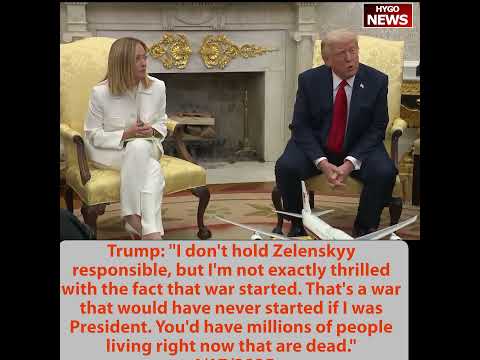
President Trump addressed three major foreign policy issues during his joint press availability with Italian PM Meloni in April 2025. On Iran, Trump pushed back on reports he had “waved off” an Israeli attack on nuclear facilities: “I wouldn’t say waved off. I’m not in a rush because I think Iran has a chance to have a great country and to live happily without death. But Iran can’t have a nuclear weapon.” On Italy, he called Meloni “a fantastic person” and “certainly one of our great allies, not just in Europe, anywhere.” On Ukraine, Trump was blunt: “That’s a war that would never have started if I were President. You’d have millions of people living right now that are dead."
"Iran Can’t Have a Nuclear Weapon”
When a reporter asked whether Trump had “waved off” an Israeli plan to attack Iranian nuclear facilities, Trump reframed the question entirely.
“I wouldn’t say waved off,” Trump said. “I’m not in a rush to do it because I think that Iran has a chance to have a great country and to live happily without death. And I’d like to see that. That’s my first option.”
He made the alternative clear: “If there’s a second option, I think it would be very bad for Iran.”
Trump expressed hope for diplomacy: “And I think Iran is wanting to talk. I hope they’re wanting to talk. It’s going to be very good for them if they do.”
He then offered a remarkably generous assessment of the Iranian people: “And I’d like to see Iran thrive in the future. Do fantastically well. I know the Iranian people, they’re incredible people. Always have been very smart, very energetic, very successful people.”
He stated his fundamental position: “And I don’t want to do anything that’s going to hurt anybody. I really don’t. But Iran can’t have a nuclear weapon. It’s pretty simple. It’s really simple.”
He clarified the limits of American demands: “We’re not looking to take their industry. We’re not looking to take their land. We’re just saying you can’t have a nuclear weapon.”
The Iran answer revealed the layered sophistication of Trump’s foreign policy approach. The surface reading — “he waved off an Israeli attack” — missed the strategic calculation entirely. Trump was not preventing an attack; he was sequencing his options. Diplomacy first, with a genuine offer of prosperity for Iran. Military action second, with an unambiguous warning of consequences.
The distinction between the Iranian regime and the Iranian people was deliberate and significant. By praising Iranians as “incredible people” who were “very smart, very energetic, very successful,” Trump was speaking over the heads of the mullahs to the population. The message was: your government is preventing you from thriving. If they choose the nuclear path, the consequences will fall on them. If they choose diplomacy, your country will prosper.
”She’s a Fantastic Person”
A reporter asked whether Italy could be America’s best ally in Europe, and Trump’s answer was unequivocal.
“She’s done a great job,” Trump said. “And yeah, certainly one of our great allies, not just in Europe, anywhere.”
He elaborated: “She’s a fantastic person and doing a great job. And our relationship is great.”
He added the domestic political connection: “And we have a lot of Italians in this country. I tell you, and they like Trump and they voted for Trump.”
The praise for Meloni was consistent with Trump’s earlier remarks at the same visit, but the addition of “not just in Europe, anywhere” elevated Italy’s status in the diplomatic hierarchy. Trump was not simply calling Italy a good European ally; he was placing it among America’s most important global partners.
The reference to Italian-Americans was vintage Trump — connecting foreign policy to domestic politics with the reminder that the Italian diaspora in America was both large and politically engaged. Italian-Americans had traditionally leaned Democratic but had shifted significantly toward Trump, creating a natural bridge between the two countries’ conservative movements.
”That War Would Never Have Started”
Trump addressed Ukraine with the candor that had made his foreign policy pronouncements simultaneously controversial and refreshing.
“I don’t hold Zelensky responsible, but I’m not exactly thrilled with the fact that that war started,” Trump said. “That was a war that would never have started if I were President.”
He stated the human cost: “You’d have millions of people living right now that are dead.”
He assigned blame: “You can blame the man that was sitting in this seat, Biden. He didn’t know what the hell was going on.”
He cited his record: “I know it’s a war. It didn’t happen for four years. It was never close to happening. It was never even a thought.”
He described his first-term deterrence: “And I spoke to President Putin about it a lot. It was the apple of his eye, but there’s no way he would have ever gone in if I were President.”
He assessed Zelensky: “I’m not blaming him. But what I am saying is that I wouldn’t say he’s done the greatest job.”
The Ukraine answer encapsulated Trump’s consistent position: the war was preventable, Biden’s weakness caused it, and the human cost was catastrophic. The “millions of people living right now that are dead” was Trump’s most visceral articulation of the war’s toll — a reminder that behind the geopolitical analysis were real human beings who would be alive if different decisions had been made.
The assessment of Zelensky was nuanced in a way that media coverage often missed. Trump explicitly said he didn’t “hold Zelensky responsible” and wasn’t “blaming him.” But he also wasn’t willing to grant Zelensky the hero status that the media and the Biden administration had conferred. “I wouldn’t say he’s done the greatest job” was a measured criticism — not an attack, but an honest assessment that Zelensky’s leadership decisions, including his refusal to negotiate before the war and his handling of the conflict, were open to legitimate debate.
The Three Pillars of Foreign Policy
The press conference exchange revealed the three pillars of Trump’s second-term foreign policy.
The first pillar was strength through restraint on Iran. Trump was not eager to use military force, but he was not afraid of it either. The preference for diplomacy was genuine — he wanted Iran to thrive — but the red line was absolute: no nuclear weapons. The approach combined the carrot of economic prosperity with the stick of devastating military consequences.
The second pillar was alliance management through bilateral relationships. By cultivating personal relationships with leaders like Meloni, Trump created a network of aligned partners who could advance American interests within their own regions. Meloni’s Italy could serve as a pro-American voice within the EU, moderating Brussels’ tendency toward adversarial trade and regulatory positions.
The third pillar was accountability for past failures on Ukraine. Trump’s willingness to publicly state that the war was preventable and that Biden bore responsibility was not merely political point-scoring. It was an assertion that foreign policy decisions had consequences — that weakness invited aggression and that the lives lost in Ukraine were the direct result of a failure of American leadership.
Key Takeaways
- Trump on Iran: “I’m not in a rush. Iran has a chance to have a great country. But Iran can’t have a nuclear weapon. It’s pretty simple.”
- He praised Iranians as “incredible people — very smart, very energetic, very successful” while maintaining the red line on nuclear weapons.
- On Meloni: “Certainly one of our great allies, not just in Europe, anywhere. She’s a fantastic person.”
- On Ukraine: “That war would never have started if I were President. You’d have millions of people living right now that are dead.”
- On Zelensky: “I don’t hold him responsible, but I wouldn’t say he’s done the greatest job.”