 HYGO News
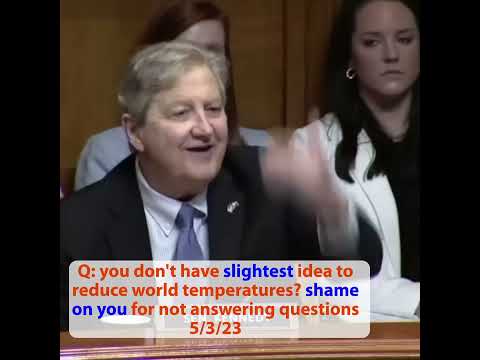
 Q: You Don't Have Slightest Idea Reduce World Temperatures? Shame On You For Not Answering
Q: You Don’t Have Slightest Idea Reduce World Temperatures? Shame On You For Not Answering
A senator closed an extended Net Zero accountability sequence with a public reprimand of the deputy secretary of energy. After the witness repeatedly pivoted away from a question about how much $50 trillion in U.S. spending would reduce world temperatures, the senator framed the witness’s posture in moral terms — “this isn’t your money and my money. It’s taxpayer money. And you can’t tell me how much it’s going to lower world temperatures.” Citing his remaining 22 seconds, the senator chose to “use them a different way”: “Mr. Secretary, shame on you for not answering my questions.” The closing reprimand crystallized the accountability frame Republicans have built around Net Zero testimony in 2023.
The Taxpayer Money Frame
- Money source: The senator framed transition spending as taxpayer money.
- Personal money distinction: “This isn’t your money and my money. It’s taxpayer money.”
- Editorial choice: The frame personalizes the spending question.
- Hearing record: The frame is now in the formal record.
- Long arc: The taxpayer money framing remains central to Republican Net Zero opposition.
The Heart Of Hearts
- Won’t vs. can’t: The senator distinguished between “won’t” and “can’t” answer.
- Editorial line: The distinction implies witness reluctance rather than ignorance.
- “Heart of hearts” framing: The framing reaches for moral accountability.
- Hearing record: The framing is now in the formal record.
- Long arc: The won’t-vs-can’t framing remains central to Republican accountability framing.
The U.S. Leadership Imperative
- Witness framing: The witness emphasized U.S. leadership as essential.
- “No way the world gets its act together”: The witness invoked global cooperation as the policy frame.
- U.S. leadership: U.S. leadership is treated as the critical lever.
- Editorial reach: The framing is standard climate policy positioning.
- Hearing record: The framing is now in the formal record.
The Shame On You Closing
- Public reprimand: The senator closed with a public reprimand.
- “Mr. Secretary, shame on you”: The line crystallized the accountability frame.
- 22 seconds choice: The senator used remaining time for the reprimand rather than additional Q&A.
- Editorial value: The closing dramatized the accountability frame.
- Hearing impact: The closing is now in the formal record.
The Republican Accountability Frame
- Cost specificity: Republicans use cost questions to expose specificity gaps.
- Temperature specificity: Republicans use temperature questions to deepen the gap.
- Money source: The taxpayer framing personalizes the accountability question.
- Public-facing posture: The strategy is designed for clip distribution.
- Long arc: The accountability frame remains central to Republican Net Zero opposition.
The Witness Posture
- General advocacy: The witness defended the 2050 target as appropriate.
- Cost framing: The witness emphasized cost of inaction over cost of action.
- Specific numbers: The witness could not produce specific cost or temperature figures.
- Editorial line: The posture reflected typical advocacy positioning.
- Hearing record: The exchange exposed the specificity gap.
The Deputy Secretary Role
- Witness identification: The witness was identified as the deputy secretary of energy.
- Department of Energy role: DoE coordinates federal energy and climate policy.
- IRA implementation: DoE coordinates much of IRA energy spending.
- Editorial weight: The deputy secretary level gives the testimony official policy weight.
- Hearing impact: The exchange placed the gap into a formal policy testimony record.
The 50 Trillion Marker
- Hearing anchor: $50 trillion was anchored as the cost figure across the sequence.
- Witness no rebuttal: The witness did not contest the $50T figure.
- Editorial value: The exchange placed a specific large number into the policy record.
- Hearing impact: The number was floated as a hypothetical, not adopted as a finding.
- Long arc: The number remains in circulation as a Republican framing tool.
The Climate Economics Layer
- Integrated assessment models: Estimates rely on integrated assessment models with wide bands.
- Discount rate sensitivity: Estimates are sensitive to discount rate assumptions.
- Damage function: The damage function from inaction is itself contested.
- Net cost framing: Climate economists frequently frame transition as net positive.
- Editorial line: Wide modeling variance complicates clean political answers.
The Free Rider Problem
- Universal action need: Net Zero requires universal or near-universal action.
- Free rider risk: Free riders can capture benefits without bearing costs.
- Trade implications: Free riding has implications for international trade policy.
- Carbon border adjustments: Border adjustments aim to address free riding.
- Editorial reach: Free riding is a central tension in international climate policy.
The U.S. Leadership Layer
- Leadership argument: The U.S. leadership argument is central to climate policy advocacy.
- Editorial reach: The argument reaches for moral and strategic justification.
- Free rider tension: The argument exists in tension with the free rider problem.
- Editorial line: The argument is contested across both U.S. parties.
- Hearing impact: The argument is now in the formal record.
The IRA Spending Context
- 2022 IRA: The Inflation Reduction Act included approximately $370 billion in climate spending.
- Tax credit framework: Most spending operates through expanded tax credits.
- Industrial policy: The IRA combines climate and industrial policy goals.
- Cost projections: Cost projections have risen materially since IRA passage.
- Editorial reach: The IRA represents the largest single climate investment in U.S. history.
The Energy Economy Transformation
- Scale of change: The transformation requires reshaping the entire energy economy.
- Power generation: Power generation must shift toward zero-carbon sources.
- Transportation: Transportation must shift away from internal combustion.
- Buildings: Building heating must shift away from natural gas in many contexts.
- Industrial processes: Industrial processes must shift toward zero-carbon inputs.
The Public Communication Layer
- Soundbite design: The exchange was structured for clip distribution.
- Documentary value: The hearing record now contains a clean Republican accountability framing.
- Media uptake: The clip moved on conservative media as a Republican Net Zero argument.
- Audience targeting: The folksy senatorial style is built for retail political distribution.
- Long arc: The framing remained central to Republican messaging through 2024.
The Democratic Response
- Cost-of-inaction framing: Democrats lean on cost of inaction over cost of action.
- Investment framing: They frame transition spending as investment rather than cost.
- Technology optimism: They emphasize cost declines in clean technologies.
- Global cooperation: Democrats emphasize global cooperation as the policy frame.
- Hearing posture: Democratic senators offered alternative framings during the same hearings.
The Carbon Border Adjustment
- EU CBAM: The EU has introduced a Carbon Border Adjustment Mechanism.
- U.S. proposals: U.S. proposals for similar mechanisms have been introduced.
- Trade tension: Border adjustments create trade tensions with non-Net Zero economies.
- Industrial competitiveness: Border adjustments protect domestic industrial competitiveness.
- Editorial reach: Border adjustments will reshape global trade in carbon-intensive goods.
The 2024 Implications
- Election positioning: Both parties use Net Zero policy for 2024 positioning.
- Energy state politics: Energy state politics shape Senate races.
- Industrial policy framing: Net Zero spending sits inside broader industrial policy debates.
- Long arc: The episode will shape climate policy through 2024 and beyond.
- Hearing legacy: The hearing record will be cited in future climate debates.
The Witness Discipline Gap
- Specificity gap: The witness defended the goal but could not produce specifics.
- Editorial line: The gap is typical for advocacy witnesses without operational responsibility.
- Hearing impact: The exchange placed the gap on the formal record.
- Future preparation: Future witnesses are likely to come prepared with specific numbers.
- Long arc: The episode will shape future Net Zero hearing testimony.
The Hearing Sequence Closure
- Multi-exchange sequence: The reprimand closed an extended Net Zero accountability sequence.
- Cumulative effect: Cumulative effect of the sequence dramatized the witness’s discipline gap.
- Editorial value: The sequence produced multiple clip-ready exchanges.
- Hearing impact: The full sequence is now in the formal record.
- Long arc: The sequence will be cited in future Net Zero accountability debates.
Key Takeaways
- The senator closed an extended Net Zero accountability sequence with a public reprimand.
- The witness pivoted to U.S. leadership and global cooperation as the policy frame.
- The senator distinguished between “won’t” and “can’t” answer.
- The senator chose remaining 22 seconds for “shame on you for not answering.”
- The closing crystallized the Republican accountability frame on Net Zero testimony.
- The full sequence produced multiple clip-ready exchanges for the formal record.
Transcript Highlights
The following quotations are drawn from an AI-generated Whisper transcript of the hearing and should be considered unverified pending official transcript release.
- “I’m all for carbon neutrality, but you’re the deputy secretary of the Department of Energy and you’re advocating we spend trillions of dollars” — senator
- “This isn’t your money and my money. It’s taxpayer money” — senator
- “You can’t tell me how much it’s going to lower world temperatures” — senator
- “There is no way the world gets its act together in climate change unless the U.S. leads” — witness
- “I’m still got a few seconds. I got 22 seconds. I’m going to use them a different way” — senator
- “Mr. Secretary, shame on you for not answering my questions” — senator
Full transcript: 136 words transcribed via Whisper AI.