 HYGO News
 Q: why not lower interest rates? Powell: forecast inflation, June, July, August; Sec VA: not fired
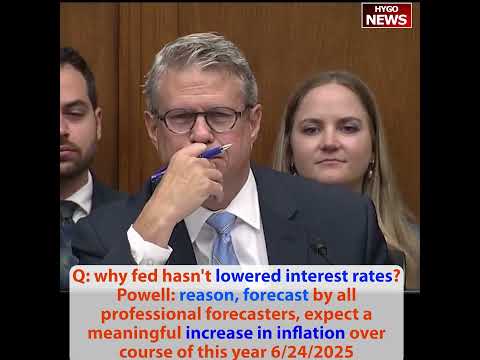
Q: why not lower interest rates? Powell: forecast inflation, June, July, August; Sec VA: not fired
The Federal Reserve Chair Jerome Powell faced an unusually sharp round of congressional questioning about why the Fed has declined to match rate cuts by other major central banks. His answer — that all professional forecasters expect “a meaningful increase in inflation” later in 2025 and that the Fed is waiting to see whether tariffs produce the predicted effects in “June, July, August” — is the most direct public explanation of the Fed’s current posture. VA Secretary Doug Collins, in a parallel hearing, had a tense exchange with Senator Tammy Baldwin over whether VA personnel were being “fired” or had “left for other reasons” amid the administration’s workforce reductions. And House Minority Leader Hakeem Jeffries escalated his Iran messaging, asking why Republicans are “hiding facts” from Americans about whether Trump’s actions will “drive us into another catastrophic war."
"A Larger Rate Cut”
Representative Bill Huizenga opened with a question every American household is asking in different forms. “How many months of steadiness do you need before you might look at an even larger rate cut from the 4.33?”
The 4.33% benchmark is the current effective federal funds rate. American mortgage rates, credit card rates, business lending rates, and auto loan rates all move in reference to the federal funds rate. When the Fed holds the rate elevated, consumer and business borrowing costs remain elevated. When the Fed cuts, borrowing costs ease.
Huizenga’s question reflects the growing Republican impatience with Fed policy. If inflation has moderated — which it has — and if growth is solid — which it is — why is the Fed keeping rates at restrictive levels?
”Non-Tariff Parts Of Inflation”
Powell’s answer addressed the analytical framework. “Inflation, the non-tariff parts of inflation that we’ve been working on for three, four years are behaving really well. And that was our forecast, but it’s good to see it coming true.”
The distinction between “tariff” and “non-tariff” inflation is the analytical move that structures the Fed’s current posture. Non-tariff inflation — the underlying price dynamics in categories like services, housing, and labor-intensive sectors — has moderated as the Fed had predicted. That is the part of inflation that traditional Fed policy addresses.
Tariff-related inflation — price effects flowing from the administration’s trade policy — is a separate question. Powell is distinguishing the two because he wants to explain why the Fed has not cut rates despite the favorable non-tariff data.
”Meaningful Effects June, July, August”
Powell delivered the specific timeline. “I would say we expected that tariffs take a while to work their way through the distribution chain several months. And I would say we would expect to see meaningful effects, you know, kind of June, July, August.”
The timeline is the Fed’s current framework. Tariffs announced earlier in 2025 are expected to translate into consumer prices with a lag of several months. The Fed is waiting to see June, July, and August inflation prints before concluding whether the tariff-inflation prediction is accurate.
If the tariff-inflation prediction is accurate, the Fed will have been justified in keeping rates elevated. If the prediction is wrong, the Fed will need to explain why it stayed restrictive when the data did not justify it.
”If We Don’t, We’ll Be Learning Something”
Powell continued. “And if we don’t, you know, we’ll be learning something. We have a highly adaptive flexible economy. And it’s certainly a possibility that the tariffs that we expect will come through in a much smaller level. We don’t, we can’t know that until we actually see it. But I think we’ll be learning as we go.”
“We’ll be learning something” is Powell’s acknowledgment that the Fed’s prediction might be wrong. The prediction is that tariffs will drive meaningful inflation. If the next three months of CPI data do not show that, the Fed will need to revise its framework.
”That Would Lead Us To Want To Cut Earlier”
Powell then signaled the condition for rate cuts. “And if we see that, then that would lead us to want to cut earlier. The other thing that would lead us to want to cut earlier is if we actually did see some weakness in the labor market of a troubling nature. And we don’t see that.”
Two conditions for earlier cuts: tariffs produce less inflation than expected, or the labor market weakens. Both are possible. Neither has materialized yet.
VA Secretary Collins And Baldwin
The video then pivoted to a VA hearing. Senator Tammy Baldwin was pressing Veterans Affairs Secretary Doug Collins on whether VA personnel were being terminated amid the administration’s workforce reductions.
Collins: “We’re not firing anyone. So I mean, for them to say that.”
Baldwin: “You’re firing the people underneath.”
Collins: “No, we’re not firing anybody. I mean, it’s not from RIF. It’s not from me. If they’re being fired, they’re being fired for calls issue in the facility they’re at.”
The distinction Collins is making is between centralized termination actions (RIF — reduction in force) and facility-level personnel decisions. The VA, he is arguing, is not conducting centralized firings. Individual facilities may be taking personnel actions for cause, but those are not administration firings.
”They Were Let Go”
Baldwin pressed. “They were let go. And I’m talking to the nurse. From things we’ve done. Since you started.”
The Baldwin framing is that personnel departures are, regardless of formal category, the result of administration actions. Nurses who leave because of policy changes, working conditions, or related factors are functionally fired even if the paperwork says otherwise.
”Tell Me Where They Were”
Collins held the line. “Tell me where they were because it’s not happening. I mean, the RIF was. Be happy to follow up with you with the examples.”
The request for specifics is the standard witness response when faced with general accusations. “Name specific instances” forces the accuser to provide facts that can be checked rather than generalities that cannot.
”If They’ve Taken Earlier Time, That’s Not Firing”
Collins then made the technical distinction. “If they’ve taken earlier time, that’s not firing. They’re not there. And so you have to face that in order to keep your nurses and doctors.”
The distinction between “firing” and “taking early retirement” or “choosing to depart” matters legally and administratively. Someone who accepts a buyout and leaves is not fired. Someone who retires early due to policy changes is not fired. Both leave the workforce, but the formal status is different.
Collins is arguing that VA’s personnel transitions fall in the voluntary-departure category, not the involuntary-termination category. Baldwin is arguing that the distinction is meaningless because the result is the same — the workforce shrinks.
”I’ll Be Happy To Work With You”
Collins offered the standard congressional-witness close. “I’ll be happy to work with you. But there’s no one being fired. They may have left for other reasons, but they’re not being fired.”
The “happy to work with you” phrasing is the diplomatic deflection. It appears cooperative while not conceding the underlying dispute. Collins is willing to follow up with Baldwin’s office on specific cases but is not accepting the premise that VA is firing personnel.
Why Not Match Other Central Banks?
The reporter returned to Powell. The question was about international comparison. “Still lower some interest rates. And by the way, match with the Bank of Canada, Bank of England, the European Central Bank, the Swiss Central Bank, a number of emerging Central Banks. By the way, that’s your own assessment on page 33, where you’re laying that out.”
The point is important. The Bank of Canada has cut rates. The Bank of England has cut rates. The European Central Bank has cut rates. The Swiss National Bank has cut rates. Many emerging market central banks have cut rates. The Federal Reserve is, increasingly, an outlier among advanced-economy central banks.
“Why aren’t we doing what the rest of the world is doing? Is it because we’re at full employment? Is it because of those tariffs concerns that you said weren’t part of part of the analysis?”
Powell’s Explanation
Powell’s response was direct. “You’re right that if you just look in the rear view mirror and look at the existing data that we’ve seen, you can make a good argument that that would call for us to be at a neutral level, which would be a couple of cuts or maybe more kind of thing.”
The admission is significant. Powell is conceding that the existing data — moderating inflation, solid growth — would support rate cuts if the Fed were looking only at the current conditions. “A couple of cuts or maybe more” is the rate-cut magnitude the rearview-mirror analysis would call for.
“The reason we’re not is the forecast in the, by all professional forecasters that I know of on the outside and the Fed, do expect a meaningful increase in inflation over the course of this year.”
The reason for not cutting is forecast-based. The Fed, along with outside forecasters, expects tariff-driven inflation to show up in coming months. Cutting rates now, before that inflation materializes, would risk allowing the predicted inflation to entrench. The Fed is trading off near-term dovishness for longer-term stability.
The Six-Month Window
Powell acknowledged the adjustment period. “When I said we weren’t going to talk about tariffs and inflation, that was to say, until we see what the policies are. And so now we know more in six months since I said that.”
Six months ago, the Fed had announced its intention to watch tariff developments before factoring them into its analysis. Now the tariff framework is clearer, and the Fed is incorporating tariff expectations into its inflation forecast. That is what Powell means by “we know more in six months.”
Jeffries’s Iran Attack
The video closed with Jeffries continuing his Iran messaging. “But the question that the American people are asking is why are Republicans hiding facts and the truth from America with respect to the possibility that their actions will drive us into another catastrophic war in the Middle East. Thank you.”
The framing is consistent with the House Democratic posture. Republicans, according to Jeffries, are hiding facts that would reveal that Trump’s Iran actions could lead to catastrophic war.
The counter-framing, which the administration has made repeatedly, is that the Iran strikes did not lead to catastrophic war. They led to a ceasefire. The predicted “World War III” outcome did not materialize. If Jeffries’s framing was predictive, it has been falsified by events.
The Hearing’s Political Lesson
The three threads in this hearing — Powell’s rate posture, Collins’s VA personnel distinctions, Jeffries’s Iran messaging — are each separate substantive matters. But they reveal a common pattern in congressional oversight.
Members pose framed questions designed to produce clips. Witnesses offer substantive answers that may or may not fit the member’s framing. Both sides then declare their version of the truth and move on. Voters who watch form their own judgments.
Powell’s framing — that the Fed is being prudent about forecast inflation — may or may not persuade voters who want rate cuts now. Collins’s framing — that the VA is not firing personnel — may or may not persuade voters who have heard specific accounts of VA departures. Jeffries’s framing — that Republicans are hiding Iran facts — may or may not persuade voters who have watched the ceasefire hold.
The political competition continues through these framings. Each hearing is a data point in the larger contest.
Key Takeaways
- Powell on rate cuts: “If you just look in the rear view mirror…you can make a good argument that that would call for us to be at a neutral level, which would be a couple of cuts or maybe more.”
- Why the Fed hasn’t cut: “Professional forecasters that I know of on the outside and the Fed, do expect a meaningful increase in inflation over the course of this year.”
- The tariff timeline: “We would expect to see meaningful effects…kind of June, July, August. And if we don’t, we’ll be learning something.”
- VA Secretary Collins: “There’s no one being fired. They may have left for other reasons, but they’re not being fired.”
- Jeffries: “Why are Republicans hiding facts and the truth from America with respect to the possibility that their actions will drive us into another catastrophic war in the Middle East.”