 HYGO News
 Q: Why ESG strategies be justification for a merger? Why would that be relevant at all?
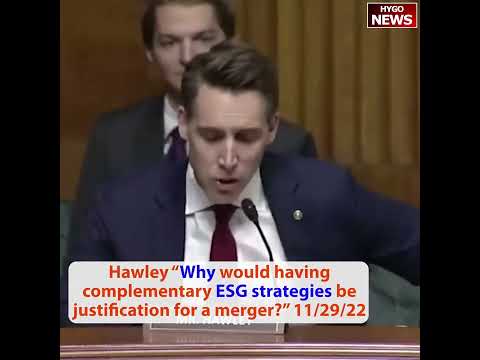
Senator Confronts Kroger CEO on ESG as Merger Justification: “I Think Frankly That’s Ridiculous” — Citing FTC Chair Lina Khan’s Sworn Testimony That ESG Has “Absolutely No Relevance” to Mergers
On 12/4/2022, a senator challenged Kroger CEO Rodney McMullen’s use of “complementary ESG strategies” as justification for the proposed Kroger-Albertsons merger. McMullen cited Kroger’s “zero hunger, zero waste” commitment as evidence of ESG alignment that the merger would advance. The senator pushed back sharply: “Don’t you think you should be asking what positive impact you’re going to have on the people you serve?” He then cited sworn testimony from FTC Chair Lina Khan, who had recently testified “she’s seeing an accelerating trend of companies justifying mergers on the basis of ESG, as if that should somehow allow them to evade scrutiny for the merger. She testified that she thought it had absolutely no relevance whatsoever.” The senator’s conclusion: “The fact that you’re using this as a justification for your merger, I think frankly is ridiculous.”
The ESG Justification
The senator’s opening question identified the issue. “Why would having complementary ESG strategies be a justification for a merger? Why would that be relevant at all?” the senator asked.
The question reflected broader congressional concern about ESG (Environmental, Social, and Governance) frameworks being used in corporate decision-making. ESG had become prominent in corporate strategy over the preceding decade, with companies touting their environmental sustainability, social impact, and governance practices as selling points for investors, customers, and regulators.
But ESG had also become politically controversial. Critics argued that:
ESG prioritized ideological alignment over financial performance — potentially violating fiduciary duties to shareholders.
ESG enabled corporate political positioning — companies took political stances based on ESG considerations rather than strict business judgment.
ESG could be used to evade legitimate scrutiny — corporate actions could be defended on ESG grounds even when their business merits were questionable.
ESG lacked clear definition — the flexibility of the term meant it could be applied to almost any corporate action.
The Kroger-Albertsons merger had apparently been justified, at least in part, on ESG grounds. The executives were arguing that the merger would advance ESG objectives (like reducing food waste or addressing hunger) and that this advancement should count as a benefit weighing in favor of merger approval.
”Zero Hunger, Zero Waste”
McMullen’s response cited specific Kroger ESG commitments. “If you look at some of the things that both of us have done — from Kroger’s commitment to zero hunger, zero waste, and we’ve — by merging with Albertsons as an example, we’ll be able to have that positive impact,” McMullen said.
“Zero Hunger, Zero Waste” was Kroger’s signature ESG initiative. The program committed the company to:
Zero Hunger — supporting food banks, reducing food insecurity, donating food that would otherwise be wasted Zero Waste — reducing landfill contributions, improving recycling, minimizing environmental footprint
These were genuinely valuable initiatives. Food insecurity is a real problem in America, and grocery chains are uniquely positioned to address it through food donations and related programs. Environmental waste reduction benefits everyone.
But McMullen was using these initiatives as justification for a merger that would reduce competition in grocery retail. The argument was: Kroger’s ESG initiatives are good; the combined company could extend these good initiatives; therefore the merger should be approved.
The senator’s question cut to the heart of this argument. Why should unrelated ESG initiatives factor into antitrust analysis of a merger’s competitive impact?
”The People You Serve”
The senator offered a counter-framing. “Don’t you think you should be asking what positive impact you’re going to have on the people you serve? Like for instance, the ability to provide food at a reasonable cost to people who need it, the ability to actually offer a product that consumers need and want,” the senator said.
This was a critical reframing. The senator was arguing that merger analysis should focus on the traditional concerns of antitrust law:
Prices — Would the merger raise or lower prices for consumers? Product quality — Would the merger improve or diminish product offerings? Innovation — Would the merger encourage or stifle innovation? Competition — Would the merger increase or reduce market competition?
These traditional concerns focused on direct consumer welfare. The senator was saying these should be the factors analyzed in merger review — not tangential ESG initiatives that had nothing to do with the competitive dynamics of grocery retail.
The senator’s examples were specific: “the ability to provide food at a reasonable cost” and “the ability to actually offer a product that consumers need and want.” These were the measures of grocery retail success that mattered to families. These were also the measures the merger could potentially harm.
Lina Khan’s Testimony
The senator then cited FTC Chair Lina Khan. “Here’s what I find interesting. Lena Kahn sat where you’re sitting as the chairman of the FTC just a few weeks ago, and she testified under oath that she’s seeing an accelerating trend of companies justifying mergers on the basis of ESG, as if that should somehow allow them to evade scrutiny for the merger. She testified that she thought it had absolutely no relevance whatsoever,” the senator said.
The citation was significant for several reasons:
Authority source — Khan was the top federal antitrust enforcement official. Her views on merger analysis carried legal weight.
Under oath testimony — Khan had testified formally before Congress. Her statements on ESG’s relevance to mergers were on the official record.
“Accelerating trend” — Khan was identifying ESG-as-merger-justification as a pattern she was seeing across multiple cases, not just the Kroger-Albertsons proposal.
“Absolutely no relevance whatsoever” — Khan’s rejection of ESG as merger justification was categorical, not nuanced.
“Evade scrutiny” — Khan was suggesting that ESG arguments were being used specifically to avoid traditional antitrust review.
The senator was essentially telling McMullen: the top federal antitrust official has already rejected what you’re doing. She sees it as an attempt to evade legitimate scrutiny. The Kroger-Albertsons merger was just one instance of a pattern the FTC was actively pushing back against.
The Political Alignment
The Khan citation was politically significant. Lina Khan was a progressive figure who had been appointed by Biden and was aligned with the Democratic administration’s aggressive antitrust enforcement agenda. The senator citing Khan approvingly was unusual for Republicans — Khan was not typically a source of authority for conservative senators.
But the citation worked because Khan’s specific position on ESG-as-merger-justification aligned with conservative skepticism of ESG. Both progressives (who wanted aggressive antitrust enforcement) and conservatives (who wanted to limit ESG influence in corporate decisions) could agree that ESG shouldn’t be used to evade merger scrutiny.
The bipartisan alignment on this specific issue — even as the broader political environment was deeply polarized — suggested that ESG-as-merger-justification was a genuinely problematic legal theory that had few defenders outside the companies using it.
”Ridiculous”
The senator’s conclusion was blunt. “And I think that she is absolutely correct. The fact that you’re using this as a justification for your merger, I think frankly is ridiculous,” the senator said.
“Ridiculous” was a strong word choice. The senator wasn’t just disagreeing with McMullen’s framing; he was declaring the framing worthy of ridicule. This was unusually direct language for a Senate hearing, where formal collegial deference typically governed exchanges even with corporate witnesses.
The “frankly” qualifier was the senator’s way of signaling that he was speaking directly rather than diplomatically. In congressional hearings, senators often pull punches to maintain institutional relationships. The “frankly” indicated that the senator was putting aside diplomatic considerations to express his actual view of McMullen’s argument.
The Antitrust Analysis Framework
The exchange reflected a substantive debate about how merger review should be conducted. The executives’ position was that mergers should be evaluated on their total impact — including ESG benefits that might offset competitive harms. The senator’s position was that mergers should be evaluated on competitive impact — with ESG considerations treated as irrelevant to the core analysis.
Traditional antitrust analysis has focused on competitive impact. The Clayton Act, the Sherman Act, and FTC merger guidelines have developed over a century to analyze mergers based on market concentration, consumer prices, and competitive dynamics. ESG considerations have never been part of this traditional framework.
Recent years had seen attempts to expand the framework to include broader social considerations. Progressive antitrust advocates argued for analysis of worker impacts, environmental impacts, and other social factors. Some scholars had proposed including ESG factors in merger analysis.
But the expansion was contested, and Khan’s testimony suggested the FTC was resisting this specific form of expansion. If ESG arguments could be used to justify any merger (because any company can find ESG commitments to invoke), then antitrust analysis would become toothless. The FTC’s position was that core competitive analysis had to remain central to merger review.
Key Takeaways
- A senator challenged Kroger CEO Rodney McMullen’s use of ESG strategies as justification for the Kroger-Albertsons merger.
- McMullen cited “zero hunger, zero waste” commitments as ESG alignment that would advance through the merger.
- The senator reframed: merger review should focus on consumer welfare — “food at a reasonable cost” and “products consumers need and want.”
- The senator cited FTC Chair Lina Khan’s sworn testimony that ESG justifications for mergers had “absolutely no relevance whatsoever.”
- The senator called the ESG justification “ridiculous” — unusually direct language in a Senate hearing.
Transcript Highlights
The following is transcribed from the video audio (unverified — AI-generated from audio).
- Why would having complementary ESG strategies be a justification for a merger? Why would that be relevant at all?
- If you look at some of the things that both of us have done from Kroger’s commitment to zero hunger, zero waste.
- Don’t you think you should be asking what positive impact you’re going to have on the people you serve?
- Lena Kahn sat where you’re sitting as the chairman of the FTC just a few weeks ago.
- She testified under oath that she’s seeing an accelerating trend of companies justifying mergers on the basis of ESG.
- She testified that she thought it had absolutely no relevance whatsoever. The fact that you’re using this as a justification for your merger, I think frankly is ridiculous.
Full transcript: 199 words transcribed via Whisper AI.