 HYGO News
 Q: They Get An F — "I Believe In Racial Equality, Everybody Should Be Treated The Same"
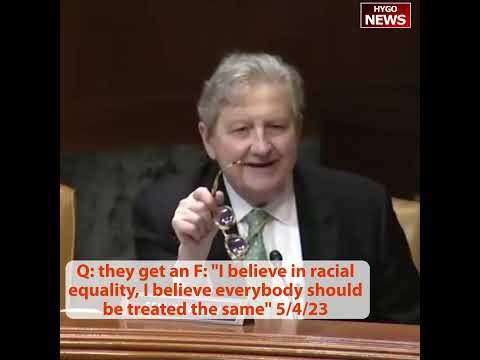
Q: They Get An F — “I Believe In Racial Equality, Everybody Should Be Treated The Same”
A senator continued an oversight sequence on federal diversity-in-hiring programs by walking a witness through a hypothetical: a candidate with hundreds of thousands of dollars of PhD debt applies to the University of New Mexico or University of South Carolina under the Faculty Institutional Recruitment for Sustainable Transformation (FIRST) program; when asked about race, the candidate says “I believe in racial equality. I believe everybody should be treated the same”; under the institutions’ administrative rules, the candidate “gets an F” and is “dismissed summarily.” The witness — refusing to opine on specific institutional rules — pivoted to “creating inclusive environments.” The senator pressed on whether the witness supported the rule “if it’s true.” The exchange dramatized the substantive constitutional question beneath the FIRST program.
The Fairness Hypothetical
- PhD debt context: The senator framed the candidate as carrying “hundreds of thousands of dollars” in PhD debt.
- Race question: The candidate is asked about race during the application process.
- Equality answer: The candidate responds with a colorblind equality statement.
- F grade: Under the rule, the candidate receives “an F” and is “dismissed summarily.”
- Editorial line: The hypothetical compressed the substantive question into a single example.
The Equality Statement
- “I believe in racial equality”: The candidate’s hypothetical statement.
- “Everybody should be treated the same”: The follow-up framing.
- Colorblind framing: The statement reflects a colorblind equality philosophy.
- Editorial reach: The statement is widely understood as a mainstream civil rights frame.
- Hearing record: The statement is now in the formal record.
The Witness Posture
- “Can’t speak to specifics”: The witness refused to engage the institutional rules directly.
- “Will look into it”: The witness offered to investigate.
- Substantive pivot: The witness pivoted to “creating inclusive environments.”
- Editorial line: The pivot avoided endorsing or rejecting the rule directly.
- Hearing record: The posture is now in the formal record.
The “If It’s True” Pressure
- Senator pressure: The senator pressed on whether the witness supported the rule “if it’s true.”
- Repeated press: The senator repeated the pressure when the witness deflected.
- Witness deflection: The witness continued to decline a direct yes-or-no answer.
- Editorial line: The repeated pressure dramatized the witness’s discomfort with the question.
- Hearing record: The repeated pressure is now in the formal record.
The Inclusive Environment Framing
- Witness defense: The witness defended the policy as “creating inclusive environments.”
- “Far too often” framing: The witness invoked historical exclusion as the justification.
- Editorial line: The framing follows standard DEI policy positioning.
- Hearing record: The framing is now in the formal record.
- Long arc: The framing remains central to DEI policy advocacy.
The Republican Strategy
- DEI scrutiny: Republicans use specific institutional rules to expose DEI program operation.
- Hypothetical method: Hypotheticals compress the substantive question into clear examples.
- Public-facing posture: The strategy is designed for clip distribution.
- Long arc: The approach remains central to Republican higher education oversight.
- Hearing impact: The exchange placed the program operation on the formal record.
The PhD Debt Frame
- Personal stakes: The PhD debt frame personalizes the candidate’s stakes.
- Hundreds of thousands: The senator emphasized the scale of educational debt.
- Career impact: Faculty hiring decisions shape PhD career outcomes.
- Editorial reach: The frame humanizes the policy abstraction.
- Hearing record: The frame is now in the formal record.
The Constitutional Question
- Equal Protection: The Equal Protection Clause governs race-conscious government action.
- Title VII: Title VII governs employment discrimination.
- State action: Public universities are state actors subject to constitutional constraints.
- Editorial reach: The constitutional questions sit beneath the policy debate.
- Hearing record: The constitutional context is now in the formal record.
The Affirmative Action Context
- SCOTUS cases: Students for Fair Admissions v. Harvard and UNC were pending at SCOTUS in 2023.
- June 2023 ruling: The Court would rule against race-conscious admissions in June 2023.
- Spillover effect: The ruling would reshape federal diversity programs.
- Editorial reach: The exchange anticipated the SCOTUS decision.
- Hearing record: The exchange is now in the formal record.
The Diversity Statement Debate
- Diversity statements: Many universities require diversity statements in faculty hiring.
- Statement function: Statements function as filters across teaching and research practice.
- Editorial line: The statement requirement is itself a contested practice.
- Hearing record: The statement requirement context is now in the formal record.
- Long arc: The statement debate has continued to shape university hiring practice.
The DEI Backlash
- Florida posture: Florida has limited public university DEI spending.
- Texas posture: Texas has imposed restrictions on DEI offices.
- North Carolina: North Carolina has restricted public university DEI activity.
- Editorial reach: Multiple state legislatures have moved against DEI infrastructure.
- Hearing record: The state-level moves give the federal exchange political resonance.
The FIRST Program
- Program name: Faculty Institutional Recruitment for Sustainable Transformation, or FIRST.
- 2020 launch: The program was created in 2020 by an unnamed federal agency.
- Funding scale: $241 million distributed across 12 institutions.
- Diversity goal: Funds were tied to “demonstrating a strong commitment to promoting diversity and inclusive excellence.”
- Hiring focus: The program centered on faculty hiring and recruitment.
The Federal Funding Layer
- $241 million scale: $241 million is substantial federal investment.
- Pass-through complications: Federal-to-state pass-through complicates oversight.
- Constitutional spillover: Federal involvement raises Equal Protection questions.
- Editorial reach: Federal funding gives the exchange constitutional resonance.
- Hearing record: The federal funding context is now in the formal record.
The Witness Discipline
- Specifics declined: The witness declined to opine on specific institutional rules.
- Future investigation: The witness offered to investigate the rules.
- Substantive pivot: The witness pivoted to general DEI defense.
- Editorial line: The discipline reflected typical agency hearing posture.
- Hearing record: The discipline is now in the formal record.
The Race Equality Frame
- Civil rights tradition: The “everybody should be treated the same” frame draws on civil rights tradition.
- Editorial reach: The frame is widely understood as a mainstream equality position.
- Constitutional alignment: The frame aligns with the Equal Protection Clause’s strict scrutiny standard.
- Hearing record: The frame is now in the formal record.
- Long arc: The frame will remain central to Republican civil rights argument.
The 2020 Racial Reckoning
- George Floyd context: 2020 saw the George Floyd-era racial justice movement.
- DEI expansion: 2020-21 saw substantial expansion of DEI infrastructure.
- Federal program response: Federal programs reflected the broader DEI expansion.
- Editorial reach: The 2020 context shaped federal program design.
- Hearing record: The 2020 context is now in the formal record.
The SCOTUS Spillover
- June 2023 ruling: The Court ruled against race-conscious admissions in June 2023.
- Spillover effect: The ruling spilled over into federal diversity programs.
- Editorial reach: Federal programs faced reformulation in light of the ruling.
- Hearing record: The exchange anticipated the spillover.
- Long arc: The ruling will reshape federal diversity programs for years.
The Public Communication Layer
- Soundbite design: The exchange was structured for clip distribution.
- Documentary value: The hearing record now contains a clean Republican DEI framing.
- Media uptake: The clip moved on conservative media as a Republican DEI argument.
- Audience targeting: The senator’s style is built for retail political distribution.
- Long arc: The framing remained central to Republican messaging through 2024.
The Democratic Response
- Diversity defense: Democrats defend diversity-in-hiring as legitimate policy goal.
- Constitutional framing: Democrats argue race-conscious programs can satisfy strict scrutiny.
- Substantive engagement: Democratic senators have pushed back on Republican DEI framing.
- Editorial line: The political layer of the debate complicates substantive engagement.
- Hearing posture: Democratic senators offered alternative framings during the same hearings.
The 2024 Implications
- Election positioning: Both parties use DEI policy for 2024 positioning.
- Higher education politics: Higher education politics shape Senate races.
- Constitutional aftermath: The 2023 SCOTUS ruling shapes the 2024 policy environment.
- Long arc: The episode will shape DEI policy through 2024 and beyond.
- Hearing legacy: The hearing record will be cited in future DEI debates.
Key Takeaways
- A senator pressed an agency witness with a fairness hypothetical on FIRST program rules.
- A candidate stating “I believe in racial equality…everybody should be treated the same” allegedly receives an F.
- The witness refused to opine on specific institutional rules.
- The witness pivoted to “creating inclusive environments” framing.
- The senator pressed on whether the witness supported the rule “if it’s true.”
- The exchange dramatized the constitutional question beneath the FIRST program.
Transcript Highlights
The following quotations are drawn from an AI-generated Whisper transcript of the hearing and should be considered unverified pending official transcript release.
- “Do you think it’s fair for the University of New Mexico and the University of South Carolina…to say to an applicant who’s borrowed hundreds of thousands of dollars” — senator
- “How do you feel about race? And they say, I believe in racial equality. I believe everybody should be treated the same” — senator hypothetical
- “They get an F. They’re dismissed summarily” — senator
- “You think that’s fair to do that with your money? With taxpayer money?” — senator
- “I can’t speak to the specifics of these institutions and I will look into it” — witness
- “What we are trying to do, sir, is create inclusive environments” — witness
Full transcript: 150 words transcribed via Whisper AI.