 HYGO News
 Trump on Zelensky 'Dictator' Question: 'Did I Say That?'; Starmer 'Earned Whatever They Pay Him' on Tariffs
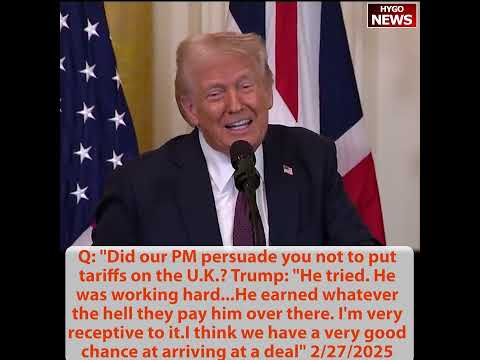
Trump on Zelensky “Dictator” Question: “Did I Say That?”; Starmer “Earned Whatever They Pay Him” on Tariffs
The Trump-Starmer press conference on February 27, 2025, produced several viral exchanges. When a reporter asked if Trump still considered Zelensky “a dictator,” Trump deflected with mock incredulity: “Did I say that? I can’t believe I said that.” Asked whether Starmer had persuaded him not to impose tariffs on the UK, Trump quipped that the Prime Minister “earned whatever the hell they pay him over there” before expressing genuine optimism about a trade deal. Starmer said “it’s good to know that the United Kingdom has a true friend in the Oval Office” and noted the return of Winston Churchill’s bust. Trump then formally received King Charles’s state visit letter and accepted “on behalf of our wonderful First Lady Melania and myself."
"Did I Say That?”
A reporter attempted to revive controversy by asking Trump about his previous characterization of Zelensky.
“Do you still think that Mr. Zelensky is a dictator?” the reporter asked.
Trump’s response was delivered with theatrical surprise: “Did I say that? I can’t believe I said that.”
The deflection was masterful for its setting. With Zelensky scheduled to visit the White House the following day to sign the minerals deal, Trump had no interest in reviving a characterization that could sabotage the signing ceremony. Rather than defending or retracting the statement, he expressed mock disbelief that he had ever made it — a response that was simultaneously a non-denial, a refusal to engage, and a signal that the “dictator” label was not the administration’s current framing of Zelensky.
The exchange captured Trump’s ability to neutralize loaded questions with humor rather than confrontation. A direct denial would have invited follow-up questions about why he had changed his position. A defense of the comment would have created a diplomatic incident the day before Zelensky’s visit. The feigned incredulity accomplished neither while defusing the question entirely.
”He Earned Whatever the Hell They Pay Him”
A British reporter asked the trade question that Starmer himself would have wanted answered: “Did our Prime Minister persuade you not to put tariffs on the UK?”
Trump’s answer blended humor with genuine substance. “He tried. He was working hard, I’ll tell you that,” Trump said. “He earned whatever the hell they pay him over there.”
The laughter from both delegations indicated the joke landed well. But Trump then pivoted to a substantive answer.
“I think there’s a very good chance that in the case of these two great, friendly countries, I think we could very well end up with a real trade deal where the tariffs wouldn’t be necessary,” Trump said. “We’ll see.”
He returned to the humor: “But he earned whatever they pay him here today. He was working hard at lunch.”
Then the serious assessment: “And I’m very receptive to it. I think in all fairness, in all seriousness, I think we have a very good chance at arriving at a very good deal.”
Trump named the team working on it: “JD and Scott and Howard, all the people are working on it. And I think we have a good chance at arriving at a deal that could be terrific, really terrific for both countries.”
The exchange revealed Trump’s approach to bilateral trade negotiations. Unlike the confrontational posture toward the EU and China, his language on the UK was warm and accommodating. Tariffs were presented not as a punishment but as a default that a good trade deal could make unnecessary. Starmer’s personal lobbying effort — “working hard at lunch” — was characterized as effective rather than futile.
The practical implication was that the UK was being offered a path to tariff-free trade with the United States that was not available to the EU. Post-Brexit Britain, by negotiating directly and bilaterally, could potentially secure preferential access to the American market that EU members could not match. This was precisely the kind of competitive advantage that Brexit proponents had predicted.
”A True Friend in the Oval Office”
Starmer’s remarks combined warmth with a politically significant visual observation.
“It’s good to know that the United Kingdom has a true friend in the Oval Office,” Starmer said. “And it was so good to see the bust of Winston Churchill back in its rightful place just a moment ago.”
The Winston Churchill bust reference carried significant diplomatic weight. The bust, a loan from the British government, had been displayed prominently in the Oval Office during Trump’s first term. Obama had moved it to a different location in the White House, and Biden had not restored it to the Oval Office. Trump’s decision to return the Churchill bust to a prominent position was a visual signal of the special relationship’s priority status.
For Starmer, a Labour prime minister, to praise the return of a bust of Britain’s most famous Conservative prime minister was itself a bipartisan gesture. It signaled that the UK-US alliance transcended domestic political divisions on both sides of the Atlantic.
The King’s Letter: A Full Ceremony
The formal presentation of King Charles’s letter was conducted with deliberate ceremony, elevating a diplomatic communication into a public event.
“Very importantly, I was just notified by letter from King Charles that he’s extended, through the Prime Minister, a historic second state visit to the United Kingdom,” Trump said. “And that’s a great honor because it’s never happened before.”
He framed the honor in national rather than personal terms: “One person has never been extended that honor, and I really do call it an honor. But it’s not for me — it’s for our country. It’s respect for our country.”
Starmer presented the letter physically. “Can I present a letter from a King to you?” he asked.
Trump received it and asked with genuine curiosity: “Am I supposed to read it right now?”
“Yes, please do,” Starmer said. “I’ve got to tell him what your reaction is, so I need to know.”
Trump read the letter and expressed approval: “Oh, that is really nice.” He added with humor: “I must make sure his signature is on that. Otherwise, it’s not quite as meaningful.”
“It is,” Starmer confirmed. “And that’s quite a signature, isn’t it?”
The exchange — Trump examining a king’s letter for authenticity, Starmer confirming the signature — had a quality of genuine human interaction that diplomatic events rarely achieved. Both leaders were visibly enjoying the moment, and the public presentation transformed what could have been a routine diplomatic communication into a shared experience witnessed by millions.
Trump accepted formally: “On behalf of our wonderful First Lady Melania and myself, the answer is yes. And we look forward to being there and honoring the King and honoring really your country.”
Key Takeaways
- Trump deflected the “Zelensky is a dictator” question with mock incredulity — “Did I say that? I can’t believe I said that” — the day before Zelensky’s White House visit.
- He said Starmer “earned whatever the hell they pay him” lobbying against UK tariffs at lunch and expressed genuine optimism about “a real trade deal where the tariffs wouldn’t be necessary.”
- Starmer called Trump “a true friend in the Oval Office” and noted the return of Churchill’s bust to “its rightful place.”
- Trump received King Charles’s letter personally, calling the unprecedented second state visit “not for me — it’s for our country, it’s respect for our country.”
- VP Vance, Treasury Secretary Bessent, and Commerce Secretary Lutnick were all working on the US-UK trade deal, with Trump predicting it would be “terrific for both countries.”