 HYGO News
 Q: Let Me Ask Again — $50T, How Much Will It Reduce World Temperatures?
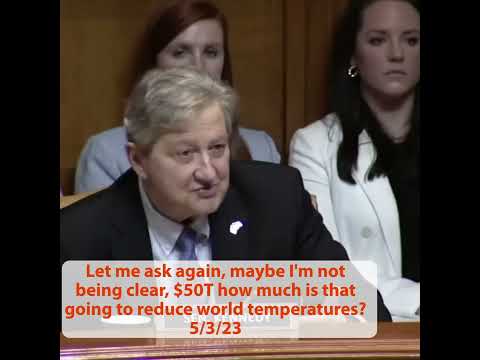
Q: Let Me Ask Again — $50T, How Much Will It Reduce World Temperatures?
A senator returned to the same question after the deputy secretary of energy declined to answer: if the United States spends $50 trillion to become carbon neutral by 2050, how much will that reduce world temperatures? The witness pivoted multiple times to global emissions framing — “we’re 13% of global emissions” — and to the cooperation imperative — “this is a global problem.” The senator pressed: “you don’t know, do you?” The witness suggested “you can do the math.” The senator closed with the rhetorical hammer: “You just want us to spend $50 trillion. And you don’t have the slightest idea whether it’s going to reduce world temperatures.” The exchange completed the accountability frame on Net Zero policy testimony.
The Repeated Question
- Same ask, second time: The senator restated the question after the witness pivoted.
- Specificity demand: The senator asked for a specific temperature impact number.
- Witness framing: The witness pivoted again to global emissions and cooperation.
- Editorial line: The repetition exposed the witness’s discipline gap.
- Hearing record: The exchange entered the formal record.
The 13 Percent Pivot
- U.S. share: The witness cited 13% as the U.S. share of global emissions.
- “If we went to zero”: The senator extrapolated that “if we went to zero, that would be 13% of the emissions.”
- Linear math: The math suggests U.S. action affects ~13% of global drivers.
- Editorial reach: The 13% framing accepts the senator’s underlying point.
- Hearing impact: The 13% number is now anchored in the formal record.
The Math Concession
- “You can do the math”: The witness offered “you can do the math” as a deflection.
- Linear extrapolation: A linear extrapolation suggests modest temperature impact.
- Editorial line: The deflection conceded the senator’s framing without endorsing it.
- Hearing record: The deflection is now in the formal record.
- Long arc: The “you can do the math” framing will be cited in future debates.
The Don’t Know Hammer
- Repeated press: The senator repeatedly asked “you don’t know, do you?”
- Witness silence: The witness did not produce a specific number.
- “Why won’t you tell me”: The senator asked “if you know, why won’t you tell me?”
- Editorial line: The repetition dramatized the discipline gap.
- Hearing impact: The exchange placed the gap on the formal record.
The Closing Frame
- Final summary: The senator closed with a rhetorical summary.
- “$50 trillion” framing: “You just want us to spend $50 trillion.”
- “Slightest idea” framing: “You don’t have the slightest idea whether it’s going to reduce world temperatures.”
- Editorial line: The framing completed the accountability narrative.
- Hearing impact: The closing frame is now in the formal record.
The Global Cooperation Framing
- “Global problem”: The witness emphasized that climate is a global problem.
- Universal action: The witness argued universal action is required.
- Free rider concern: The framing acknowledges the free rider problem.
- Editorial line: The framing is standard climate policy positioning.
- Hearing record: The framing is now in the formal record.
The Linear Math
- 13% × global: A linear extrapolation suggests U.S. action affects ~13% of global drivers.
- Sub-degree impact: Most temperature impact estimates from U.S.-only action are sub-degree.
- Climate models: Climate models include nonlinear feedbacks not captured in linear math.
- Editorial reach: The linear math frames the political vulnerability of unilateral Net Zero.
- Hearing impact: The math is anchored in the formal record.
The Net Cost Framing
- Climate benefits: The witness defended the policy on climate benefits.
- Cost-saving claim: The framing follows standard climate economics positioning.
- Specific number: The witness did not provide a specific temperature impact number.
- Editorial reach: The pivot dramatized the unresolved temperature-impact question.
- Hearing impact: The exchange placed the gap on the formal record.
The Republican Strategy
- Specificity demand: Republicans use temperature-impact questions to expose specificity gaps.
- Cost accountability: The combination of cost and temperature questions tightens the frame.
- Free rider concern: Republicans use the global cooperation framing against unilateral action.
- Public-facing posture: The strategy is designed for clip distribution.
- Long arc: Temperature-impact questions remain central to Republican Net Zero opposition.
The Witness Posture
- General advocacy: The witness defended the 2050 target as appropriate.
- Cost framing: The witness emphasized cost of inaction over cost of action.
- Specific numbers: The witness could not produce specific cost or temperature figures.
- Editorial line: The posture reflected typical advocacy positioning.
- Hearing record: The exchange exposed the specificity gap.
The Climate Economics Layer
- Integrated assessment models: Estimates rely on integrated assessment models with wide bands.
- Discount rate sensitivity: Estimates are sensitive to discount rate assumptions.
- Damage function: The damage function from inaction is itself contested.
- Net cost framing: Climate economists frequently frame transition as net positive.
- Editorial line: Wide modeling variance complicates clean political answers.
The Free Rider Problem
- Universal action need: Net Zero requires universal or near-universal action.
- Free rider risk: Free riders can capture benefits without bearing costs.
- Trade implications: Free riding has implications for international trade policy.
- Carbon border adjustments: Border adjustments aim to address free riding.
- Editorial reach: Free riding is a central tension in international climate policy.
The Temperature Impact Specificity
- Lukewarm models: Some climate models suggest modest temperature impact from current policy.
- Nordhaus framework: Nordhaus integrated assessment treats temperature as policy variable.
- Tipping points: Tipping point concerns complicate linear extrapolation.
- Editorial reach: Specific temperature math remains contested.
- Hearing impact: The exchange exposed the political vulnerability of advocacy without specifics.
The IRA Spending Context
- 2022 IRA: The Inflation Reduction Act included approximately $370 billion in climate spending.
- Tax credit framework: Most spending operates through expanded tax credits.
- Industrial policy: The IRA combines climate and industrial policy goals.
- Cost projections: Cost projections have risen materially since IRA passage.
- Editorial reach: The IRA represents the largest single climate investment in U.S. history.
The Energy Economy Transformation
- Scale of change: The transformation requires reshaping the entire energy economy.
- Power generation: Power generation must shift toward zero-carbon sources.
- Transportation: Transportation must shift away from internal combustion.
- Buildings: Building heating must shift away from natural gas in many contexts.
- Industrial processes: Industrial processes must shift toward zero-carbon inputs.
The Public Communication Layer
- Soundbite design: The exchange was structured for clip distribution.
- Documentary value: The hearing record now contains a clean Republican accountability framing.
- Media uptake: The clip moved on conservative media as a Republican Net Zero argument.
- Audience targeting: The folksy senatorial style is built for retail political distribution.
- Long arc: The framing remained central to Republican messaging through 2024.
The Democratic Response
- Cost-of-inaction framing: Democrats lean on cost of inaction over cost of action.
- Investment framing: They frame transition spending as investment rather than cost.
- Technology optimism: They emphasize cost declines in clean technologies.
- Global cooperation: Democrats emphasize global cooperation as the policy frame.
- Hearing posture: Democratic senators offered alternative framings during the same hearings.
The Carbon Border Adjustment
- EU CBAM: The EU has introduced a Carbon Border Adjustment Mechanism.
- U.S. proposals: U.S. proposals for similar mechanisms have been introduced.
- Trade tension: Border adjustments create trade tensions with non-Net Zero economies.
- Industrial competitiveness: Border adjustments protect domestic industrial competitiveness.
- Editorial reach: Border adjustments will reshape global trade in carbon-intensive goods.
The 2024 Implications
- Election positioning: Both parties use Net Zero policy for 2024 positioning.
- Energy state politics: Energy state politics shape Senate races.
- Industrial policy framing: Net Zero spending sits inside broader industrial policy debates.
- Long arc: The episode will shape climate policy through 2024 and beyond.
- Hearing legacy: The hearing record will be cited in future climate debates.
The Witness Discipline Gap
- Specificity gap: The witness defended the goal but could not produce specifics.
- Editorial line: The gap is typical for advocacy witnesses without operational responsibility.
- Hearing impact: The exchange placed the gap on the formal record.
- Future preparation: Future witnesses are likely to come prepared with specific numbers.
- Long arc: The episode will shape future Net Zero hearing testimony.
Key Takeaways
- A senator restated the temperature-impact question after the witness pivoted.
- The witness pivoted to global emissions framing — “we’re 13% of global emissions.”
- The witness offered “you can do the math” as a deflection.
- The senator closed: “You just want us to spend $50 trillion. And you don’t have the slightest idea whether it’s going to reduce world temperatures.”
- The exchange completed the accountability frame on Net Zero policy testimony.
- Both cost and temperature impact specifics remain unsettled in policy testimony.
Transcript Highlights
The following quotations are drawn from an AI-generated Whisper transcript of the hearing and should be considered unverified pending official transcript release.
- “Let me ask again, maybe I’m not being clear” — senator
- “If we spent $50 trillion to become carbon neutral by 2050 in the United States of America, how much is that going to reduce world temperatures?” — senator
- “This is a global problem. So we need to reduce our emissions and we need to do everything we can” — witness
- “We’re 13% of global emissions” — witness
- “If you know, why won’t you tell me? If we went to zero, that would be 13% of the emissions” — senator
- “You just want us to spend $50 trillion. And you don’t have the slightest idea whether it’s going to reduce world temperatures” — senator
Full transcript: 157 words transcribed via Whisper AI.