 HYGO News
 Q: legally scurrilous footing? A: Supreme Court got it wrong & HEROES Act pathway was quicker
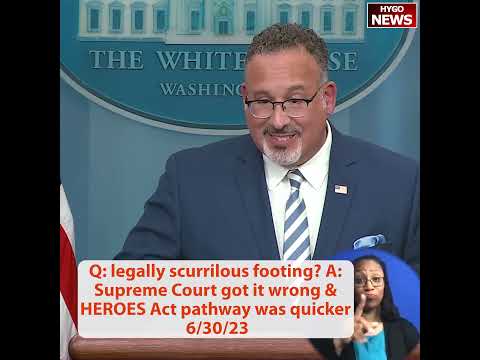
Reporter Presses Cardona: If Plan B Is on Even Shakier Legal Ground, Why Not Use It First?
On June 30, 2023, hours after the Supreme Court struck down Biden’s student loan forgiveness program, Education Secretary Miguel Cardona and Deputy National Economic Council Director Bharat Ramamurti faced sharp questioning from reporters about the administration’s newly announced “Plan B” to pursue debt relief through the Higher Education Act. A reporter pointed out the logical problem: if the HEROES Act approach had been struck down as exceeding presidential authority, the alternative pathway might be on even more “legally scurrilous footing.” And if the Higher Education Act was a viable option all along, why had the administration not used it in the first place? Cardona’s answer revealed that the HEROES Act had been chosen because it was “quicker” — an admission that speed and political timing had taken precedence over legal soundness.
The Reporter’s Devastating Question
The reporter laid out the logical trap with precision: “If the HEROES Act was on legally scurrilous footing, this might be even more so. And if you’re more secure that this is a legal route to do it, why didn’t you just use this in the first place?”
The question exposed two interconnected problems with the administration’s strategy. First, if the Supreme Court had determined that the HEROES Act did not authorize blanket student debt cancellation, it was unclear why the Higher Education Act — which had never been used for anything approaching this scale of debt relief — would fare better in court. The reporter’s observation that the alternative pathway might be on even shakier legal ground was well-founded, as the Higher Education Act’s “compromise and settlement” authority had traditionally been used for individual cases, not mass debt cancellation.
Second, if the Higher Education Act was a legitimate pathway, the question of why it was not used from the beginning was damning. The implication was that the administration had chosen the legally weaker approach first, suggesting that the decision was driven by something other than sound legal strategy.
Cardona’s Revealing Answer
Cardona’s response began with the administration’s standard line: “We believe the Supreme Court got it wrong today. We believe the HEROES Act does give me the authority. The Supreme Court made their decision today. We accept that.”
The juxtaposition of “we believe the HEROES Act does give me the authority” with “we accept that” the Court disagreed was notable. Cardona was simultaneously maintaining that the original approach was legal while acknowledging that it had been definitively ruled unlawful. The statement conveyed defiance without substance.
He then pivoted to the new strategy: “The Higher Education Act has a pathway, and we’re going to use that pathway.”
When the reporter pressed further — “But if you think that’s a better way to do it, why didn’t you just use that in the first place?” — Cardona delivered the answer that explained the entire strategy: “We believe that the HEROES Act pathway was quicker and we had the authority to do that.”
The word “quicker” was the most significant admission of the day. It confirmed that the administration’s choice of the HEROES Act over the Higher Education Act was driven by speed rather than legal certainty. The HEROES Act approach allowed Biden to announce the program quickly, process applications rapidly, and get approval notices to 16 million borrowers before the legal challenges could be resolved. The Higher Education Act pathway, by contrast, required a lengthy federal rulemaking process.
Speed Over Legal Soundness
Cardona’s admission that the HEROES Act was chosen because it was “quicker” raised fundamental questions about the administration’s priorities. The timeline of the student loan forgiveness program aligned with the political calendar: Biden announced it in August 2022, just months before the November 2022 midterm elections. The speed of the announcement and the rapid processing of applications were consistent with a political strategy designed to maximize the program’s electoral impact.
If the administration had chosen the Higher Education Act pathway from the start, the rulemaking process would have extended well beyond the midterms. The political benefit of announcing immediate debt relief before the election would have been lost. By choosing the “quicker” HEROES Act approach, the administration was able to make the promise, process applications, and generate headlines about 16 million approved borrowers — all before the legal challenges could work their way through the courts.
The fact that the quicker approach was also the legally weaker one suggested that the administration had accepted the risk of losing in court in exchange for the political benefits of the announcement. When the program was indeed struck down, the administration pivoted to “Plan B” — the slower but potentially more defensible pathway that it could have pursued from the beginning.
Ramamurti Confirms: “Certainly Not Weeks”
A reporter then asked about the timeline for the new approach: “But that sounds like a pretty complicated process. Are we talking about weeks, months?”
Bharat Ramamurti, the Deputy Director of the National Economic Council, provided a frank answer: “Well, certainly not weeks. It’s going to be months. I think, as I said, even the typical rulemaking process typically takes months. But we are aiming to do it as quickly as possible.”
The “certainly not weeks” admission underscored the contrast between the two approaches. The HEROES Act pathway had allowed the administration to announce immediate relief and begin processing applications within weeks of the announcement. The Higher Education Act pathway would require a formal rulemaking process that could take many months, during which borrowers who had been promised relief would continue waiting.
The timeline also raised questions about whether the new pathway would survive legal challenges any better than the first. If the rulemaking process took months, legal challenges could begin almost immediately, potentially resulting in injunctions that would block relief before it reached borrowers. The administration could find itself in the same position it was in with the HEROES Act approach: promising relief that courts would ultimately prevent it from delivering.
The Legal Landscape for Plan B
The administration’s pivot to the Higher Education Act was not without legal risk. The statute authorized the Secretary of Education to “compromise, waive, or release” federal student loan claims, but this authority had historically been used on a case-by-case basis. Using it for mass debt cancellation would again raise major questions doctrine concerns: whether an executive agency could use a broadly worded statute to implement a program of vast economic significance without explicit congressional authorization.
Legal scholars were divided on whether the Higher Education Act provided a stronger legal foundation than the HEROES Act. Some argued that the rulemaking process, which required public notice and comment, gave the program more procedural legitimacy. Others argued that the substance of the authority was just as questionable and that the Supreme Court’s Biden v. Nebraska ruling signaled that the current Court would be skeptical of any executive attempt at mass debt cancellation.
The reporter’s original observation — that if the HEROES Act was on “legally scurrilous footing,” the alternative “might be even more so” — captured this concern. The administration was not pivoting to a clearly legal pathway but to a different legal theory that might face the same constitutional obstacles.
Key Takeaways
- A reporter asked why the administration chose the HEROES Act pathway when the Higher Education Act was an alternative, and Cardona admitted it was because the HEROES Act was “quicker.”
- The admission confirmed that speed and political timing drove the choice of legal strategy, with the August 2022 announcement aligned with the November midterm elections.
- Ramamurti acknowledged the new pathway would take “certainly not weeks” but months, requiring a formal rulemaking process.
- The reporter noted that the Higher Education Act pathway might be on even more legally uncertain ground than the HEROES Act approach the Court had just struck down.
- Cardona maintained the administration believed the HEROES Act gave him authority despite the 6-3 ruling, saying “we accept that” the Court disagreed while continuing to call the decision wrong.