 HYGO News
 Q: Admin very confident HEROES Act, Why should borrowers trust you this time? A: fight harder
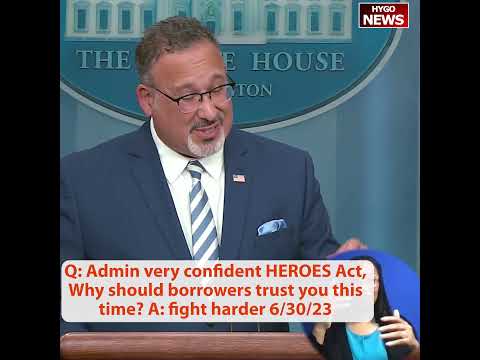
Reporter Asks: You Were Confident About the HEROES Act — Why Should Borrowers Trust You This Time?
On June 30, 2023, a reporter asked Education Secretary Miguel Cardona the question that millions of student loan borrowers were thinking: “This administration was very confident that the HEROES Act would work. Of course, the Supreme Court blocked that. Why should borrowers trust you this time that this one will work?” Cardona’s answer did not address the trust deficit at all. Instead of explaining what was legally different about the new approach, he appealed to emotion, declaring that no president had “done more to fight for student debt relief” and that the Court’s decisions made him want to “fight harder.” The response was heavy on passion and entirely lacking in the legal substance that would have justified renewed confidence.
The Trust Question
The reporter’s question was perhaps the most important one posed during the entire briefing. It cut through the administration’s rhetoric and asked the fundamental question: given that you were wrong before, why should anyone believe you now?
The question was framed from the borrower’s perspective, which made it particularly powerful. These were the 43 million Americans who held federal student loans, many of whom had been told by the Biden administration that up to $20,000 of their debt would be canceled. Approximately 16 million had been approved for relief. The money, as Biden himself had said earlier that day, “was literally about to go out the door.” And then the Supreme Court ruled 6-3 that the entire program was unlawful.
For those borrowers, the administration’s confidence in the HEROES Act had been worth nothing. The White House had repeatedly assured the public that the legal basis was sound, that the program would withstand judicial review, and that relief was on the way. None of that proved to be true. Now the same administration was asking borrowers to place their faith in a new plan under a different statute. The reporter was asking: what has changed?
Cardona’s Emotional Non-Answer
Cardona’s response replaced legal analysis with personal sentiment: “Yeah. There has been no other president that has done more to fight for student debt relief.”
The claim was intended to establish Biden’s credentials on the issue, but it was beside the point. The question was not whether Biden had tried harder than other presidents but whether his efforts were legally viable. A president can fight very hard for a policy that is unconstitutional. The effort does not make the policy legal.
Cardona continued: “And in the last 48 hours, these two decisions from SCOTUS make me want to fight harder.”
The reference to “two decisions” encompassed both the student loan ruling and the previous day’s ruling against affirmative action in college admissions. Cardona was framing both rulings as injustices that demanded an intensified response. But the emotional framing — “make me want to fight harder” — was a political statement, not a legal one. Borrowers were not asking whether Cardona was emotionally motivated. They were asking whether the next plan would actually survive in court.
He then listed the administration’s alternative measures: “With the SAVE plan, the income-driven repayment plan, with the on-ramp, and with the processes that we’re going to take, we’re doing everything we can to fight for our students.”
The list of programs was a substantive reference to real policies. The SAVE (Saving on a Valuable Education) plan was a new income-driven repayment plan that would lower monthly payments for many borrowers. The “on-ramp” was a 12-month period during which borrowers who missed payments would not face default or negative credit reporting as loan repayments resumed after the pandemic pause. These were genuine relief measures, but they were fundamentally different from the blanket debt cancellation that the Supreme Court had just struck down.
What Cardona Did Not Say
The gap between what Cardona said and what borrowers needed to hear was significant. Borrowers needed to know whether the new plan under the Higher Education Act was on stronger legal ground than the HEROES Act approach. Cardona did not address this.
Borrowers needed to know what specific legal arguments distinguished the new approach from the old one. Cardona did not address this.
Borrowers needed to know whether the administration had adjusted its legal strategy to account for the Supreme Court’s reasoning in Biden v. Nebraska, particularly the application of the major questions doctrine. Cardona did not address this.
Instead, Cardona offered the promise to “fight harder,” which was an implicit acknowledgment that fighting hard had not been enough the first time. The administration had fought hard for the HEROES Act approach, and it had lost 6-3. Fighting harder did not change the constitutional analysis. It did not give the President authority he did not possess. And it did not protect borrowers from the possibility that the next plan would face the same legal fate.
The SAVE Plan and Other Alternatives
The programs Cardona referenced — the SAVE plan, income-driven repayment reforms, and the repayment on-ramp — were the administration’s fallback strategy. Unlike the blanket debt cancellation that the Court had struck down, these programs operated within more traditional regulatory frameworks.
The SAVE plan, announced shortly before the Court’s ruling, would reduce monthly payments for undergraduate borrowers to 5 percent of discretionary income, down from 10 percent under previous income-driven repayment plans. Borrowers earning below 225 percent of the federal poverty line would have zero-dollar monthly payments. After 20 to 25 years of payments, remaining balances would be forgiven.
The 12-month on-ramp, which took effect when pandemic-era payment pauses expired in October 2023, gave borrowers a grace period during which missed payments would not result in default, negative credit reporting, or referral to collections.
These programs provided real financial relief to many borrowers, but they were a far cry from the $10,000 to $20,000 in immediate debt cancellation that Biden had promised. For borrowers who had been approved for instant forgiveness, being told that their monthly payments might be lower in the future was a significant downgrade.
The Political Dimension
Cardona’s answer also served a political function. By emphasizing the administration’s determination to “fight harder” and listing multiple programs, he was signaling to borrowers that the administration had not given up — a message aimed squarely at young voters who were a critical part of Biden’s 2024 re-election coalition.
The political calculation was clear: even if the legal prospects for blanket debt cancellation remained uncertain, the message that the President was still fighting for borrowers was itself valuable. It kept student debt relief as a campaign issue and maintained the narrative that Republicans and the conservative Court were the obstacles to relief rather than the administration’s own legal strategy.
The Supreme Court had ruled 6-3 in Biden v. Nebraska that the original $400 billion program exceeded presidential authority under the HEROES Act. Biden had announced that program in August 2022, offering up to $10,000 for borrowers earning under $125,000 and up to $20,000 for Pell Grant recipients. The ruling came after six Republican state attorneys general challenged the program on separation of powers grounds.
Key Takeaways
- A reporter asked why borrowers should trust the administration’s new legal approach after the HEROES Act strategy was struck down 6-3. Cardona did not provide a legal answer.
- Cardona responded emotionally, saying no president had fought harder for student debt relief and that the Court’s rulings made him want to “fight harder,” without explaining what was legally different about the new plan.
- He listed the SAVE plan, income-driven repayment reforms, and the repayment on-ramp as alternative measures, but these fell far short of the blanket debt cancellation the Court had struck down.
- The response highlighted the trust gap between an administration that had confidently promised relief under the HEROES Act and the reality that the program was found unconstitutional.
- The emotional framing served political purposes by signaling continued commitment to student loan borrowers ahead of the 2024 election, even if the legal basis for new relief remained uncertain.