 HYGO News
 Trump Reads MS-13 Record of Van Hollen's 'Maryland Man': Deportation Order, Rolls of Money, Accused Wife-Beater; Authorizes Venezuelan Deportations
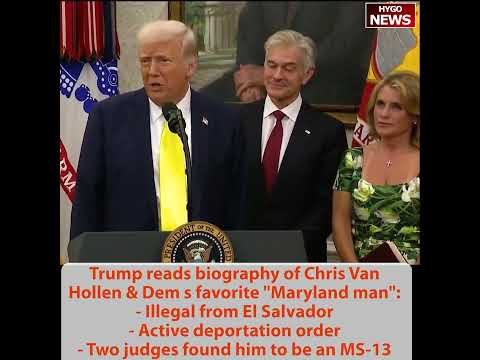
Trump Reads MS-13 Record of Van Hollen’s “Maryland Man”: Deportation Order, Rolls of Money, Accused Wife-Beater; Authorizes Venezuelan Deportations
President Trump addressed two explosive immigration issues in a single press conference in April 2025. First, when asked about Venezuelan men in Texas flagged for deportation under the Alien Enemies Act, Trump said: “If they’re bad people, I would certainly authorize it. I won an election in a landslide. Probably the biggest reason was because of the border.” Then Trump read from certified government documents detailing the criminal record of the man Sen. Chris Van Hollen had visited in El Salvador — an illegal alien with a deportation order from 2019, identified as an MS-13 member by two separate judges, arrested with “rolls of money pouring out” of his sweatshirt alongside two violent MS-13 gang members, caught transporting seven people from Texas to Maryland, and accused of domestic violence by his wife.
”If They’re Bad People, I Would Certainly Authorize It”
A reporter opened with a direct question about imminent deportations.
“There’s a group of Venezuelan men down in Texas who have been alerted that they are soon going to be deported under the Alien Enemies Act,” the reporter said. “Have you authorized that operation? And where are they going to go?”
Trump’s response was characteristically direct: “I don’t know about the group you’re talking about, but if they’re bad people, I would certainly authorize it.”
He then cited his mandate: “Yeah, you know, I won an election in a landslide. We won all seven swing states. We won by millions of votes. We won 2,750 districts to 505 districts. The map when you look at it is all red.”
He identified the core issue: “Probably the biggest reason was because of the border, because of illegal immigration. And the people of this country want those people out.”
He assigned blame: “Because what Biden did — and I don’t know if he did it, I’m not even sure he knows what the hell he was doing — but what his people did representing him was allow millions and millions of people.”
The Alien Enemies Act, invoked by Trump for deportation operations, was a 1798 law that allowed the president to detain and deport nationals of countries deemed hostile to the United States during times of declared emergency. Its application to Venezuelan nationals reflected the administration’s designation of the Maduro regime and associated criminal organizations as threats to American security.
Trump’s citation of his electoral mandate was not mere boasting — it was a constitutional argument. When courts attempted to block deportation operations, Trump’s response was that the American people had voted overwhelmingly for exactly this policy. The democratic mandate was clear, specific, and recent. A judge who blocked deportations was substituting his judgment for the judgment of 77 million voters.
Van Hollen’s “Maryland Man”
A reporter then raised the controversy surrounding Sen. Chris Van Hollen’s visit to El Salvador.
“Photos have emerged of Senator Van Hollen sipping what appears to be margaritas with Garcia down in El Salvador,” the reporter said. “Do you encourage other Democrats to fly down to El Salvador to meet with this illegal alien who’s an accused wife-beater?”
Trump loved the question: “I like this guy. See, now this is the kind of reporter we like. There aren’t enough of them. We got to get some more of them.”
He assessed Van Hollen: “Look, he’s a fake. I know them all. They’re all fake. And they have no interest in that prisoner.”
Trump then asked Leavitt to retrieve notes he had prepared and began reading the man’s record from certified government documents.
The Criminal Record
Trump read from what he described as certified State Department information.
“This comes out of the State Department and very legitimate sources,” Trump said. “This was supposed to be certified stuff.”
The first entry: “In 2019, Garcia was issued a deportation order.”
The gang affiliation: “Two separate judges affirmed Garcia was a member of MS-13, which is a gang that may be even worse than Tren de Aragua.”
The arrest details: “When Garcia was originally arrested, he was wearing a sweatshirt with rolls of money pouring out, an MS-13 gang symbol, and he was driving with two other known violent MS-13 gang members, two of the most violent members that we know of in the MS-13 gang of thugs.”
The trafficking: “In 2022, Garcia was stopped by the Tennessee Highway Patrol, was found to be transporting seven people from Texas to Maryland, and he had no driver’s license. He was driving violently.”
The domestic violence: “In 2020 and 2021, Garcia’s wife filed for a protective order from him.”
Trump summarized with disgust: “This is the man that the Democrats are wanting us to fly back from El Salvador to be a happy and ensconced member of the USA family. Isn’t it a shame?”
The catalog of Garcia’s criminal history was devastating not because any single element was unusual — MS-13 members routinely had records of gang activity, human trafficking, and violence — but because it exposed the absurdity of the Democratic position. A United States senator had traveled to a foreign country to advocate for the return of a man who had been ordered deported in 2019, confirmed as an MS-13 gang member by two judges, caught trafficking humans, and accused of beating his wife.
The Media Double Standard
Trump highlighted how the media had covered the case.
“I’ve been hit pretty hard by fake shows, fake news, MSDNC in particular,” Trump said, “where they talk about how evil I am that this man would be thrown out of our country.”
He contrasted the coverage: “This man is, according to certified statements that we get — they talk about this guy like he’s an angel.”
He pointed to the briefing room: “See the angel up there? They think he’s like that.”
The media’s treatment of Garcia epitomized the inverted moral framework that had characterized immigration coverage for years. An illegal alien with an active deportation order, confirmed gang membership, a human trafficking arrest, and domestic violence accusations was portrayed as a victim of Trump’s cruelty. The actual victims — the people Garcia had trafficked, the wife he had allegedly abused, the communities terrorized by MS-13 — were invisible in the coverage.
The fact that major networks had devoted hours of coverage to criticizing Garcia’s deportation while spending virtually no time examining his criminal record was itself a story. It revealed that the media’s opposition to deportation was not based on the facts of individual cases but on a categorical objection to immigration enforcement — regardless of how dangerous the person being deported was.
Van Hollen’s El Salvador Trip
The broader context of the exchange was Sen. Van Hollen’s decision to travel to El Salvador and meet with deported individuals, including Garcia. The trip had generated controversy when photos emerged showing Van Hollen apparently socializing with a man the government classified as a dangerous gang member.
From the administration’s perspective, the visit was an act of political theater designed to generate sympathetic coverage for deportees. Van Hollen had not traveled to Maryland communities terrorized by MS-13. He had not met with Garcia’s wife, who had sought protective orders against him. He had not visited the families of MS-13 victims. Instead, he had flown to El Salvador to have margaritas with a gang member.
The political calculation was transparent: by creating images of a senator meeting with a deported individual in El Salvador, Democrats hoped to humanize deportees and build the narrative that the administration was unjustly removing people from the country. But Trump’s reading of Garcia’s record turned that narrative inside out. The more the public learned about the specific individual Van Hollen had chosen to champion, the worse the Democratic position looked.
The Electoral Mandate
Trump’s repeated citations of his electoral victory — “all seven swing states,” “millions of votes,” “2,750 districts to 505” — served as a reminder that immigration enforcement was not a fringe position imposed by executive overreach. It was the most popular policy in the most decisive election in a generation.
The American public had voted specifically for this outcome. They wanted illegal immigrants with criminal records removed from their communities. They wanted MS-13 members deported. They wanted the border secured. When a judge or a senator attempted to obstruct that mandate, they were overriding the expressed will of the democratic majority.
Key Takeaways
- Trump on Venezuelan deportations under the Alien Enemies Act: “If they’re bad people, I would certainly authorize it. Our people voted for me to get them out.”
- He read Garcia’s certified record: 2019 deportation order, MS-13 membership confirmed by two judges, arrested with rolls of money and two violent MS-13 members.
- Garcia was caught in 2022 transporting seven people from Texas to Maryland; his wife filed protective orders in 2020 and 2021.
- Trump on Van Hollen: “He’s a fake. They have no interest in that prisoner” — while media coverage portrayed the deportee “like he’s an angel.”
- Electoral mandate cited: “We won all seven swing states, 2,750 districts to 505. The biggest reason was the border.”