 HYGO News
 Trump Returns to DOJ as Portrait Hangs in Lobby: 'Department of Injustice' Days Are Over
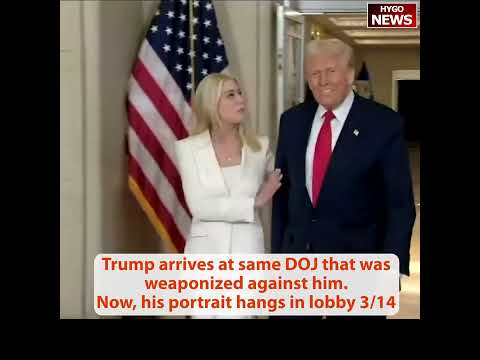
Trump Returns to DOJ as Portrait Hangs in Lobby: “Department of Injustice” Days Are Over
President Trump returned to the Department of Justice in March 2025 — the same building that had housed the investigations and prosecutions he had long characterized as political persecution. His official presidential portrait now hung in the lobby. Flanked by Attorney General Pam Bondi, Trump delivered a speech declaring that “the processes turned this Department of Justice into the Department of Injustice, but I stand before you today to declare that those days are over, and they are never going to come back.” He then cataloged the actions his administration had already taken: stripping security clearances, firing FBI officials, pardoning January 6 defendants, and banning government censorship.
The Return: Portrait in the Lobby
The visual symbolism of the event was unmistakable. Trump was standing inside the Department of Justice — the institution whose investigators had raided his Mar-a-Lago residence, whose prosecutors had brought federal charges against him, and whose career officials had been involved in multiple investigations spanning both his first term and the years between his administrations.
Now, his official presidential portrait hung in the building’s lobby. The man the department had investigated and indicted was the man whose portrait greeted every employee and visitor who walked through the doors. The power dynamic had reversed completely.
Trump acknowledged the moment with characteristic informality. “Hello everybody,” he said as he arrived. “Oh wow. You are such a nice person. That’s a rough picture. That’s a rough picture.” The self-deprecating humor about his own portrait belied the gravity of what the moment represented: a president returning in triumph to the institution he believed had been weaponized against him.
”Department of Injustice”
Trump wasted no time establishing the speech’s central thesis. “I know that the processes turned this Department of Justice into the Department of Injustice,” he declared, “but I stand before you today to declare that those days are over, and they are never going to come back. They’re never coming back.”
The “Department of Injustice” label was not new — Trump had used variations of it for years — but delivering it inside the DOJ itself, as president, transformed it from a campaign line into a governing declaration. He was not criticizing the institution from the outside; he was standing at its podium, with his attorney general beside him, announcing a new era.
Trump outlined the mission in broad strokes: “In everything we do, we’re restoring law, restoring order, and restoring public safety in America. That’s what we want to do. And we’re bringing honor and integrity and accountability back to the highest levels of the FBI, DOJ, and throughout our government.”
He connected the DOJ’s reform to the broader national project: “We’re bringing our country back faster than anyone ever thought possible. We’re working so hard at doing it, and we want fairness in the courts.”
Executive Actions: Censorship Ban and Clearance Revocations
Trump then moved from rhetoric to a catalog of specific actions his administration had taken since inauguration.
“That’s why on day one I signed an executive order banning all government censorship and directing the removal of every bureaucrat who conspired to attack free speech and many other things and values in America,” Trump said.
The censorship executive order had been one of the administration’s earliest and most significant actions, targeting the government-social media coordination that had been exposed through the “Twitter Files” and subsequent congressional investigations. By framing it as a Day One priority, Trump was signaling that the relationship between government agencies and information control was a foundational concern, not a secondary issue.
On security clearances, Trump was equally specific: “My administration stripped the security clearances of the disgraced intelligence agents who lied about Hunter Biden’s laptop from hell.” This was a reference to the 51 former intelligence officials who had signed a letter before the 2020 election suggesting that the Hunter Biden laptop story bore hallmarks of a Russian disinformation operation — a claim that was subsequently debunked when the laptop’s authenticity was confirmed.
“We revoked the clearances of Deranged Jack Smith, Alvin Bragg, Leticia James, and the crooked law firms that aided their partisan persecutions,” Trump continued. Jack Smith had served as special counsel investigating Trump on federal charges; Alvin Bragg was the Manhattan District Attorney who had prosecuted the New York business records case; Letitia James was the New York Attorney General who had pursued the civil fraud case. By revoking their clearances, the administration was making a tangible statement that the prosecutions had been illegitimate.
Trump also extended the clearance revocations to his predecessor: “We also terminated the clearances of the Biden crime family and Joe Biden himself. He didn’t deserve it.”
Biden’s Competency Finding
Trump then offered an extended commentary on the legal resolution of Biden’s own classified documents case, in which Special Counsel Robert Hur had declined to prosecute Biden while describing him as an “elderly man with a poor memory.”
“In fact, he was essentially found guilty, but they said he was incompetent,” Trump said. “And therefore, let’s not find him guilty, I guess. Nobody knows what that ruling was.”
Trump found dark humor in the comparison to his own legal situation: “I think I would have rather been found guilty than what they found with him. They said he didn’t know what the hell he was doing, and therefore he’s just let him go. I said, you know, I’d rather be convicted, Pam, I think than that. That was not good. I said, please convict me. Don’t say that.”
The commentary highlighted what Trump and his supporters viewed as a fundamental double standard: Biden had retained classified documents and avoided prosecution on competency grounds, while Trump had been indicted for similar allegations. The disparity in treatment had become one of the most potent arguments for the “weaponization” narrative.
January 6 Pardons and FBI Firings
Trump then addressed the January 6 defendants and the FBI leadership.
“I pardoned hundreds of political prisoners who had been grossly mistreated,” Trump said, using the term “political prisoners” to describe the January 6 defendants who had been prosecuted. The characterization was itself a political act — reframing criminal defendants as victims of political persecution.
On the FBI, Trump was direct about the personnel changes: “We removed the senior FBI officials who misdirected resources to send SWAT teams after grandmothers and J6 hostages.” The reference to “SWAT teams after grandmothers” invoked the dramatic early-morning raids that had been conducted on some January 6 defendants and on Trump associate Roger Stone — operations that critics argued were disproportionate to the alleged offenses.
Trump then addressed the firing that had defined much of his first term: “And it was a great honor for me to fire — I will tell you this, a great honor to fire James Comey, a great, great honor.”
He described the initial political reaction and the eventual vindication: “A lot of people said, oh, that’s too bad. You did that. And they said that’s going to be — and you know what, a year later, they said that actually saved the administration. Because the level of corrupt things that we learned after that turned out to be that they were doing, in fact, really bad things.”
Trump delivered the final assessment of Comey: “He was a terrible person, did terrible things and persecuted people. And all in the guise of being an angel, but he wasn’t an angel.”
Courts, Elections, and the Broader Reform
Trump connected the DOJ reform to the judicial system and election integrity.
“We want fairness in the courts,” he said. “The courts are a big factor. The elections, which were totally rigged, are a big factor. We have to have honest elections. We have to have borders. And we have to have courts and law that’s fair.”
The linkage of courts, elections, and borders reflected the administration’s view that these issues were interconnected: a compromised legal system enabled election irregularities, which in turn prevented border enforcement, which undermined national sovereignty. Fixing the DOJ was not an end in itself but part of a comprehensive restoration of institutional integrity.
The speech at the DOJ represented something larger than a policy address. It was a symbolic reclamation. The president who had been investigated, raided, indicted, and prosecuted was now standing inside the building that had authorized those actions, declaring them over. His portrait hung where prosecutors had once prepared cases against him. His attorney general sat where Merrick Garland had appointed the special counsel. The institution that had been used against him was now under his command.
Key Takeaways
- Trump returned to the DOJ building where he had been investigated and declared “the Department of Injustice” era was “over and never coming back.”
- His official presidential portrait now hung in the DOJ lobby, symbolizing the complete reversal of power.
- He cataloged executive actions: Day One censorship ban, security clearance revocations for the 51 intelligence agents, Jack Smith, Alvin Bragg, Letitia James, and Biden himself.
- Trump pardoned “hundreds of political prisoners” from January 6 and fired senior FBI officials, calling the firing of James Comey “a great, great honor.”
- He mocked Biden’s classified documents resolution: “They said he didn’t know what the hell he was doing, and therefore just let him go. I’d rather be convicted than that.”