 HYGO News
 Speaker Johnson: Tax Bill 'On Track to Pass House by Memorial Day'; Bessent: 'Big Celebration by July 4th' -- Permanence and Certainty
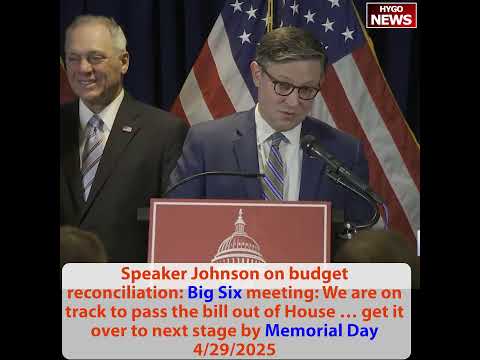
Speaker Johnson: Tax Bill “On Track to Pass House by Memorial Day”; Bessent: “Big Celebration by July 4th” — Permanence and Certainty
Speaker Mike Johnson outlined the timeline for the landmark budget reconciliation bill in April 2025, confirming: “We are on track to pass the bill out of the House and get it over to the next stage by Memorial Day.” Johnson described a “Big Six” meeting with Treasury Secretary Bessent, NEC Director Hassett, Senate Leader Thune, Finance Chairman Crapo, and Ways and Means Chairman Jason Smith. Bessent praised the pace: “The tax bill is going much better than I would have thought, through President Trump’s leadership.” He predicted “a big celebration by July 4th” and stated the stakes: “It will give permanence to the 2017 Tax Cuts and Jobs Act. It will give American business certainty. It will give American people certainty.”
The Big Six Meeting
Johnson described the coordination between the House, Senate, and White House.
“We’re sticking to our plan,” Johnson said. “We had a Big Six meeting yesterday with Secretary Bessent, Kevin Hassett at NEC, Senator Crapo, who’s the finance chair over there, Leader Thune, myself, and Jason Smith, Ways and Means Chair. And we had White House folks there as well.”
He described the purpose: “What we discussed was the timeline.”
He cited Bessent’s praise: “As the Treasury Secretary Bessent has said a few times, he gave us credit for moving this so aggressively on this calendar.”
He explained the urgency: “I’m really glad that we did, because we got to deliver this economic relief for the American people quickly. We got to codify all this.”
The “Big Six” format — the speaker, Senate leader, the chairmen of the tax-writing committees, and the Treasury Secretary and NEC director — represented the most important legislative meeting in Washington. These six officials controlled every lever necessary to pass the reconciliation bill: House floor scheduling, Senate procedure, committee markup, and executive branch coordination.
The fact that all six were aligned on the timeline and moving “aggressively” suggested that the internal disagreements that had plagued earlier legislative efforts had been resolved or managed. Republican unity on the tax bill was holding — a significant achievement given the party’s narrow margins in both chambers.
”Pass by Memorial Day”
Johnson set a specific, public deadline.
“We are on track to pass the bill out of the House, as we’ve said from the very beginning, and get it over to the next stage by Memorial Day,” Johnson confirmed.
He assessed the Senate: “Now, I don’t know how long the Senate’s going to take to do their piece, but I was very encouraged after the meeting yesterday, frankly.”
He praised Senate leadership: “Leader Thune and Senator Crapo are on point. The Senate Republicans have been working very hard together.”
He explained the sequence: “We got almost a year head start on them on this process, so that explains the sequence of events.”
He committed to the timeline: “But we’re going to get it done by Memorial Day. Send it over there. They take a couple of few weeks to work through that. We merge this together. We get it to the president’s desk quickly for signature.”
The Memorial Day House passage target was aggressive but achievable. The budget reconciliation process — which allowed passage with a simple majority in the Senate, bypassing the filibuster — was the only viable path for major tax legislation in a closely divided Congress. By passing the House version by Memorial Day, Johnson was giving the Senate several weeks to mark up and vote on its version before a conference committee merged the two.
The “year head start” comment reflected the fact that House Republicans had begun working on the reconciliation framework during the 2024 campaign, well before the election. This advance preparation meant that by the time Trump took office, the legislative architecture was already in place — committee jurisdiction had been established, revenue targets had been set, and policy provisions had been drafted.
Bessent: “Permanence and Certainty”
Bessent provided the economic rationale for the bill’s urgency.
“The tax bill is going much better than I would have thought,” Bessent said. “And that’s through President Trump’s leadership.”
He praised the unity: “Speaker Johnson, Leader Thune are united.”
He described the meeting: “Speaker Johnson held a very good meeting yesterday with something called the Big Six — Director Kevin Hassett, myself, Speaker Johnson, Leader Thune, Committee Chairman Jason Smith, Senator Crapo.”
He stated what the bill would achieve: “The tax bill is moving forward. It is going to give permanence to the 2017 Tax Cuts and Jobs Act.”
He stated the stakes: “It will give American business certainty. It will give American people certainty.”
He projected the celebration: “Secretary Bessent said yesterday, a big celebration by July 4th.”
The “permanence” issue was the bill’s most important economic feature. The 2017 Tax Cuts and Jobs Act — Trump’s signature first-term legislative achievement — had included provisions that were set to expire at the end of 2025. If those provisions expired, taxes would increase on virtually every American household and business.
Making the tax cuts permanent would provide “certainty” — the word Bessent repeated three times. Businesses that had been hesitant to make long-term investment decisions because the tax code might change could now plan with confidence. American families could budget knowing their tax rates would remain stable. The economic benefits that the 2017 act had produced — record low unemployment, rising wages, strong GDP growth — would have a permanent foundation.
The Debt Limit
A reporter asked whether the debt limit would be included in the reconciliation package.
Johnson confirmed: “Yes.”
The inclusion of the debt limit in the reconciliation bill was strategically important. By packaging the debt ceiling increase with tax cuts, spending reforms, and other popular provisions, Republican leadership ensured that the debt limit would not become a standalone hostage negotiation. Democrats could not hold the debt limit hostage to extract policy concessions because it was embedded in a comprehensive package that would pass on Republican votes alone through reconciliation.
The Legislative Architecture
The reconciliation bill represented the most ambitious legislative package since the 2017 Tax Cuts and Jobs Act itself. Its components included:
Making the 2017 individual tax cuts permanent, preventing a tax increase on American families.
Business tax provisions that would encourage domestic investment and manufacturing.
Spending reforms that would begin to address the fiscal deficit that both parties acknowledged was unsustainable.
A debt limit increase that would prevent a government default.
Potentially, provisions related to border security, energy, and other administration priorities that could be included under the reconciliation rules.
The breadth of the package explained the urgency. Every component reinforced the others — permanent tax cuts drove business investment, spending reforms reduced the deficit impact, the debt limit increase prevented fiscal disruption, and border and energy provisions addressed national security. Passing the package as a whole was far more effective than addressing each element separately.
July 4th Target
Bessent’s “big celebration by July 4th” projection set the most optimistic timeline. If the House passed its version by Memorial Day and the Senate acted within a few weeks, a conference committee could merge the versions and produce a final bill for Trump’s signature by Independence Day.
The symbolism of signing the most comprehensive economic legislation of the second term on America’s birthday was not lost on anyone involved. It would cap 100+ days of tariff restructuring, trade negotiations, and fiscal reform with a permanent law that locked in the economic agenda voters had endorsed.
Key Takeaways
- Speaker Johnson confirmed the tax bill is “on track to pass the House by Memorial Day” after a Big Six meeting with Bessent, Hassett, Thune, Crapo, and Smith.
- Bessent: “The tax bill is going much better than I would have thought. It will give permanence to the 2017 Tax Cuts and Jobs Act.”
- Bessent’s vision: “It will give American business certainty. It will give American people certainty. A big celebration by July 4th.”
- The debt limit is included in the reconciliation package, preventing standalone hostage negotiations.
- Johnson on Senate: “Leader Thune and Senator Crapo are on point. Senate Republicans have been working very hard together.”