 HYGO News
 Omnibus spending no brainer: do you want Nancy Pelosi or Kevin McCarthy to decide Federal budget?
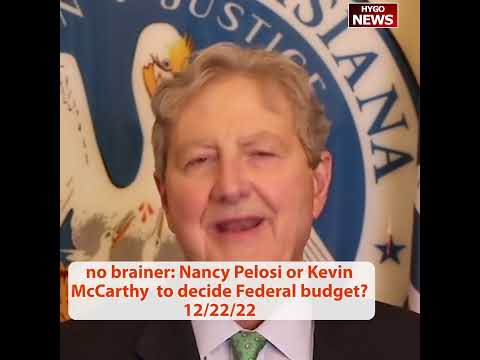
Senator Kennedy Repeats Core Argument: Why Pass Omnibus With Pelosi Instead of Waiting for McCarthy as Speaker?
On 12/22/2022, Senator John Kennedy of Louisiana repeated his core argument about why the omnibus spending bill should have been delayed rather than passed with outgoing Speaker Nancy Pelosi. “Would you rather have Nancy Pelosi decide what the federal budget is going to be, or would you rather wait until he’s sworn in as Speaker of the House and have Kevin McCarthy? And that to me is a no-brainer,” Kennedy said. He questioned the urgency: “You’ve got to ask yourself why Senator Schumer and Speaker Pelosi were so desperate to pass this budget now. And believe me, they were desperate to pass this budget. I’ll tell you why I think they were so desperate because they didn’t more wait for a Republican House of Representatives.”
The Repeated Core Argument
Kennedy’s “no-brainer” framing was repeated. The repetition served:
Message reinforcement — Across multiple appearances.
Voter education — Through repeated exposure.
Media clip generation — For multiple cycles.
Principled positioning — Through consistency.
Campaign messaging — For future use.
Kennedy’s repetition of his core argument across multiple media appearances was strategic:
Different audiences — Reached each time.
Different clips — Generated for coverage.
Consistent message — Maintained.
Personal branding — Reinforced.
Political positioning — Established.
The Political Logic
Kennedy’s logic was:
Pelosi would decide — If bill passed now.
McCarthy would decide — If waited.
McCarthy more fiscal conservative — Generally.
Less spending likely — With Republican control.
Therefore wait — For better outcome.
This logic assumed:
McCarthy more restrained — Than Pelosi.
Republican majority more disciplined — Than Democratic.
Delay was feasible — Without crisis.
Wait better than act — Strategically.
Conservative preference — For delay.
Some assumptions were contestable:
McCarthy’s discipline — Would be tested.
Republican caucus unity — Was questionable.
Delay costs — Weren’t just political.
Government shutdown — Was alternative.
Defense funding — Critical concern.
But Kennedy’s basic principle — that waiting for Republican House would produce different outcomes — was valid. The question was whether the delay was worth the costs.
The Schumer/Pelosi Analysis
Kennedy’s theory was political analysis. “I’ll tell you why I think they were so desperate because they didn’t more wait for a Republican House of Representatives,” Kennedy said.
The analysis:
Democrats anticipated House loss — Correctly.
Republican priorities — Would differ.
Democratic wins — Required now.
Strategic timing — To secure priorities.
Political rationale — Rather than policy.
This was accurate political analysis. Democrats did:
Lose House majority — In January.
Face different negotiation — With Republicans.
Have different priorities — Than McCarthy Republicans.
Seek to preserve — Their policy agenda.
Use remaining majority — Strategically.
Kennedy was explaining the political calculation behind the rush. This was legitimate political criticism, not conspiratorial accusation.
The Timing Political Reality
By December 2022:
Republican House majority — Confirmed.
Democratic Senate — Retained.
Biden presidency — Continuing.
Divided government — Approaching.
Last opportunity — For Democratic unified preferences.
The timing incentives:
Democrats to pass now — Unified control.
Republicans to wait — New majority leverage.
Each side calculated — Differently.
Legitimate strategic — Considerations.
Political reality — Driving decisions.
Kennedy’s “desperate” framing was politically loaded but captured real dynamics. Democrats did have strong motivation to pass the omnibus before January. Republicans did have reasons to prefer delay.
The Principled vs. Strategic Stance
Kennedy’s position combined principle and strategy:
Principle — Against high spending.
Strategy — Wait for better leverage.
Combination — Powerful political message.
Consistency — With prior positions.
Credibility — Through consistency.
The combination was effective because:
Pure principle — Might not work politically.
Pure strategy — Seems cynical.
Combined approach — Shows thought.
Voter resonance — With both aspects.
Long-term positioning — For career.
The McCarthy Speakership Questions
Kennedy’s confidence in McCarthy leadership was tested:
January 2023 speakership battle — 15 ballots.
Conservative opposition — To McCarthy.
Concessions made — For votes.
Weakened position — As Speaker.
Constraint on leadership — From conservatives.
Whether McCarthy would have delivered more conservative budget was uncertain:
House Republican unity — Would have been tested.
Shutdown dynamics — Would have applied.
Conference committees — Would have negotiated.
Biden veto threat — Would have existed.
Final outcomes — Unclear.
Kennedy’s confidence in “Speaker McCarthy” may have been overstated. The actual McCarthy speakership proved troubled, ending with his removal in October 2023.
The Alternative Scenario
If Congress had delayed the omnibus:
Government shutdown — Possible.
Continuing resolution — Required.
New negotiations — With Republican House.
Different priorities — From McCarthy.
Different outcomes — Likely.
But alternative scenarios had their own problems:
Shutdown costs — Real and immediate.
Military funding — Delayed.
Government services — Disrupted.
Political blame — Distributed.
Economic effects — Of uncertainty.
The delay advocated by Kennedy wasn’t costless. Republicans who delayed might have faced different problems than those who accepted the current deal.
The Senator’s Role
Kennedy’s consistent opposition established his role:
Fiscal conservative — Reliable position.
Media-engaged — Through colorful language.
Louisiana-focused — Through direct communication.
Principled — On record.
Conservative movement — Within Republican Party.
Individual senators couldn’t change outcomes alone. But Kennedy’s sustained advocacy:
Maintained pressure — For discipline.
Informed voters — About alternatives.
Positioned for influence — In future fights.
Established credentials — For leadership.
Built political brand — For career.
The Future Implications
Kennedy’s December 2022 stand had 2023 implications:
Debt ceiling negotiations — Coming.
Appropriations fights — In 2023.
Continuing resolutions — Likely.
Republican House leverage — Testing.
Fiscal discipline — Opportunity.
The December 2022 omnibus had set baselines that Republicans would:
Try to reduce — In future negotiations.
Face challenges — With increased baselines.
Use as reference — For comparisons.
Cite as problematic — For precedent.
Advocate reversal — When possible.
Kennedy’s opposition positioned him for these coming fights. He could reference his December 2022 vote as evidence of consistent fiscal concerns.
The Communication Style
Kennedy’s communication style was distinctive:
Folksy metaphors — Accessible.
Simple questions — “Would you rather.”
Direct language — Not technical.
Memorable phrases — For clips.
Louisiana voice — Authentic.
This style served multiple purposes:
Voter accessibility — Beyond policy wonks.
Media engagement — For coverage.
Personal branding — Distinctive.
Political positioning — As genuine.
Long-term value — For career.
The Partisan Framing
Kennedy’s Pelosi/McCarthy framing was partisan but honest:
Clear partisan choice — Not disguised.
Honest political positioning — Fiscal conservative.
Acknowledged leadership roles — Of both.
Assumed voter views — Rural South.
Louisiana specifically — Conservative state.
The framing wasn’t universally appealing. Voters who:
Preferred Pelosi’s priorities — Would disagree.
Supported higher spending — Would oppose.
Valued Democratic agenda — Wouldn’t be convinced.
But for Kennedy’s political constituency, the framing was effective. Louisiana voters trending Republican and conservative would respond positively to the Pelosi vs. McCarthy framing.
Key Takeaways
- Senator John Kennedy repeated his core argument against the omnibus: waiting for McCarthy as Speaker was a “no-brainer” compared to letting Pelosi make the decisions.
- Kennedy’s political analysis was that Schumer and Pelosi were “desperate” to pass the budget before Republicans took the House.
- The analysis was accurate — Democrats had strong strategic incentives to use their unified control before losing the House majority.
- Kennedy’s confidence in “Speaker McCarthy” was tested by the subsequent difficult speakership election and troubled tenure.
- The senator’s sustained advocacy established his fiscal conservative credentials for future fights.
- The omnibus passed despite Kennedy’s opposition, setting baselines that Republicans would try to reduce in subsequent years.
Transcript Highlights
The following is transcribed from the video audio (unverified — AI-generated from audio).
- Would you rather have Nancy Pelosi decide what the federal budget is going to be, or would you rather wait until he’s sworn in as Speaker of the House and have Kevin McCarthy?
- That to me is a no-brainer.
- There was never any doubt in my mind that the prudent decision in terms of controlling spending was to wait for Kevin McCarthy.
- You’ve got to ask yourself why Senator Schumer and Speaker Pelosi were so desperate to pass this budget now.
- Believe me, they were desperate to pass this budget.
- I’ll tell you why I think they were so desperate because they didn’t more wait for a Republican House of Representatives.
Full transcript: 147 words transcribed via Whisper AI.