 HYGO News
 Noem: Delaney Hall Incident 'Was Not Oversight -- It Was a Political Stunt'; Border Encounters Down 93%, 'Lowest in American History'
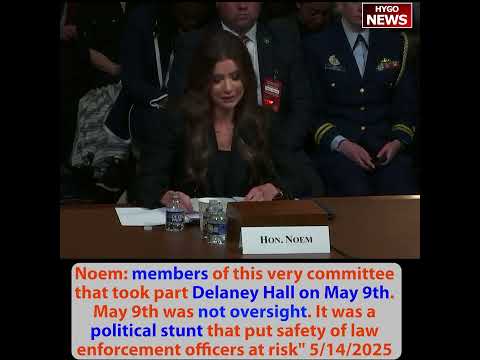
Noem: Delaney Hall Incident “Was Not Oversight — It Was a Political Stunt”; Border Encounters Down 93%, “Lowest in American History”
DHS Secretary Kristi Noem delivered blistering testimony to the House Committee on Homeland Security in May 2025. “There were members of this very committee that took part in an action at Delaney Hall on May 9th that need to be addressed,” Noem said. “I served in Congress for eight years. What happened on May 9th was not oversight. It was a political stunt that put the safety of our law enforcement officers, agents, staff, and detainees at risk.” She described the video evidence: “Members of Congress slamming their bodies into our law enforcement officers, shoving them, screaming profanities, striking them with their fists and otherwise assaulting law enforcement.” She reported border metrics: “Daily encounters down 93%. March saw the lowest numbers in American history at just 7,200."
"It Was a Political Stunt”
Noem opened her testimony by confronting the committee members directly.
“Now having previously served as a member of Congress, it’s my honor to be on this side of the dais to present as the Secretary of Homeland Security today,” Noem said.
She acknowledged the administrative agenda: “I’m proud to discuss the accomplishments of President Trump and all that he has accomplished since he’s taken office in the White House.”
She pivoted to the confrontation: “But first I would be remiss if I did not address the disturbing actions that we saw last week. There were members of this very committee that took part in an action at Delaney Hall on May 9th that need to be addressed.”
She invoked her own institutional experience: “I served as a member of Congress in this body for eight years, and I understand the importance of congressional oversight.”
She delivered the distinction: “What happened on May 9th was not oversight. It was a political stunt that put the safety of our law enforcement officers, our agents, our staff, and our detainees at risk.”
The direct confrontation was unusual for cabinet-level testimony. Secretaries typically delivered prepared remarks focused on their department’s agenda, engaging with specific members during the Q&A period. Noem was using her opening statement to name members of the committee as perpetrators of misconduct against her department’s personnel.
The “political stunt” characterization was precise. Oversight meant ordered review of government operations through established procedures — scheduled visits, authorized tours, formal inquiries. Political stunts meant unauthorized actions designed to generate media attention rather than to fulfill oversight responsibilities. The May 9 incident — in which Democratic House members had stormed an ICE facility without proper coordination — fit the stunt definition, not the oversight definition.
”Slamming Their Bodies”
Noem described the video evidence with specific detail.
“Here are the facts,” Noem said. “As a vehicle approached the security gate at Delaney Hall Detention Center, a mob of protesters, including three members of Congress, stormed the gate and they trespassed into the detention facility.”
She detailed the assault: “We have footage of those members of Congress slamming their bodies into our law enforcement officers, shoving them, screaming profanities in their faces, striking them with their fists, and otherwise assaulting law enforcement.”
She characterized the conduct: “The behavior was lawlessness, and it was beneath this body.”
She stated the principle: “Members of Congress should not break into detention centers or federal facilities.”
She described the proper procedure: “Had these members requested a tour, we certainly would have facilitated a tour. As the body knows, there are proper protocols and there are procedures that must be abided by.”
She noted the routine nature of legitimate visits: “These congressional members and staff visit our facilities all of the time, and these members could have followed the policies that have been in place, and they would have been followed. We would have facilitated a tour of this important facility.”
The detailed description of the assault was devastating. Democratic members had not merely violated administrative protocols; they had committed physical assault on federal officers. Under any other circumstances, such conduct would result in federal criminal charges — assault on federal officers carried penalties of up to eight years in prison. The only reason the members had not been arrested on the spot was the political sensitivity of detaining sitting members of Congress.
The “beneath this body” language was deliberately insulting in the congressional tradition — a formal way of saying that the members’ conduct dishonored the institution they served in.
The Tour That Happened Anyway
Noem revealed that the administration had provided the tour despite the misconduct.
“Even after these members assaulted our federal law enforcement officers, we still provided them with a tour of that facility,” Noem said.
She cited the members’ own conclusion: “I’m glad that at their press conference following the tour, these members acknowledged that Delaney Hall is in good condition and meets federal standards.”
She addressed the false claims: “Charges made by these politicians that Delaney does not have the proper permitting is false. We have valid permits and inspections for plumbing and electricity and fire codes that have been cleared.”
The fact that the administration had still provided the tour — despite the assault — demonstrated the agency’s commitment to transparency. Democrats could not credibly argue they had been denied access; they had been given the tour they had demanded, under duress, after assaulting officers to obtain it.
More importantly, the tour had confirmed that Democratic claims about the facility were false. The members had alleged that Delaney Hall lacked proper permits, had unsafe conditions, and housed vulnerable populations inappropriately. After seeing the facility, they acknowledged it met federal standards. The entire pretext for the May 9 assault — that conditions at the facility required immediate congressional intervention — had been fabricated.
Border Metrics
Noem pivoted to the border statistics that defined the administration’s success.
“We’ve delivered the most secure border in American history at the southern border,” Noem said. “We have obtained near total control with daily encounters down 93% since President Trump has been in office.”
She provided the specific comparison: “March saw the lowest numbers in American history of border encounters at just 7,200.”
She cited the Biden baseline: “Under the previous administration, U.S. Customs and Border Protection was at times under Joe Biden encountering over 15,000 people per day.”
She credited the turnaround: “This astonishing turnaround is a testament to the resolve and the leadership of President Trump to make America safe again. And it is also a testament to the incredible work done by the men and women of the Department of Homeland Security.”
The numerical contrast was staggering. Under Biden: 15,000+ encounters per day. Under Trump: 7,200 encounters per month. The daily rate had dropped from over 15,000 to roughly 240 — a reduction of approximately 98.4% on a daily basis.
The “lowest numbers in American history” claim was factually accurate. Border Patrol statistics went back decades, and the March 2025 figure was indeed the lowest monthly total on record. A border that had been defined by chaos during the Biden years was now more controlled than at any point in recorded American history.
Cartel Designations
Noem described the enforcement expansion.
“The secure border has allowed Border Patrol to zero in on fighting cartels and all of their illicit activities,” Noem said.
She described the strategic action: “Under President Trump’s leadership, six cartels for dangerous and criminal gangs have been designated as foreign terrorist organizations.”
She described the resulting approach: “This has allowed us to take a whole of government approach to address the illegal activity.”
The foreign terrorist organization designations were legally significant. FTO status allowed the U.S. government to freeze assets, prosecute supporters, and coordinate international action against designated organizations. Cartels like the Sinaloa Cartel, the Jalisco New Generation Cartel, MS-13, and Tren de Aragua now faced the same legal framework that had previously been reserved for groups like al-Qaeda and ISIS.
The practical implications were far-reaching. Banks that facilitated cartel finances faced prosecution. Americans who aided cartel operations could be charged with providing material support to terrorists. International cooperation on cartel enforcement could proceed under the same frameworks that supported counter-terrorism operations. The cartels — which had operated with relative impunity during decades of border openness — were now priority targets of the full American security apparatus.
Key Takeaways
- Noem to committee: “What happened May 9 was not oversight. It was a political stunt that put our officers, staff, and detainees at risk.”
- Members of Congress caught on video “slamming bodies into officers, shoving, screaming profanities, striking with their fists.”
- The tour was provided anyway; members acknowledged Delaney Hall “meets federal standards” — exposing the false claims about permits.
- Border encounters down 93% since Trump inauguration. March: “Lowest numbers in American history at 7,200.”
- Six cartels designated as foreign terrorist organizations, enabling “whole of government approach” to cartel illicit activity.