 HYGO News
 Sen. Kennedy on DOE Biden Era: '$99B New Appropriations, $30B Authorizations, $400B Loan Authority -- 20% Headcount Growth, 2% Electricity Output, 28% Cost Increase'; 'Tired of the Spending Porn'; Stellantis $7.5B, Blue Oval $9.6B Questioned
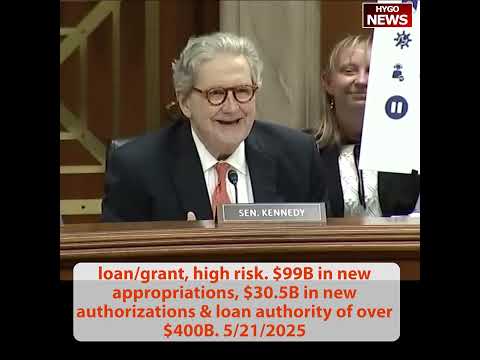
Sen. Kennedy on DOE Biden Era: “$99B New Appropriations, $30B Authorizations, $400B Loan Authority — 20% Headcount Growth, 2% Electricity Output, 28% Cost Increase”; “Tired of the Spending Porn”; Stellantis $7.5B, Blue Oval $9.6B Questioned
Senator John Kennedy (R-LA) continued his devastating questioning of Energy Secretary Chris Wright with a forensic examination of Biden-era DOE spending. “We had a party around here under the Biden administration. And when you have a party, you have to pay the band when the party’s over. As a result of the party, if you count the Inflation Reduction Act, which was the Green New Deal, the Infrastructure Investment and Jobs Act, also part of the Green New Deal, the Chips and Science Act, your department got $99 billion in new appropriations, $30.5 billion in new authorizations, and loan authority of over $400 billion. Nearly $100 billion” of that loan authority used. Results: “Headcount grew over 20% during those four years. Our electricity output grew about 2% and the cost per unit of electricity grew 28%.” On the Chinese companies: “DOE announced it was going to make a $400 million grant to two companies. Then somebody pointed out they were Chinese companies.” On the specific loans: “Stellantis $7.5 billion. Blue Oval $9.6 billion. Why?” Kennedy’s solar plant example: “Gentleman putting up $1 billion. American taxpayer puts up $850 million.” Kennedy closed: “I’m tired of the spending porn."
"Party Under the Biden Administration”
Kennedy opened with rhetorical framing that captured the scale.
“We had a party around here under the Biden administration,” Kennedy said. “And when you have a party, you have to pay the band when the party’s over.”
He laid out the financial scope: “As a result of the party, if you count the Inflation Reduction Act, which was the Green New Deal, the Infrastructure Investment and Jobs Act, also part of the Green New Deal, the Chips and Science Act, your department got $99 billion in new appropriations, $30.5 billion in new authorizations, and loan authority of over $400 billion.”
The total fiscal commitment through DOE:
- $99 billion: Direct appropriations for spending
- $30.5 billion: Additional authorization for spending
- $400+ billion: Loan authority to back projects
Combined, this was approximately $530+ billion in fiscal firepower. The Department of Energy had typically operated with annual budgets around $30-40 billion. The Biden-era funding increased DOE’s financial resources approximately tenfold on a four-year basis.
The “Green New Deal” framing of IRA and IIJA was politically charged but substantively defensible. The IRA (Inflation Reduction Act) and IIJA (Infrastructure Investment and Jobs Act) had:
- Included massive clean energy subsidies
- Funded renewable energy infrastructure
- Supported electric vehicle manufacturing
- Promoted battery storage development
- Backed various “green” technologies
While Democrats had not called these bills “Green New Deal” legislation, their substantive content matched much of what the original Green New Deal proposal had advocated. The renaming as “Inflation Reduction” had been branding rather than substantive policy change.
Loan Authority Usage
Kennedy focused on a specific metric.
“How much of that $400 billion authority to loan money did the Department of Energy use?” Kennedy asked.
Wright confirmed: “Nearly $100 billion, nearly $100 billion.”
The $100 billion in loans was roughly equal to the entire annual budget of the Department of Homeland Security. This was not small-scale lending for energy startups; it was massive capital deployment comparable to major federal agencies’ entire operations.
The loan program office (LPO) at DOE had historically operated modestly, occasionally making loans for specific energy projects. The Obama administration’s Solyndra controversy had made DOE cautious about loan program expansion. Under Biden, the loan program had been dramatically expanded with massive authority and aggressive lending.
The result was that DOE became essentially a large-scale development bank, lending tens of billions to various energy companies. This transformed DOE’s core function from technical oversight and research to financial intermediation.
The Results
Kennedy laid out the outcome metrics.
“Thank you for making the point that more money as is shown in your graph and the numbers you quoted and more people, the head count of the department grew over 20% during those four years,” Kennedy said.
He compared to results: “Our electricity output of the nation as a whole grew about 2% and the cost per unit of electricity grew 28%.”
He made the conclusion: “Well, here’s what this is. We didn’t deliver results for all that.”
The metrics Kennedy cited were devastating:
DOE headcount growth: 20%+ increase. This reflected the massive new programs being administered.
National electricity output growth: 2%. Despite massive federal investment in new generation, total electricity produced grew modestly.
Cost per unit of electricity: 28% increase. Consumers paid dramatically more for electricity despite the federal investment.
The combination was damning. The federal government had spent hundreds of billions, employed thousands more people at DOE, and:
- Produced only small output growth
- Caused large cost increases
Traditional economic logic predicted that massive investment in new generation would increase output substantially and potentially reduce per-unit costs through scale economies. The Biden-era experience had produced the opposite: modest output growth combined with dramatic cost increases.
The causes of this perverse outcome included:
- Subsidies for expensive renewable energy while restricting cheap fossil fuels
- Grid interconnection challenges with variable renewable sources
- Supply chain disruptions affecting equipment costs
- Labor cost increases in construction
- Regulatory burden on new projects
- Inefficient allocation of federal resources
”High Risk” Loans
Kennedy cited the Inspector General’s findings.
“The Inspector General called many of these loans quote, ‘high risk, high risk,’” Kennedy said.
He explained the IG’s characterization: “And he said that these loans were designed to promote innovation by financing projects, fine, not otherwise acceptable by private equity and investors.”
He delivered the key implication: “What does that mean? That means that the private sector wouldn’t get near these projects with a 10 foot pole, would they? Only government would put up the money, wouldn’t it?”
Wright confirmed: “That’s correct.”
The IG’s characterization was devastating. The loans DOE had been making were:
- Not commercially viable (private investors wouldn’t fund them)
- High risk (probability of default was substantial)
- Subsidizing unprofitable projects (defying normal market discipline)
- Using taxpayer money where private money wouldn’t go
This directly contradicted how federal loan programs were supposed to work. The traditional theory was that federal loans should fill gaps in private capital markets where good projects couldn’t access capital. If projects were commercially viable, they should be financed privately. Federal loans should be limited to addressing genuine capital market gaps.
In practice, DOE had been funding projects that were not commercially viable. The “capital market gap” had been created by the unviability of the projects themselves, not by market imperfections in viable projects. This was fiscally and economically problematic.
The Chinese Companies
Kennedy cited a specific embarrassing incident.
“For example, he found that DOE under your predecessor announced that it was gonna make a $400 million loan,” Kennedy said.
He corrected himself: “Actually, it wasn’t a loan, it was a grant to two companies.”
He described the process: “Then they announced it. And then somebody pointed out to them that they were Chinese companies.”
He noted the outcome: “They had to pull the grant back.”
The Chinese company incident was the kind of procedural failure that made Biden-era DOE notorious. The sequence had been:
- DOE program officers identified two companies for $400 million in grants
- Grants were approved through internal processes
- Grants were publicly announced
- Someone (presumably outside DOE) noticed the companies were Chinese
- Grants were withdrawn
The incident revealed: Inadequate vetting: Basic due diligence had not identified the companies as Chinese Political blindness: No one had considered whether subsidizing Chinese companies was politically appropriate Bureaucratic capture: Program officers had prioritized their substantive interest in the projects over broader policy considerations Lack of oversight: Senior officials had not reviewed the grants before announcement
This was emblematic of Biden-era regulatory failures. Rather than single-point failures, there had been systematic breakdowns in basic government processes.
”Why Are We Loaning $7.5 Billion to Stellantis?”
Kennedy got specific about major loans.
“This is another issue brought out by the Inspector General,” Kennedy said. “Why are we loaning $7.5 billion to Stellantis?”
He asked the underlying question: “They can’t get a bank loan themselves. I mean, J.P. Morgan and Bank of America have been shoving money out the door for energy projects.”
He cited another loan: “Why did we own $9.63 billion to Blue Oval? Why are we doing all of this?”
Stellantis was the parent company of Chrysler, Dodge, Jeep, Ram, Fiat, Peugeot, and various other car brands. With approximately $190 billion in annual revenue and operations in dozens of countries, Stellantis was one of the world’s largest automakers. The company was profitable and had strong access to capital markets.
A $7.5 billion federal loan to Stellantis was not addressing capital market gaps. Stellantis could easily borrow $7.5 billion commercially if needed for viable projects. The federal loan subsidized Stellantis’s cost of capital, essentially transferring taxpayer wealth to the multinational corporation’s shareholders.
Blue Oval was Ford’s battery manufacturing joint venture with SK On. The $9.6 billion federal loan similarly subsidized major corporate operations that could have been funded commercially. Ford’s market cap was approximately $50 billion; the company had obvious access to capital markets.
These massive subsidies to major corporations contradicted the stated purpose of DOE loan programs. Rather than addressing capital market gaps for innovative projects, DOE was providing below-market capital to large corporations for projects those corporations would have undertaken anyway.
The Solar Manufacturing Example
Kennedy cited a specific current situation.
“I’m gonna quickly give you an example,” Kennedy said. “I had a gentleman, I’m not gonna use any names, coming to my office yesterday. He’s from a very wealthy family in another country. He wants to build a solar manufacturing plant in America.”
He laid out the deal: “He’s putting up a billion dollars. You know how much the American taxpayer is gonna put up? $850 million.”
He delivered the analysis: “So he’s gonna get, thanks to the American taxpayer, a billion dollar plant for $150 million to produce solar panels. What’s the world is a wash in?”
He delivered the judgment: “This is unconscionable. And I hope you’ll do something about it, Mr. Secretary.”
Kennedy’s specific example captured the perverse economics of DOE programs:
- Foreign wealthy family investing $1 billion
- American taxpayers providing $850 million
- Total project cost $1.85 billion
- Foreign family’s effective contribution: $150 million for a $1 billion plant
- Foreign family’s effective return multiplier: 6.7x just from the subsidy
- Product: solar panels (commodity product with global oversupply)
The solar panel market was already oversupplied globally. Chinese manufacturers had dramatic cost advantages from scale and subsidies. American solar manufacturing faced structural disadvantages that federal subsidies could partially offset but not fundamentally solve. The result was taxpayer subsidies funding uneconomic production of commodity products that would likely struggle commercially regardless of subsidies.
”Spending Porn”
Kennedy closed with his signature phrase.
“Now at some point, we’re gonna get real specific about savings,” Kennedy said. “And I’m gonna expect you to get real specific with us.”
He acknowledged legitimate spending: “I don’t wanna not fund anything that’s vital.”
He delivered his conclusion: “But I’m tired of the spending porn. I’m tired of it.”
He closed with appreciation: “I think you have good reason to be concerned with how monies have been deployed outside of the loan program office and for other assistance as well.”
“Spending porn” was Kennedy’s characteristic phrase for excessive government expenditure. The analogy was pointed: just as pornography was visually stimulating but ultimately unsatisfying and destructive, spending porn provided political stimulation (federal dollars flowing to favored constituencies) without delivering genuine benefits (useful outputs or sustainable outcomes).
The comparison also captured the addictive quality of federal spending. Each program’s recipients became constituencies defending continued funding. Political figures could claim credit for programs they advocated. Media coverage of programs tended to be positive. The result was a steady expansion of spending without corresponding accountability for results.
Kennedy’s “vital” caveat was important. He was not arguing against all federal spending or even most federal spending. He was arguing against the specific pattern of spending that produced:
- Large numbers without corresponding results
- Subsidies to entities that didn’t need subsidies
- Projects that served political rather than substantive purposes
- Expenditures that grew recurring costs without benefit
Wright’s Position
Wright’s brief response indicated alignment.
“And I think you have good reason to be concerned with how monies have been deployed outside of the loan program office and for other assistance as well,” Wright said.
The “good reason to be concerned” framing was endorsement of Kennedy’s critique while maintaining diplomatic form. As an administration official, Wright could not openly attack specific predecessor decisions. But he could acknowledge that the concerns Kennedy raised were legitimate.
The Broader Reform Agenda
The Kennedy-Wright exchange illustrated how the Trump administration was approaching federal reform:
Forensic accounting: Careful examination of how federal dollars had been spent in prior administration.
Results orientation: Asking what outcomes had been produced for money spent.
Market discipline: Applying private sector logic about capital allocation and project viability.
Public accountability: Senate hearings creating documentary record of past failures.
Reform direction: Using identified failures to justify new approaches and discontinuation of wasteful programs.
This represented a significant institutional response to what Republicans had long considered wasteful federal spending. Rather than merely complaining about spending levels, the administration was documenting specific failures and using those failures to justify specific reforms.
The OBBB and various other Trump policies would roll back many of the Biden-era programs Kennedy had critiqued. The IRA subsidies would be substantially reduced. The loan programs would be restricted. The ideological direction of DOE would shift from renewable energy emphasis to all-of-the-above approach with substantial nuclear emphasis.
Key Takeaways
- Biden DOE: “$99B new appropriations, $30.5B authorizations, $400B loan authority ($100B used).”
- Results: “20% headcount growth, 2% electricity output growth, 28% cost per unit increase.”
- IG called many loans “high risk” — for projects private equity wouldn’t touch.
- $400M grant to two Chinese companies until someone pointed that out; Stellantis $7.5B and Blue Oval $9.6B questioned.
- Solar plant example: “Foreign family puts $1B, American taxpayer puts $850M — $1B plant for $150M.”
- Kennedy: “I’m tired of the spending porn.”