 HYGO News
 Massive omnibus spending increase: last year $6.3T vs $4.4T in 2019; 23% more than $1.3T than 2019
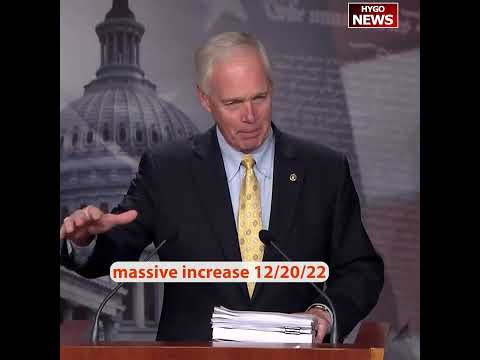
Senator: Federal Spending $6.3T Last Year vs $4.4T in 2019 — Discretionary Spending 23% Higher Than Pre-Pandemic
On 12/22/2022, a Republican senator provided stark spending comparison data while criticizing the omnibus. “Nobody talks about the numbers, I mean, in total, the macro numbers, I thought it was interesting last week as I was asking my colleagues and quite honestly a number of you reporters, just the simple question, do you know how much we spent last year? And the blank stares I got for most people,” the senator said. “The answer is $6.3 trillion last year. To compare that to before the pandemic in 2019, we spent $4.4 trillion. The discretionary side, less than 70% of what we spend is gonna be $1.65 trillion, which is 23% more than the $1.3 trillion we spent in 2019.” The data illustrated dramatic spending growth that had occurred during and after the pandemic.
The Spending Comparison
The senator cited specific numbers:
Last year (FY 2022) — $6.3 trillion total.
Pre-pandemic (FY 2019) — $4.4 trillion total.
Increase — Approximately $1.9 trillion.
Percentage growth — About 43% over 3 years.
Without inflation adjustment — These were nominal figures.
These numbers were:
Staggering in scale — Trillions of dollars.
Dramatic growth — Over short period.
Context requiring — For understanding.
Policy implications — Significant.
Political weight — In debate.
The 43% nominal growth in three years was extraordinary. Even accounting for:
Pandemic emergency — Major driver.
Inflation — Reducing real growth.
Population growth — Small factor.
Normal program growth — Modest.
Interest costs — Growing.
The real growth was still historically significant.
The “Blank Stares”
The senator made a point about public awareness. “I thought it was interesting last week as I was asking my colleagues and quite honestly a number of you reporters, just the simple question, do you know how much we spent last year? And the blank stares I got for most people,” the senator said.
The blank stares reflected:
Limited public knowledge — Of federal spending levels.
Abstract numbers — Hard to grasp.
Media coverage — Focused on specifics.
Political messaging — On individual programs.
Scale beyond comprehension — For most.
Even:
Elected officials — Uncertain about totals.
Reporters covering Congress — Unfamiliar with macro.
Political staff — Focused on specifics.
Engaged citizens — Missing big picture.
Budget committee members — Might know.
The senator’s point was that debate about specific provisions missed the fundamental spending growth context. Without knowing that total federal spending had grown from $4.4 trillion to $6.3 trillion, individual provisions couldn’t be evaluated against scale.
The Discretionary Spending Data
The senator provided detailed breakdown. “The discretionary side, less than 70% of what we spend is gonna be $1.65 trillion, which is 23% more than the $1.3 trillion we spent in 2019,” the senator said.
The discretionary spending:
$1.65 trillion — Current year.
$1.3 trillion — 2019 baseline.
23% increase — In nominal terms.
Less than full inflation — Maybe real growth.
Represents annual choices — Congress makes.
Discretionary vs. mandatory spending:
Discretionary — Annual appropriations.
Mandatory — Entitlements (Medicare, Social Security).
Interest — On debt, growing.
Each with different dynamics — For growth.
Political attention varied — Across types.
The 23% discretionary growth was concerning because:
Direct Congressional choice — Not automatic.
Could have been different — With restraint.
Reflected decisions — Not just mandatory growth.
Policy implications — For future.
Inflation contributions — Potentially.
The 2019 Baseline
The senator used 2019 as baseline:
Pre-pandemic normal — Before emergency.
Stable economy — Growing economy.
Reasonable comparison — For “normal” spending.
Before emergency measures — That became permanent.
Democratic benchmark — For meaningful comparison.
The 2019 baseline was important because:
Pandemic spending — Was supposed to be temporary.
Emergency measures — Expected to wind down.
Normal operations — Should return.
Specific emergencies — Justified temporary growth.
Sustained higher spending — Required explanation.
The comparison showed that pandemic-era spending increases had become baseline rather than temporary. The federal government was operating at permanently higher spending levels than pre-pandemic.
The Public Communication Challenge
The senator’s data illustrated communication challenges:
Trillion-dollar scale — Difficult to grasp.
Short-term comparisons — More accessible.
Per-capita figures — Sometimes more meaningful.
Percentage terms — Often clearer.
Historical trends — Need context.
Politicians often struggled to communicate:
Budget totals — Meaningfully.
Growth rates — In accessible terms.
Specific items — In context.
Impact on households — Clearly.
Long-term implications — Concretely.
The senator’s “blank stares” observation captured how even politically engaged people struggled with these numbers.
The Pandemic Context
The 2019-2022 growth reflected the pandemic:
Emergency spending — COVID response.
Economic stimulus — Various programs.
Public health — Vaccines, treatments, testing.
Individual payments — Direct stimulus.
Business support — PPP and similar.
State/local aid — Significant amounts.
Much of this was:
Genuinely emergency — Pandemic-related.
Short-term in design — Meant to be temporary.
Extended through time — By continued emergency.
Embedded in baseline — Increasingly.
Difficult to remove — Politically.
The challenge was distinguishing:
Genuine pandemic response — That ended.
Programs that persisted — Beyond emergency.
Baseline increases — From temporary spending.
Future commitments — From emergency authorizations.
Reform opportunities — As emergency ended.
The Political Debate
The spending growth debate had partisan dimensions:
Republican concern — About growth rates.
Democratic defense — Of specific programs.
Bipartisan involvement — In specific votes.
Trump-era spending — Also high.
Biden-era continuation — Of high levels.
Both parties had contributed to spending growth:
Trump administration — Supported pandemic spending.
Biden administration — Continued and added.
Republican Congress — Some opposition, some support.
Democratic Congress — Mostly supportive.
Leadership deals — Bipartisan in nature.
The senator’s critique wasn’t purely partisan. It was:
Fiscal conservative — Within Republican Party.
Process-focused — On deliberation.
Long-term concerned — About debt.
Comprehensive — Across parties.
Consistent — Over time.
The Historical Context
Federal spending had grown dramatically over decades:
1990s — Generally restrained.
2000s — Post-9/11 growth.
2008-2009 — Financial crisis.
2010s — Relatively stable.
2020-2022 — Pandemic explosion.
Post-pandemic — Uncertain trajectory.
Each crisis had ratcheted spending upward. Crisis spending rarely returned to pre-crisis levels. The pattern was:
Emergency increases — Necessary.
Transition difficulty — Back to normal.
Program embedding — In baselines.
Baseline increases — Permanent.
Next crisis — Starts from higher base.
The senator’s specific concern was that pandemic-era spending had become baseline. Without deliberate effort to return to lower levels, the higher spending would continue indefinitely.
The Inflation Connection
High federal spending connected to inflation:
Fiscal policy — Affects money supply.
Demand effects — On prices.
Administration spending — Over Fed tightening.
Working at cross-purposes — Sometimes.
Inflation persistence — Partly fiscal.
Economists debated:
Fiscal contribution — To inflation.
Monetary policy primacy — Over fiscal.
Specific program effects — On prices.
Supply-side issues — Beyond demand.
Global factors — Independent of fiscal.
The senator’s critique connected to inflation concerns that affected voters directly. Americans experiencing higher prices could link this to federal spending through political messaging.
The Debt Implications
Growth in spending without corresponding revenue meant growing debt:
$31 trillion debt — In late 2022.
$1+ trillion annual deficits — Continuing.
Interest costs growing — Significantly.
Future constraints — From debt service.
Generational transfer — To future taxpayers.
The senator’s concerns about “children’s future” and debt connected to this data. The $1.9 trillion growth from 2019 to 2022 was largely debt-financed. Each dollar of spending above revenue:
Added to federal debt — Directly.
Required future interest — Compounding.
Reduced future flexibility — Significantly.
Committed future citizens — To repayment.
Limited future programs — By servicing costs.
The Senator’s Pattern
The senator’s pattern of spending criticism:
Consistent concern — About fiscal discipline.
Multiple bills targeted — Over time.
Process and substance — Both criticized.
Public education efforts — Through speeches.
Media engagement — For reach.
Individual senators rarely affected outcomes. But sustained advocacy could:
Shift political debate — Over time.
Build public awareness — Of fiscal concerns.
Establish political positioning — For senator.
Influence future reforms — When possible.
Create accountability — For voting records.
The Reform Pathway
The senator’s data suggested reform pathways:
Return to 2019 baseline — Where possible.
Strip pandemic-era spending — That became baseline.
Process reforms — For appropriations.
Fiscal discipline — Through statute.
Long-term planning — Beyond year-to-year.
Specific reforms could include:
Sunset provisions — On emergency spending.
Automatic review — Of baseline increases.
Spending caps — Enforced.
Balanced budget — Constitutional amendment.
Biennial budgeting — Instead of annual.
None had been implemented. The senator’s data illustrated the cumulative cost of reform absence.
The Media Coverage
The senator’s specific numbers provided media content:
Concrete figures — For coverage.
Clear comparisons — For audience.
Partisan ammunition — For both sides.
Historical perspective — For context.
Memorable soundbites — From clear data.
But media coverage of specific numbers competed with:
Political drama — More engaging.
Specific provisions — More immediate.
Personal stories — More emotional.
Campaign politics — More current.
Policy debates — More specific.
Large aggregate spending numbers struggled to get sustained attention despite their significance.
Key Takeaways
- A Republican senator cited specific data: federal spending was $6.3 trillion in FY 2022 vs. $4.4 trillion in 2019 — a 43% nominal increase.
- Discretionary spending alone was $1.65 trillion — 23% higher than the $1.3 trillion in 2019.
- The senator noted that most colleagues and reporters couldn’t answer basic questions about total federal spending.
- The comparison illustrated that pandemic-era spending had become baseline rather than temporary.
- The growth implied growing federal debt, which had reached $31 trillion by late 2022.
- The data connected to inflation concerns that affected voters directly.
- The senator’s consistent criticism represented fiscal conservative positioning, though reform had proved elusive despite regular concerns.
Transcript Highlights
The following is transcribed from the video audio (unverified — AI-generated from audio).
- Nobody talks about the numbers, I mean, in total, the macro numbers.
- I thought it was interesting last week as I was asking my colleagues and quite honestly a number of you reporters, just the simple question, do you know how much we spent last year?
- The blank stares I got for most people.
- The answer is $6.3 trillion last year. To compare that to before the pandemic in 2019, we spent $4.4 trillion.
- The discretionary side, less than 70% of what we spend is gonna be $1.65 trillion, which is 23% more than the $1.3 trillion we spent in 2019.
- That is a massive increase in the last year.
Full transcript: 139 words transcribed via Whisper AI.