 HYGO News
 Lankford Spars with Yellen on Billionaire Bailout Paid for by Oklahoma Community Banks
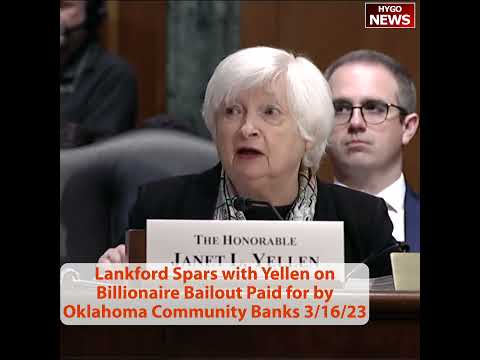
Lankford Spars with Yellen on Billionaire Bailout Paid for by Oklahoma Community Banks
Sen. James Lankford (R-Okla.) sharply challenged Treasury Secretary Janet Yellen during March 2023 Senate Finance Committee testimony, pressing her on whether the administration’s Silicon Valley Bank and Signature Bank depositor guarantees would accelerate deposit flight from community banks to big banks. Lankford argued the de facto policy created a two-tiered system: if a depositor placed money in a “preferred” bank the government deemed systemically important, they were fully insured; if they chose a community bank, they were not — a disparity he said would “accelerate” the decade-long trend of bank consolidation.
The Hearing Context
- Senate Finance: Yellen appeared before the Senate Finance Committee during tense banking-system testimony.
- Bank failures: Silicon Valley Bank collapsed March 10, 2023, followed by Signature Bank on March 12.
- Systemic risk exception: Regulators invoked the systemic risk exception to guarantee all SVB and Signature deposits regardless of the $250,000 FDIC insurance cap.
- First Republic stress: First Republic Bank was under severe deposit flight pressure at the time of the hearing.
- Political firestorm: The interventions became known among critics as a “billionaire bailout” since wealthy SVB depositors were made whole.
Lankford’s Consolidation Concern
- Decade trend: Lankford noted bank mergers had accelerated over the preceding decade, concentrating assets in fewer institutions.
- Preferred bank framing: He argued the government’s intervention effectively created categories of “preferred” banks.
- Community bank disadvantage: Depositors with large balances at community banks now faced structural incentive to move funds to big banks.
- Two-tier system: The de facto implication was full coverage at systemic banks, $250,000 limit at community banks.
- Oklahoma focus: As a senator from Oklahoma, Lankford emphasized implications for rural and community banking.
Yellen’s Defense
- “Not encouraging”: The Treasury Secretary said the administration was “certainly not encouraging” deposit flight from community banks.
- Market reaction: Yellen attributed deposit movement to depositor concerns about bank failures, not administration policy.
- Systemic risk framing: She maintained that the SVB and Signature interventions were necessary to prevent broader contagion.
- Institution neutrality: The Secretary argued the interventions protected the banking system generally, not specific institutions.
- Community bank health: Yellen emphasized that community banks remained fundamentally sound and well-capitalized.
The De Facto Insurance Two-Tier
- Lankford’s rebuttal: The senator directly challenged Yellen’s framing, arguing the dynamic was driven by the administration’s policy choice.
- Full insurance signal: SVB and Signature depositors received effectively unlimited insurance via the systemic risk exception.
- Community bank limits: Community bank depositors remained limited to the $250,000 FDIC standard.
- Rational response: Large depositors responding rationally would move funds to institutions with implicit unlimited coverage.
- Policy consequence: The hearing argued government action caused the deposit flight, not just bank failures.
The Systemic Risk Exception
- FDIC authority: The Federal Deposit Insurance Corporation can invoke a systemic risk exception with approval from Treasury, Fed, and the president.
- SVB precedent: March 12 determination of systemic risk authorized full SVB depositor coverage.
- Signature precedent: Same-day determination covered Signature Bank depositors equally.
- First Republic question: Speculation focused on whether the exception might extend to First Republic.
- Moral hazard: Critics argued repeated systemic risk exceptions eroded deposit insurance discipline.
The “Billionaire Bailout” Framing
- SVB depositor profile: Silicon Valley Bank primarily served technology companies and venture capital firms with large deposits.
- Uninsured amounts: Approximately 93% of SVB deposits exceeded the $250,000 FDIC insurance cap.
- Wealthy beneficiaries: Full coverage primarily benefited wealthy individuals and corporate depositors.
- Peter Thiel coverage: Peter Thiel’s Founders Fund was among high-profile SVB depositors protected by the intervention.
- Populist critique: Both progressive Democrats and conservative Republicans criticized the perceived disparity.
Community Banking Importance
- Rural banking: Community banks disproportionately serve rural America and small business borrowing.
- Relationship banking: Small banks typically maintain closer customer relationships than large institutions.
- Economic impact: Community bank decline can accelerate rural economic disadvantage.
- Political constituency: Community bankers form a significant political constituency, particularly for Republican senators from agricultural states.
- ICBA advocacy: The Independent Community Bankers of America actively advocated against the two-tier insurance structure.
The Funding Mechanism
- DIF replenishment: The FDIC’s Deposit Insurance Fund would be replenished through special assessments on other banks.
- Community bank burden: Critics argued community banks would disproportionately fund the bailout of large-bank depositors.
- FDIC fee structure: Proposals to weight assessments toward larger institutions emerged in subsequent weeks.
- Statutory limits: FDIC assessment authority has statutory constraints requiring congressional attention for major changes.
- Political flash point: The funding mechanism became its own political controversy separate from the initial interventions.
Broader Policy Implications
- Deposit insurance reform: Senators across parties called for reconsidering the $250,000 insurance cap.
- Regulatory tiering: Questions emerged about whether medium-sized banks faced inadequate regulation.
- 2018 rollback scrutiny: Criticism focused on the 2018 legislation that raised the threshold for enhanced regulation from $50 billion to $250 billion.
- Fed supervision gap: Federal Reserve stress-test requirements for banks in the $50-250 billion range came under scrutiny.
- Signature crypto concern: Signature Bank’s cryptocurrency exposure raised separate questions about regulatory gaps.
Key Takeaways
- Sen. Lankford pressed Yellen on how the SVB and Signature interventions would prevent accelerated deposit flight from community banks to big banks.
- The senator framed the situation as creating a two-tier insurance system: full coverage at systemically important banks, $250,000 limit at community banks.
- Yellen insisted the administration was “not encouraging” deposit movement, attributing it to market reaction to bank failures.
- Lankford directly rebutted that framing, arguing the administration’s policy was driving the consolidation trend.
- The exchange highlighted broader concerns about the “billionaire bailout” framing critics applied to the SVB depositor coverage.
- Community bankers and their political allies raised alarm about the structural disadvantages the interventions created for smaller institutions.
Transcript Highlights
The following quotations are drawn from an AI-generated Whisper transcript of the hearing and should be considered unverified pending official transcript release.
- “What is your plan to keep large depositors from moving their funds out of community banks into the big banks?” — Sen. James Lankford
- “I’m concerned you’re about to accelerate that by encouraging anyone who has a large deposit in a community bank to say, we’re not going to make you whole.” — Sen. James Lankford
- “If you go to one of our preferred banks, we will make you whole at that point.” — Sen. James Lankford
- “That’s certainly not something that we’re encouraging. That is happening right now. That is happening because depositors are concerned about the bank failures.” — Janet Yellen
- “It’s happening because you’re fully insured, no matter what the amount is. If you’re in a big bank, you’re not fully insured if you’re in a community bank.” — Sen. James Lankford
- “We have seen the mergers of banks over the past decade.” — Sen. James Lankford
Full transcript: 162 words transcribed via Whisper AI.