 HYGO News
 Trump Arrives in Rome: Told Netanyahu 'You Got to Be Good to Gaza'; Blasts Sanctuary City Judges; 'We'll Set the Tariff'
Trump Arrives in Rome: Told Netanyahu “You Got to Be Good to Gaza”; Blasts Sanctuary City Judges; “We’ll Set the Tariff”
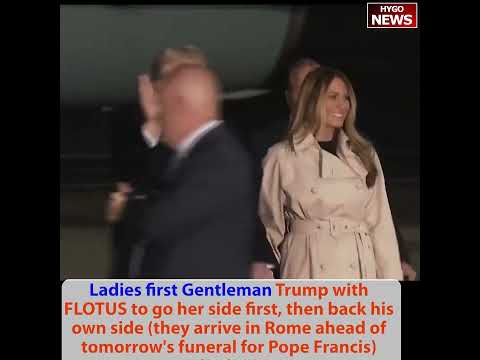
President Trump and First Lady Melania arrived in Rome ahead of Pope Francis’s funeral in April 2025, with Trump fielding questions on multiple fronts. On Gaza, he revealed his conversation with Netanyahu: “Gaza came up and I said, ‘You got to be good to Gaza.’ Those people are suffering. There’s a very big need for food and medicine, and we’re taking care of it. We’re pushing people very hard.” On sanctuary cities, Trump denounced judicial overreach: “It’s unbelievable when a judge in San Francisco or San Diego does nationwide injunctions. Sanctuary cities are sanctuary for criminals.” On tariffs, he confirmed the dual-track approach: “We’ll have deals made, but we’ll also make deals — in other words, we’ll just set the tariff and we’ll be reasonable, very reasonable, and that’ll be the end."
"You Got to Be Good to Gaza”
Trump disclosed the substance of his conversation with Prime Minister Netanyahu with unusual directness.
“Gaza came up and I said, ‘You got to be good to Gaza,’” Trump said. “Those people are, those people are suffering.”
He described the need: “There’s a very big need for food and medicine. We’re taking care of it.”
He described the challenge: “It turns out like opening up the access — very hard to get food and medicine into Gaza.”
He confirmed he was applying pressure: “We’re pushing people very hard. We’re pushing Israelis to open up accesses.”
When asked how Netanyahu responded, Trump was brief: “Well, they’ll call back.”
The “you got to be good to Gaza” statement was the most direct public evidence that Trump was pressing Israel on humanitarian conditions in the territory. While maintaining strong support for Israel’s security operations, Trump was simultaneously demanding that the civilian population receive food and medicine — a position that reflected both humanitarian concern and strategic calculation.
The humanitarian dimension was genuine. Gaza’s civilian population — millions of people, the majority of whom were women and children — had been caught in a devastating conflict. Food shortages, medical supply disruptions, and infrastructure destruction had created a humanitarian crisis that the international community was demanding be addressed.
The strategic dimension was equally important. America’s credibility as a peace broker in the Middle East depended on being seen as concerned with all populations, not just allies. By publicly pressuring Netanyahu on Gaza aid, Trump demonstrated to the Arab world — including the Abraham Accords partners and potential new signatories — that American engagement meant genuine advocacy for all parties.
The “they’ll call back” response to the Netanyahu question suggested that the conversation had created real pressure. Netanyahu had not immediately agreed, but neither had he rejected Trump’s demand. The diplomatic follow-up was underway.
Sanctuary City Judges
Trump addressed a federal judge’s decision to block the administration’s effort to defund sanctuary cities.
“It’s unbelievable when you hear a judge in San Francisco or a judge in San Diego does nationwide injunctions,” Trump said.
He described the absurdity: “A judge can close down — sitting behind a bench, a local bench” — issuing orders that affected the entire country.
He stated the principle: “Sanctuary cities are sanctuary for criminals.”
The nationwide injunction problem had become one of the most contentious constitutional issues of the Trump presidency. A single federal district judge — appointed by a previous president, serving in a jurisdiction chosen by the plaintiffs specifically because of its ideological orientation — could issue an order that blocked a presidential policy across all fifty states.
The practice meant that any policy the administration implemented could be challenged in the most hostile possible jurisdiction, with a single judge effectively overruling the President of the United States on matters of national policy. Immigration enforcement, tariff implementation, executive orders — all were vulnerable to the nationwide injunction weapon.
Trump’s characterization of sanctuary cities as “sanctuary for criminals” was the administration’s core argument. Sanctuary city policies — which prohibited local law enforcement from cooperating with federal immigration authorities — created safe havens for illegal immigrants who had committed crimes. When a city refused to honor an ICE detainer on an illegal immigrant arrested for a crime, that individual was released back into the community rather than transferred to federal custody for deportation.
”We’ll Set the Tariff”
Trump provided the clearest explanation of the administration’s dual-track trade strategy.
“We’ll have deals made, but we’ll also make deals,” Trump said. “In other words, we’ll just set the tariff and we’ll be reasonable, very reasonable, and that’ll be the end.”
He explained the leverage: “We set the price. They want to come in.”
He noted the asymmetry: “Now they set the price for their country, but everybody wants to come into our market.”
He addressed market concerns: “When you look at what’s happening, I said there’d be a transition. People haven’t understood it. Now they’re starting to understand it.”
He stated the fiscal case: “We’ve lost billions of dollars per day for years on trade. Now we’re going to make millions of dollars a day. This is such a statement.”
The “we’ll set the tariff” formulation clarified that the administration had two approaches running simultaneously. The first was negotiated deals — bilateral agreements where countries offered concessions in exchange for lower tariff rates. The second was unilateral tariff-setting — for countries that refused to negotiate or couldn’t reach acceptable terms, the United States would simply set the tariff rate and let the market adjust.
The “reasonable, very reasonable” qualifier was important. Trump was not proposing punitive rates designed to destroy trade relationships. He was proposing rates that reflected the true cost of the trade imbalances — rates that were fair rather than free, that protected American workers while still allowing international commerce.
The Rome Arrival
Trump and Melania arrived in Rome with the understated elegance that had characterized their international appearances. The trip — departing Washington Friday morning, attending the funeral Saturday, returning Saturday evening — was designed as a rapid diplomatic deployment rather than a state visit.
The papal funeral would bring together the largest gathering of world leaders since the beginning of Trump’s second term. The president had confirmed “a lot of meetings” with foreign leaders, all of whom had requested time. The combination of mourning and diplomacy — paying respects to Pope Francis while advancing trade negotiations, peace talks, and bilateral relationships — was quintessential Trump: extracting maximum value from every moment.
Markets and the Transition
Trump acknowledged that markets were adjusting to the new tariff reality.
“I said there’d be a transition,” he noted. “People haven’t understood it. Now they’re starting to understand it. They’re thinking this way.”
The market adjustment Trump described was real. After initial volatility following Liberation Day, financial markets had begun pricing in the tariff regime as a permanent feature rather than a negotiating bluff. Companies were making investment decisions based on the assumption that tariffs would remain — which was exactly the behavior the administration wanted. The tariffs were designed not just to generate revenue but to change corporate behavior: incentivizing domestic production, reshoring manufacturing, and reducing dependence on foreign supply chains.
Key Takeaways
- Trump told Netanyahu: “You got to be good to Gaza. Those people are suffering. There’s a very big need for food and medicine.” He confirmed pushing Israel “very hard” to open access.
- On sanctuary city judge: “It’s unbelievable — a local bench issuing nationwide injunctions. Sanctuary cities are sanctuary for criminals.”
- Trade dual-track: “We’ll have deals made, but we’ll also set the tariff — reasonable, very reasonable — and that’ll be the end.”
- Trump and Melania arrived in Rome for Pope Francis’s funeral with multiple bilateral meetings planned.
- On market adjustment: “I said there’d be a transition. Now people are starting to understand it.”