 HYGO News
 Kroger: 'the colors were not tied to any specific thing' Cotton: I'm not sure I believe that
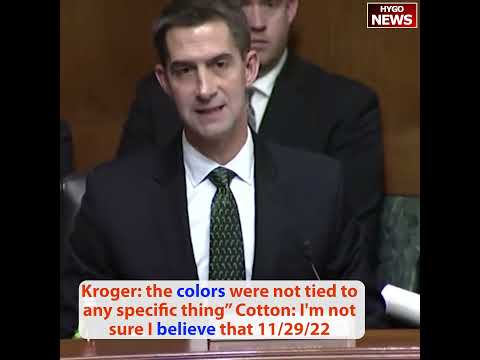
Senator Cotton: “I’m Not Sure I Believe That” — Kroger CEO Claims Rainbow Apron Colors “Not Tied to Any Specific Thing” Despite Pride Month Launch
On 12/4/2022, Senator Tom Cotton (R-AR) pressed Kroger CEO Rodney McMullen on the rainbow heart apron that had cost the company $180,000 in a religious discrimination settlement. McMullen defended the apron’s symbolism: “Kroger’s fundamental purpose is to feed the human spirit and part of feeding the human spirit is the heart. And that heart is our fundamental strategy to support our purpose. The colors were not tied to any specific thing.” Cotton responded bluntly: “Well, I’m not sure I believe that.” Cotton noted the apron was “introduced during Pride Month as a supposed sign of inclusivity” and that a federal judge had agreed with the religious discrimination claim — rejecting Kroger’s motion for summary judgment. Cotton then asked if McMullen would apologize to the fired employees, Brenda Lawson and Trudy Rickard, for the ordeal they had gone through. McMullen’s response: “I would need to understand more of the details, Senator. Thank you.”
McMullen’s Explanation of the Apron
McMullen offered a corporate rationale for the apron design. “Yeah, if you — we put in place an apron several years ago because our associates wanted to have a common dress code. Kroger’s fundamental purpose is to feed the human spirit and part of feeding the human spirit is the heart. And that heart is our fundamental strategy to support our purpose. The colors were not tied to any specific thing,” McMullen said.
The explanation was a masterpiece of corporate speak that strained credulity. Several elements stood out:
“Associates wanted a common dress code” — This framing attributed the apron to employee preferences rather than executive decision-making. But employee input rarely results in multi-colored rainbow heart imagery being selected as corporate uniforms. This was clearly an executive decision being retroactively attributed to employees.
“Feed the human spirit” — This was Kroger’s corporate slogan. Using it as part of the apron justification linked the design to marketing rather than to any genuine operational purpose. The “human spirit” explanation made the apron sound spiritually meaningful when it was actually a marketing choice.
“The heart is our fundamental strategy” — This elevation of a uniform apron to “fundamental strategy” was corporate-speak inflation. The apron wasn’t Kroger’s strategy; it was a piece of employee uniform. Calling it fundamental strategy attempted to make the design sound more important than it actually was.
“The colors were not tied to any specific thing” — This was the core claim that Cotton would dispute. McMullen was asserting that the multicolored heart wasn’t meant to reference anything specific — particularly not gay pride imagery.
”I’m Not Sure I Believe That”
Cotton’s response was direct. “Well, I’m not sure I believe that,” Cotton said.
The phrase “I’m not sure I believe that” was a polite but direct expression of skepticism. Cotton wasn’t calling McMullen a liar, but he was communicating that the CEO’s explanation didn’t hold up to scrutiny. In a congressional hearing context, senatorial skepticism of this kind carries weight — it signals to viewers and readers that the witness’s statement should be treated as doubtful.
Cotton then provided two specific reasons for his skepticism.
”Introduced During Pride Month”
Cotton’s first point was about timing. “It was introduced during Pride Month as a supposed sign of inclusivity,” Cotton said.
This was a factual observation. The apron with the multicolored heart had been rolled out during June — LGBT Pride Month. The timing wasn’t coincidental. Corporations routinely launch new initiatives during cultural awareness months to align their public positioning with the broader cultural moment. A rainbow-colored heart launched during Pride Month was being presented as connected to Pride celebrations regardless of what Kroger said about the design intent.
If the apron’s colors genuinely had no specific meaning, Kroger could have introduced it at any time of year. Launching it specifically during Pride Month communicated a connection to LGBT pride imagery whether the company formally stated that connection or not. Corporate timing decisions carry communicative weight, and the Pride Month launch sent a specific message.
”A Federal Judge Didn’t Agree”
Cotton’s second point was about legal findings. “And a federal judge didn’t agree with it either. That’s why he rejected your company’s motion for summary judgment and you just paid $180,000 to two employees who wrongly terminated,” Cotton said.
This was the most important substantive point. Kroger had tried to get the EEOC lawsuit dismissed through a summary judgment motion. Summary judgment would have ended the case without a trial by concluding that Kroger hadn’t done anything wrong as a matter of law.
The federal judge rejected this motion. A summary judgment denial means the judge found that there was enough evidence to support the employees’ claims to go to trial. The judge essentially concluded that the employees’ perception of the apron as LGBT pride imagery was reasonable — otherwise the religious discrimination claim would have failed as a matter of law.
Kroger then settled rather than go to trial. The $180,000 settlement was effectively Kroger’s acknowledgment that they might lose at trial. If they had been confident that “the colors were not tied to any specific thing,” they could have defended that position at trial and won. Instead, they paid.
Cotton’s use of “wrongly terminated” was important. It wasn’t just the senator’s characterization; it was the implication of the legal proceedings. Kroger paid the settlement because they had wrongly fired the employees.
The Burden of Evidence
Cotton’s argument rested on a layered demonstration:
Layer 1: The apron’s timing (Pride Month launch) suggested LGBT pride significance.
Layer 2: Multiple employees perceived the apron as LGBT pride imagery, not just a generic colored heart.
Layer 3: A federal judge found these perceptions credible enough to deny summary judgment.
Layer 4: Kroger chose to settle rather than defend the “no specific meaning” claim at trial.
Layer 5: The settlement required paying $180,000 to the wrongly terminated employees.
Given this evidence, McMullen’s claim that “the colors were not tied to any specific thing” became very hard to defend. Either everyone else — the employees, their colleagues, the EEOC, the federal judge — was wrong, or McMullen’s claim was wrong. The weight of external evidence favored the latter interpretation.
The Apology Question
Cotton’s most powerful moment came next. “By the way, would you like to offer an apology here to Brenda Lawson and Trudy Rickard for the ordeal they went through?” Cotton asked.
The question transformed the abstract legal discussion into a human accountability moment. Cotton identified the specific women by name: Brenda Lawson and Trudy Rickard. These weren’t abstract plaintiffs in a legal case. They were specific people who had been fired from their jobs in Conway, Arkansas, for religious beliefs.
An apology would have been a powerful corporate response. It would have acknowledged that the specific individuals had been wronged. It would have shown corporate responsibility. It would have humanized the legal matter in a way that allowed Kroger to move forward with dignity.
McMullen declined. “I would need to understand more of the details, Senator. Thank you,” McMullen said.
The refusal to apologize was remarkable. McMullen was the CEO of the company that had fired these women. The company had paid a federal settlement acknowledging the wrongful terminations. The women had names, ages, locations, and documented employment histories with Kroger. What “more of the details” did McMullen need to understand before apologizing?
The Pattern of Corporate Non-Apology
McMullen’s response fit a broader pattern of corporate non-apologies. When faced with wrongdoing, corporations typically:
- Pay settlements — to end legal liability without trial
- Avoid admissions — including in settlement language
- Refuse apologies — to prevent further legal exposure or emotional acknowledgment
- Express vague regret — if anything, in controlled corporate statements
- Deflect to process — claiming the need for further review before personal engagement
McMullen’s “need to understand more of the details” was a variation of the deflect-to-process pattern. It allowed him to avoid the direct apology Cotton was requesting while appearing to take the matter seriously. The unspoken understanding was that McMullen would not, in fact, be apologizing — the “need to understand more” was the permanent delay.
The Corporate DEI Contradictions
The exchange highlighted fundamental contradictions in corporate DEI practices. Kroger had implemented the rainbow apron to signal inclusivity. The company’s own message was that the apron represented welcoming all employees and customers. But the company’s actions had fired two employees whose religious views conflicted with the apron’s implicit message.
The “inclusive” apron had produced exclusion. The policy meant to signal welcoming had resulted in terminations. The effort to support some employees (LGBT employees who might feel welcome seeing the imagery) had harmed other employees (religious employees who objected to it).
This was the fundamental tension in many corporate DEI initiatives: attempts to signal support for some groups could alienate or harm members of other groups. When the tensions produced legal consequences — as with the EEOC settlement — companies had to acknowledge the problem at least to the extent of paying. But they often refused to acknowledge the problem more broadly, continuing the policies and rejecting apologies for specific affected individuals.
Key Takeaways
- Senator Tom Cotton pressed Kroger CEO Rodney McMullen on the rainbow heart apron that had cost $180,000 in religious discrimination settlement.
- McMullen claimed “the colors were not tied to any specific thing” — despite launching the apron during Pride Month as a “sign of inclusivity.”
- Cotton responded: “I’m not sure I believe that,” citing both the Pride Month timing and a federal judge’s rejection of Kroger’s summary judgment motion.
- Cotton named the specific fired employees — Brenda Lawson and Trudy Rickard — and asked McMullen to apologize for their ordeal.
- McMullen refused to apologize: “I would need to understand more of the details, Senator. Thank you.”
Transcript Highlights
The following is transcribed from the video audio (unverified — AI-generated from audio).
- Are you still requiring employees to wear the apron with the rainbow heart symbol on it?
- Kroger’s fundamental purpose is to feed the human spirit and part of feeding the human spirit is the heart.
- The colors were not tied to any specific thing.
- Well, I’m not sure I believe that. It was introduced during Pride Month as a supposed sign of inclusivity.
- A federal judge didn’t agree with it either. That’s why he rejected your company’s motion for summary judgment.
- Would you like to offer an apology here to Brenda Lawson and Trudy Rickard for the ordeal they went through? — I would need to understand more of the details, Senator.
Full transcript: 160 words transcribed via Whisper AI.