 HYGO News
 Kroger agreed to pay $180K to settle religious discrimination (wear an apron with LGBTQ symbol)
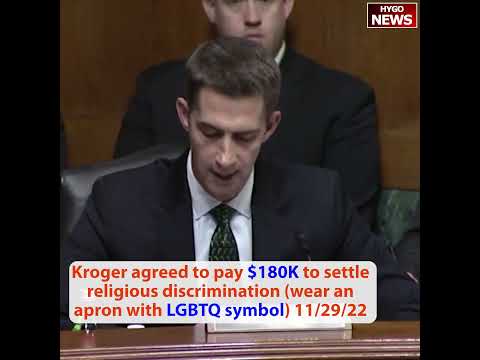
Senator to Kroger CEO: Your Company Paid $180K to Settle EEOC Religious Discrimination Case After Firing Two Employees — One Age 72 — For Refusing to Wear Rainbow Apron; CEO: “I’m Not Aware”
On 12/4/2022, a senator provided the specific details of the Kroger religious discrimination case that had cost the company $180,000 to settle. The case involved two Kroger employees — Brenda Lawson, age 72, and another employee named Rickard, age 57 — who were fired in Conway, Arkansas, for refusing to wear a new store apron with a multicolored heart symbol. “They, like many other of your employees, felt uncomfortable with new aprons because they thought the heart resembled a gay pride symbol. Rather than make accommodations, Kroger fired these two employees,” the senator said. The senator then asked CEO Rodney McMullen: “Are you aware of these terminations?” The CEO’s response was remarkable: “Senator, I am not.” When informed that the EEOC had brought the lawsuit (not private employees), McMullen still maintained he wasn’t aware. The senator expressed his reaction: “Well, I’m disappointed by that.”
The Specific Facts
The senator provided details about the underlying case. “The reason I ask is that you recently agreed to pay $180,000 to settle a religious discrimination case in Conway, Arkansas. In that case, two Kroger employees, Brenda Lawson, age 72, Rickard, age 57, declined the directive to begin wearing a new store apron with a multi-colored heart symbol on it,” the senator said.
The details humanized what might otherwise have been an abstract legal matter. Two specific employees — one 72 years old, one 57 — had been fired. They had names: Brenda Lawson and someone named Rickard (the first name wasn’t fully captured in the transcript). They had ages — Lawson was 72 years old, an age when finding new employment was exceptionally difficult, and many workers were considering retirement. They worked in Conway, Arkansas — a small city where Kroger employment might be among the best options available to older workers.
The ages were particularly significant. A 72-year-old woman fired from her Kroger job in rural Arkansas wasn’t easily replaceable. She wasn’t likely to find equivalent employment. The termination represented a severe economic consequence for exercising what she considered a religious conviction.
”The Heart Resembled a Gay Pride Symbol”
The senator explained the employees’ objection. “They, like many other of your employees, felt uncomfortable with new aprons because they thought the heart resembled a gay pride symbol,” the senator said.
The “like many other of your employees” phrase was important. It indicated that Lawson and Rickard weren’t unusual in their perception. Other Kroger employees had also been uncomfortable with the new apron because of its resemblance to LGBT pride imagery. The senator was suggesting that Kroger knew or should have known that many employees would object to the symbol.
The specific objection — that the heart symbol resembled a gay pride symbol — was important for the legal analysis. Religious discrimination claims under Title VII require the employee’s religious belief to be sincerely held. The employees’ perception of the symbol as representing views that conflicted with their religious beliefs was the basis of their claim. The EEOC’s willingness to bring the case suggested federal investigators had found the religious objection credible.
”Rather Than Make Accommodations”
The senator identified the specific violation. “Rather than make accommodations, Kroger fired these two employees,” the senator said.
Title VII requires employers to provide “reasonable accommodations” for religious beliefs unless doing so would create “undue hardship.” The accommodations Kroger could have provided — alternative uniforms without the symbol, name tags instead of aprons, modified aprons with the symbol removed — would have been straightforward and low-cost.
Instead, Kroger chose termination. This was the specific decision that created legal liability. Fire employees for religious beliefs, without offering reasonable accommodations, and Title VII violations almost inevitably follow.
The $180,000 settlement reflected this violation. The EEOC had investigated, found violations of Title VII, and secured a settlement for the affected employees. The amount covered back pay, damages, and other remedies for the specific harm caused by the illegal terminations.
”Are You Aware?”
The senator asked the direct accountability question. “Are you aware of these terminations, Mr. McMullen?” the senator asked.
The CEO’s response was extraordinary. “Senator, I am not,” McMullen said.
The answer was implausible on its face. Kroger had paid $180,000 to settle a federal religious discrimination lawsuit. The settlement had received press coverage. The case had involved two specific employees who had been terminated. The CEO of Kroger — a multi-billion-dollar public corporation — was claiming he didn’t know about this matter.
For the CEO to genuinely be unaware of a federal lawsuit settlement, several things would have to be true:
His legal department wouldn’t have informed him — but major corporations typically brief CEOs on significant legal matters, especially settlements.
His public affairs team wouldn’t have informed him — but press coverage of the settlement would have triggered internal notifications.
His HR department wouldn’t have informed him — but HR typically briefs CEOs on employment issues that have legal implications or policy impacts.
His direct reports wouldn’t have informed him — but direct reports typically flag matters involving company policy enforcement to CEOs.
For the CEO to genuinely not know, all of these internal information flows would have had to fail. This was possible but improbable.
The EEOC Clarification
The senator clarified the nature of the lawsuit. “This was not a private lawsuit either by two disgruntled employees, Mr. McMullen. This was brought by the EEOC. So are you not aware when your company is sued for religious discrimination by the United States government?” the senator asked.
The clarification was important because it raised the stakes of the CEO’s claim. Private employment lawsuits are common and might not always reach CEO attention. But lawsuits brought by the federal Equal Employment Opportunity Commission are not routine — they represent official federal findings that the employer has violated civil rights law. The EEOC doesn’t bring lawsuits lightly; it typically pursues formal litigation only after investigation and failed settlement attempts.
A CEO should know when the federal government is suing his company for civil rights violations. The EEOC lawsuit would have required:
- Formal complaint — requiring corporate legal response
- Discovery proceedings — requiring corporate document production
- Settlement negotiations — requiring executive approval of terms
- Payment authorization — requiring financial approval at senior levels
At every step, the CEO should have been in the information chain. Claiming not to know was claiming that the company’s legal and executive processes had somehow failed to loop in the person ultimately responsible for corporate decisions.
”No, Sir, I Am Not. Not Always”
The CEO’s response to the EEOC clarification was equally striking. “No, sir, I am not. Not always,” McMullen said.
The “not always” qualifier was revealing. The CEO was acknowledging that he wasn’t systematically informed when the federal government sued Kroger for civil rights violations. This was itself a significant management failure — the CEO should be informed about all federal civil rights enforcement actions against the company.
The “not always” suggested that EEOC lawsuits against Kroger were frequent enough that the CEO couldn’t be expected to know about all of them. This implication was damaging. A company that generated enough EEOC lawsuits to make CEO notification “not always” feasible was a company with systemic problems in civil rights compliance.
Alternatively, the CEO might have been exaggerating his lack of knowledge to avoid having to answer for the specific case. Claiming general unfamiliarity with EEOC matters allowed him to avoid specific questions about Kroger’s handling of the Lawson and Rickard terminations. This interpretation suggested strategic ignorance rather than actual ignorance.
”Well, I’m Disappointed”
The senator’s response to the CEO’s answer captured the political significance. “Well, I’m disappointed by that,” the senator said.
The disappointment was multifaceted. The senator was:
Disappointed in the CEO for not knowing about major legal matters affecting his company.
Disappointed in Kroger’s practices that had led to the EEOC lawsuit in the first place.
Disappointed in the corporate response that had chosen termination over accommodation.
Disappointed in the evasive testimony during the hearing.
“I’m disappointed” was polite but damning. The senator wasn’t accusing the CEO of anything specific; he was expressing the reaction that many viewers would have. A CEO who couldn’t engage with specific facts about a major civil rights case involving his company was failing a basic test of executive accountability.
The Corporate Structure Implications
The exchange had implications beyond the specific Kroger case. It suggested that major corporations often had executive-level leadership that was disconnected from the actual practices being implemented in stores and local operations. Policies were made at headquarters, implemented at stores, and generated legal consequences — but the CEO who was ultimately responsible might not know the specific details of how policies affected specific employees.
This disconnect allowed corporate leaders to defend abstract values (like “inclusivity”) without having to account for specific consequences (like firing 72-year-old employees for religious beliefs). The abstract level was where executives operated; the specific level was where employees lived.
For congressional oversight, this created challenges. Senators could establish the facts and the legal consequences, but they couldn’t always extract accountability from executives who claimed not to know about the specific matters being questioned.
Key Takeaways
- A senator detailed the Kroger religious discrimination case: two employees (ages 72 and 57) fired in Conway, Arkansas, for refusing to wear aprons with multicolored heart symbols they believed resembled gay pride symbols.
- Rather than provide religious accommodations, Kroger fired the employees; the EEOC subsequently sued.
- Kroger paid $180,000 to settle the federal lawsuit.
- When asked if he was aware of these terminations, CEO Rodney McMullen said “Senator, I am not.”
- Told the EEOC had brought the suit (not private employees), McMullen still said “No, sir, I am not. Not always” — suggesting EEOC lawsuits against Kroger happened often enough that the CEO wasn’t always informed.
Transcript Highlights
The following is transcribed from the video audio (unverified — AI-generated from audio).
- You recently agreed to pay $180,000 to settle a religious discrimination case in Conway, Arkansas.
- Two Kroger employees, Brenda Lawson, age 72, Rickard, age 57, declined the directive to begin wearing a new store apron with a multi-colored heart symbol on it.
- They, like many other of your employees, felt uncomfortable with new aprons because they thought the heart resembled a gay pride symbol.
- Rather than make accommodations, Kroger fired these two employees. Are you aware of these terminations, Mr. McMullen? — Senator, I am not.
- This was brought by the EEOC. So are you not aware when your company is sued for religious discrimination by the United States government?
- No, sir, I am not. Not always. — Well, I’m disappointed by that.
Full transcript: 154 words transcribed via Whisper AI.