 HYGO News
 Sen. Kennedy to PM Carney: 'Go to Zero Tariffs -- Challenge America to Remove Ours'; 'Let's Don't Be Stupid'
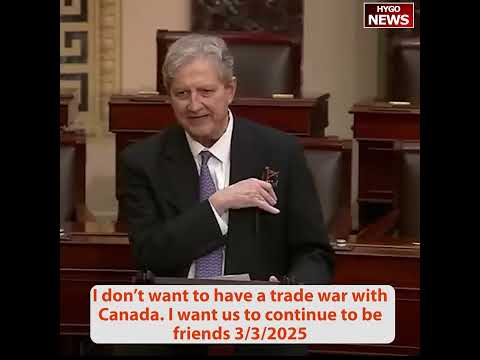
Sen. Kennedy to PM Carney: “Go to Zero Tariffs — Challenge America to Remove Ours”; “Let’s Don’t Be Stupid”
Senator John Kennedy of Louisiana delivered a Senate floor speech in April 2025 proposing a simple solution to the U.S.-Canada trade war: “Prime Minister Carney, if you believe in free trade, offer to go to zero tariffs in Canada on American goods — no tariffs, none, zero, zilch, nada — and challenge America to remove all of our tariffs on Canada.” Kennedy grounded his appeal in the deep friendship between the nations, citing Operation Yellow Ribbon on 9/11, Canada’s Hurricane Katrina relief, and decades of shared security through NATO and NORAD. He concluded with his trademark folksy wisdom: “Remember what Mama Gump said — stupid is as stupid does. Let’s don’t be stupid. Let’s don’t have a trade war.”
The Friendship Preamble
Kennedy opened by establishing the relationship he was trying to preserve.
“The United States of America and Canada have been friends and allies for decades,” he said. “We’re neighbors. We share a 5,525-mile border. I’m proud of that. We share history. We share values.”
He cited the security architecture: “We maintain long-standing mutual security commitments. We’re both members of NATO. Canada and America are members of the Binational North American Aerospace Defense Command — you probably know that as NORAD.”
Kennedy then elevated the relationship beyond institutions: “It’s more than just security commitments, though. It’s more than just business. We’re friends. I’m proud of that.”
The preamble was strategically important. Kennedy was not delivering a hostile speech demanding Canadian capitulation. He was speaking as a friend who wanted to preserve a friendship — and who was offering a path to do so.
9/11 and Katrina
Kennedy provided the historical examples that demonstrated the friendship was not abstract.
“I remember on 9/11 — who will ever be able to forget 9/11?” Kennedy said. “U.S. airspace was shut down. The people of Canada stepped right up to the plate. They immediately implemented Operation Yellow Ribbon. They opened their airports. The Canadians opened their homes. The Canadians opened their hearts to 33,000 Americans who were stranded.”
He then offered the Louisiana connection: “I remember after Hurricane Katrina, which hit my state — it destroyed southeast Louisiana, New Orleans, yes, but many other parts of my state as well, and Mississippi. Canada was the very first country. And the people of Canada were the very first people to send disaster relief.”
He named the Canadian operation: “The program was called Operation Unison. Their military ships sailed south to help us in Louisiana. They sent 1,000 people and a lot of supplies.”
The 9/11 and Katrina stories accomplished two things. They demonstrated that the U.S.-Canada relationship was built on something deeper than trade agreements — it was built on mutual aid in moments of crisis. And they created a moral context for Kennedy’s proposal: nations that had sheltered each other’s citizens and sent each other’s disaster relief should be able to find a way to resolve a trade dispute.
”I Don’t Want to Be at War with Canada”
Kennedy stated his position directly.
“Here’s my point,” he said. “I don’t want to be at war with Canada. I don’t want to have a trade war with Canada. I want us to continue to be friends.”
He acknowledged making the suggestion before: “I made this suggestion to the new Prime Minister of Canada the other day, Prime Minister Carney. I’m going to make it again. And I hope this time he’ll take it more seriously.”
Kennedy added a condition: “Remember, if you want to be taken seriously, you have to act seriously. If you want respect, you have to act respectfully.”
The admonition was aimed at Carney’s recent rhetoric — the “relationship is over” declaration followed by the rapid walk-back. Kennedy was suggesting that performative hostility was not the path to resolution; serious engagement was.
He acknowledged Carney’s position with fairness: “Prime Minister Carney, you say that President Trump is not a fair trader. And I understand your point of view. I don’t agree with you, but I understand your point of view. You’ve got to stand up for your people.”
The Zero-Tariff Challenge
Kennedy then delivered his proposal in its most detailed form.
“If Prime Minister Carney, if you believe in free trade, then here’s what you do,” Kennedy said. “Make this offer today.”
The offer: “Offer to go to zero tariffs in Canada on American goods. No tariffs. None. Zero. Zilch. Nada.”
The challenge: “And challenge America to remove all of our tariffs on Canada. So the people of Canada can sell their goods to Americans without a tariff, and the people of America can sell their goods to our friends in Canada without a tariff. Zero tariffs.”
The principle: “Let Canadian businesses and American businesses compete. Competition makes all of us better. That’s one of the shared values that we have with our friends in Canada.”
Kennedy’s proposal was elegantly simple and politically brilliant. If Carney claimed to support free trade, the purest expression of free trade was zero tariffs on both sides. By proposing mutual elimination rather than mutual escalation, Kennedy was calling Carney’s bluff: if Canada truly wanted free trade, it should offer to remove its 250-300% dairy tariffs, its barriers to American poultry, and every other trade restriction it maintained.
The beauty of the proposal was that it put Canada in an impossible rhetorical position. If Carney accepted, the trade war would end and both countries would benefit from genuine free trade. If Carney rejected, he would be revealed as someone who supported “free trade” only when it benefited Canada and not when it required reciprocity.
”I’ll Encourage Trump to Accept”
Kennedy made his own commitment: “I don’t speak for President Trump, but I’ll certainly encourage President Trump to accept that offer, and I think he will.”
The statement aligned with Trump’s own rhetoric. Trump had repeatedly said that his preference was for zero tariffs on all sides — but that reciprocity was the non-negotiable condition. If Canada went to zero, Trump would have every incentive to reciprocate.
Kennedy offered the path forward: “There’s a way to stop this trade war. It’s just to remove the tariffs on both sides."
"Mama Gump”
Kennedy concluded with the folksy wisdom that had made him one of the Senate’s most quotable members.
“Remember what Mama Gump said,” Kennedy said. “Stupid is as stupid does. Let’s don’t be stupid. Let’s don’t have a trade war. Let’s continue to be friends. Let’s get rid of these tariffs.”
The Forrest Gump reference was pure Kennedy — a Louisiana senator quoting a movie set in Alabama, using the simplest possible language to make the simplest possible point. The trade war was stupid. Both countries would be better off without it. The solution was obvious. The only thing preventing it was pride.
Key Takeaways
- Sen. Kennedy proposed that Canada go to zero tariffs on American goods and “challenge America to remove all of our tariffs” — creating genuine free trade.
- He grounded the appeal in friendship: Canada took in 33,000 stranded Americans on 9/11 and was the first country to send Katrina relief to Louisiana.
- Kennedy told Carney: “If you believe in free trade, make this offer today. No tariffs. None. Zero. Zilch. Nada.”
- He pledged to encourage Trump to accept a zero-tariff deal: “There’s a way to stop this trade war. Remove the tariffs on both sides.”
- His conclusion: “Remember what Mama Gump said — stupid is as stupid does. Let’s don’t be stupid. Let’s don’t have a trade war.”