 HYGO News
 Kennedy: "Telling 2 Justices If They Vote In A Way He Doesn't Like, They Will Pay The Price"
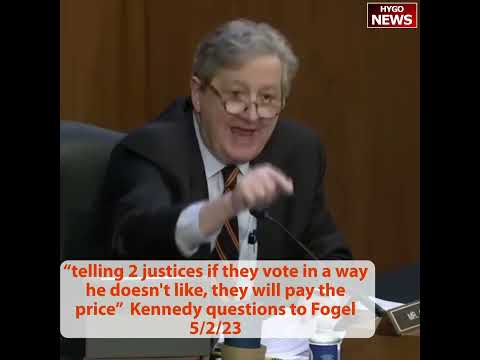
Kennedy: “Telling 2 Justices If They Vote In A Way He Doesn’t Like, They Will Pay The Price”
Senator John Kennedy (R-LA) used a Senate Judiciary hearing on Supreme Court ethics to invoke a now-infamous 2020 episode in which Senate Minority Leader Chuck Schumer stood on the steps of the U.S. Supreme Court and warned Justices Neil Gorsuch and Brett Kavanaugh that they would “pay the price” and “reap the whirlwind” if they ruled the wrong way on abortion. Kennedy raised the moment to confront a witness who had publicly described some justices as “politicians in robes” — turning a question about institutional reform into a sharp commentary on the rhetorical pressure justices face from the political branches.
The Schumer Reference
- Steps of the Supreme Court: Schumer’s March 2020 rally outside the Supreme Court during oral arguments in a Louisiana abortion case.
- Whirlwind language: “You have released the whirlwind, and you will pay the price” became one of the most quoted lines of the era.
- Names mentioned: Schumer named Justices Gorsuch and Kavanaugh by name from outside the building.
- Chief Justice rebuke: Chief Justice John Roberts issued a rare public statement calling the comments “dangerous.”
- Lasting symbolism: Kennedy revived the moment to argue that political pressure on the Court is not unilateral.
The Reform Framing
- Committee purpose: Witnesses had urged the Senate Judiciary Committee to consider strengthening Supreme Court institutions.
- Kennedy’s pivot: Kennedy reframed the question from “what reforms?” to “what behaviors should we name?”
- Institutional health: He suggested institutions are damaged not only by ethical lapses but by direct political threats.
- Two-way pressure: Kennedy argued reform conversations cannot ignore pressure originating from elected officials.
- Senate accountability: He implicitly placed responsibility on Senate leadership for the tenor of public discourse on the Court.
The Politicians In Robes Comment
- Witness tweet: Kennedy quoted a witness who had tweeted that some justices are “politicians in robes” thriving in a system where “access and influence are for sale.”
- Sack of potatoes: Kennedy paraphrased the witness as describing justices as “bought like a sack of potatoes.”
- Witness response: The witness declined to defend the language, saying “I’m not going to comment on that, Senator.”
- Strategic exposure: Kennedy used the witness’s own words to challenge the premise of the day’s reform testimony.
- Credibility test: The exchange tested whether reform advocates would stand behind their public rhetoric.
The Ethics Hearing Context
- Hearing topic: The Senate Judiciary Committee was reviewing ethics standards and disclosure rules for Supreme Court justices.
- Reporting environment: ProPublica reporting earlier in 2023 had drawn attention to undisclosed gifts and travel involving Justice Clarence Thomas.
- Democratic posture: Democratic senators framed the hearing as a step toward binding ethics rules for the Court.
- Republican posture: Republican senators including Kennedy framed the hearing as politically motivated targeting.
- Constitutional question: The hearing surfaced unresolved questions about Congress’s authority to regulate the Court.
The Gorsuch And Kavanaugh Naming
- Targeted threat: Schumer’s 2020 statement called out two specific justices by name in front of a hostile crowd.
- Security implications: Court security tightened after the rally, and again after the Dobbs draft leak in 2022.
- Recusal pressure: The naming created an unusual record of a Senate leader publicly pressuring identifiable justices.
- Historical anomaly: Public threats to specific justices by Senate leadership are extremely rare in modern history.
- Citation potential: Kennedy’s revival of the quote keeps it active in Court ethics debates.
The Reap The Whirlwind Phrase
- Biblical origin: The phrase comes from the Book of Hosea — “they sow the wind, and they shall reap the whirlwind.”
- Implied consequence: In the Schumer context, the phrase implied political or personal consequences for unfavorable rulings.
- Schumer clarification: Schumer later said he had been referring to political consequences for Republicans, not threats.
- Symbolic weight: The phrase entered Supreme Court politics as shorthand for political pressure on the bench.
- Republican usage: Republicans have repeatedly cited the line to argue Democrats undermine the Court when convenient.
The Roberts Rebuke
- Chief Justice statement: Chief Justice Roberts said threatening statements of that kind “are not only inappropriate” but “dangerous.”
- Institutional defense: Roberts framed his statement as a defense of judicial independence.
- Rare intervention: Public statements by the Chief Justice about specific elected officials are nearly unprecedented.
- Lasting record: Roberts’s rebuke is now a fixed part of Supreme Court ethics debates.
- Bipartisan citation: The statement is invoked by both parties depending on the controversy of the moment.
The Witness Tweet
- Public posture: A witness at the hearing had used social media to call certain justices “politicians in robes.”
- Access-for-sale framing: The tweet alleged a system in which justices benefit from access and influence purchased by donors.
- Witness deflection: When confronted, the witness opted not to defend or restate the post on the record.
- Editorial restraint: Kennedy did not name the witness on camera but quoted the language directly.
- Hearing record: The exchange placed the tweet’s claims into the formal Senate hearing record.
The Bought Like A Sack Of Potatoes Line
- Vivid framing: Kennedy paraphrased the tweet as accusing justices of being “bought like a sack of potatoes.”
- Rhetorical weight: The phrasing dramatized what the tweet implied without quoting it word-for-word.
- Witness silence: The witness did not endorse, deny, or clarify the paraphrase.
- Editorial choice: Kennedy used the line to test whether ethics critics would defend their full posture under questioning.
- Quotability: The exchange became a clipped Senate Republican highlight in subsequent media coverage.
The Senate Judiciary Dynamic
- Chair-ranking tension: The committee’s debate on Court ethics has run on partisan lines since the 2022 term.
- Witness selection: Witness panels have reflected the partisan split, with each side calling friendly experts.
- Procedural friction: Republican members have used floor and committee tools to slow ethics legislation.
- Democratic strategy: Democratic chairs have emphasized hearings and reporting to apply public pressure.
- Public-facing posture: Both parties treat the ethics fight as a base-mobilizing issue heading into 2024.
The Court Independence Argument
- Constitutional design: Kennedy implicitly invoked the constitutional separation of powers as the frame for the exchange.
- Branch-on-branch pressure: He argued that elected officials publicly threatening justices undermines that design.
- Reform skepticism: The exchange let Kennedy cast Democratic ethics proposals as one-sided pressure on the Court.
- Counterweight argument: Republicans point to Schumer’s rally and other rhetoric as themselves a Court-pressure problem.
- Long arc: The argument sits inside a broader debate about whether Congress should legislate Court ethics at all.
The Public Communication Strategy
- Soundbite design: Kennedy structured the exchange so a single clip would carry the message.
- Documentary value: The hearing record now contains a sustained Republican counter-narrative on Court pressure.
- Media uptake: The clip moved on conservative media as a Republican response to the ethics push.
- Audience targeting: Kennedy’s questioning style — folksy, deliberate — is built for retail political distribution.
- Strategic patience: The pivot from policy to rhetoric was a deliberate use of a small window of speaking time.
The Whirlwind Quote Revival
- Citation strategy: Republicans have made repeated use of the Schumer quote as a counterweight to ethics critiques.
- Hearing context: Kennedy embedded the quote in an ethics hearing to maximize the contrast.
- Witness positioning: The witness’s reluctance to engage made the quote dominate the exchange.
- Long memory: Schumer’s 2020 statement remains a live reference point three years later.
- Symbolic stakes: Both sides treat that moment as evidence of the other’s bad faith on Court politics.
The Political Stakes
- Court legitimacy: The fight over ethics overlaps a broader public debate about Court legitimacy.
- Approval ratings: Public approval of the Supreme Court is at multi-decade lows in 2023 polling.
- Election year horizon: 2024 campaigns will likely use Court ethics as a turnout issue on both sides.
- Donor sensitivity: Allegations of access and influence cut at fundraising posture for both parties.
- Institutional strain: Each new clash adds pressure on the Court’s ability to operate without political friction.
The Bipartisan Restraint Question
- Norm preservation: Some senators in both parties privately favor norms over legislation.
- Institutional risk: Public attacks risk eroding norms that protect the Court from politicization.
- Reformer skepticism: Reformers argue that disclosure and recusal rules have already eroded.
- Status-quo defense: Defenders argue Congress should be cautious before regulating Article III conduct.
- Outcome uncertainty: It remains unclear whether the hearing will produce binding rules or remain rhetorical.
The Constitutional Question
- Article III scope: The Constitution grants Congress significant authority over the structure of federal courts.
- Internal governance: How far that authority extends to internal Supreme Court conduct is contested.
- Self-regulation precedent: The Court has historically set its own ethics framework via internal practice.
- Enforcement gap: Critics say the existing framework lacks clear enforcement mechanisms.
- Pending legislation: Proposed bills would impose disclosure and recusal rules subject to constitutional challenge.
The Media Coverage
- Conservative outlets: Right-leaning outlets played the Kennedy clip as a Republican rejoinder to ethics critics.
- Mainstream coverage: Mainstream coverage focused on the substance of ethics testimony from other panels.
- Social distribution: The clip circulated widely on social platforms in short-form edits.
- Democratic response: Democratic senators dismissed the framing as a deflection from substantive ethics issues.
- Long-tail effect: The exchange will likely be quoted in future hearings on Court ethics.
The 2024 Implications
- Election-year pressure: Court ethics will likely intensify as a campaign issue through 2024.
- Court rulings: Major end-of-term rulings will sharpen attention to the ethics fight.
- Confirmation echoes: Republican memories of recent confirmation battles inform the current posture.
- Down-ballot effects: Senate races may turn in part on competing visions of Court reform.
- Institutional outcome: How the Court itself responds to ethics pressure will shape the next decade.
Key Takeaways
- Kennedy revived Schumer’s 2020 “whirlwind” remarks during a Supreme Court ethics hearing.
- He confronted a witness who had publicly called justices “politicians in robes.”
- The witness declined to defend or restate the language under questioning.
- Kennedy framed reform debate as incomplete without naming political pressure on the Court.
- The exchange entered the Senate hearing record as a Republican counter-narrative.
- The 2020 Schumer rally remains a live reference point in 2023 ethics debates.
Transcript Highlights
The following quotations are drawn from an AI-generated Whisper transcript of the hearing and should be considered unverified pending official transcript release.
- “How do we make our institutions” — witness offering reform framing
- “One of our leaders from whom I have great respect going on the steps of the United States Supreme Court” — Sen. Kennedy
- “Telling two justices if they vote in a way he doesn’t like, they will pay the price and reap the whirlwind” — Sen. Kennedy
- “Some justices or politicians in robes who thrive in a system where access and influence are for sale” — Sen. Kennedy quoting witness
- “He said they were bought like a sack of potatoes” — Sen. Kennedy paraphrase
- “I’m not going to comment on that, Senator. That’s not anything I had anything to do with” — witness response
Full transcript: 174 words transcribed via Whisper AI.