 HYGO News
 Kennedy on President physically & mentally in bad shape, staff member 25th Amendment
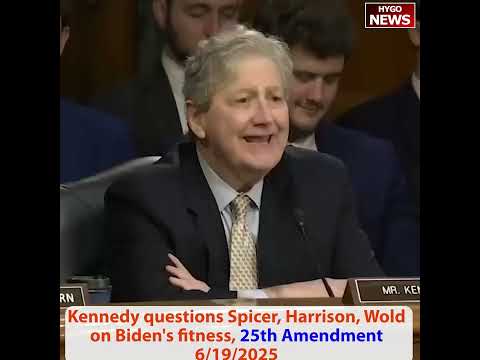
Kennedy on President physically & mentally in bad shape, staff member 25th Amendment
Senator John Kennedy of Louisiana conducted a Senate hearing that produced one of the more substantive discussions of the 25th Amendment in recent congressional memory. Kennedy’s hypothetical — a president who is “physically and mentally in bad shape” with staffers aware of the situation — was, in the context of the first-year post-Biden era, unavoidably backward-looking. The hearing walked through the moral obligations of staffers, the procedural mechanics of the 25th Amendment’s Section 4, and the tension between personal loyalty and constitutional duty. Former White House press secretary Sean Spicer was one of the witnesses. A constitutional law professor and a second witness provided expert testimony. The conversation is the kind of rare Senate exchange in which members work through a serious constitutional question without the theatrical flourishes that characterize most hearings.
Kennedy’s Hypothetical
Kennedy’s setup was precise. “You have all been staffers. You’ve worked in government, you’ve had a boss using your experience as a staffer. I suppose the president’s talking like he was from outer space. Let’s suppose the president became fatigued very easily. He couldn’t finish a sentence without taking a nap. I mean, he was just physically in bad shape. Mentally and physically.”
The hypothetical is a thinly veiled reference to the final years of the Biden administration, during which reports had emerged — confirmed by some insiders — that the president had been showing signs of cognitive decline that were not always visible in the carefully managed public appearances. Kennedy’s question is whether staffers who observed such decline have a moral obligation to act on what they observed.
”Bake A Thanksgiving Turkey”
Kennedy’s most memorable line was the analogy. “Physically you can see you could make a Thanksgiving turkey in the time it takes him to walk across the stage.”
The image is vivid. A Thanksgiving turkey takes four to five hours to roast. If a president takes that long to walk across a stage, the physical limitation is severe. Kennedy is not describing a president who moves slowly. He is describing a president whose physical impairment is evident to anyone watching.
The line is both humorous and serious. The humor makes the point memorable. The seriousness is in the underlying question — at what point does physical decline become grounds for constitutional action?
The 25th Amendment Section 4
Kennedy’s hypothetical walked directly into Section 4 of the 25th Amendment, which provides the mechanism for removing a president who is unable to discharge the duties of the office. The section requires the vice president and a majority of the Cabinet (or another body established by Congress) to declare the president unable. The president can dispute the declaration, at which point Congress is required to decide by a two-thirds vote in both chambers.
The section has never been successfully invoked. Presidents have voluntarily transferred power to their vice presidents under Section 3 — the voluntary provision — during medical procedures. But Section 4’s involuntary mechanism has remained theoretical.
The Professor’s Response
A constitutional law professor was one of the witnesses. His response walked through the analytical framework. “Senator, I think the first thing you would have to do in a situation like that is exercise your own judgment. Is this how serious is this problem? Because everybody has moments when they lose focus, it happens. But if somebody thinks this is a really serious problem, I think the first thing to do is the most difficult, which is to say to the president, because the 25th amendment also provides, the president can say, I’m unable to exercise the power’s duties of my office.”
The professor’s answer emphasizes the voluntary path. A president who recognizes his own limitations can, under Section 3, voluntarily cede authority to the vice president. That is the cleanest path. It avoids the constitutional crisis that would accompany an involuntary Section 4 invocation.
”Suppose The President Says, Trust Me”
Kennedy pressed. “And suppose the president says, Look, trust me, I can. And it’s clear to you that he has neurodegenerative disease and he can’t. What do you do? Do you ever moral obligation as a staff member to go to the American people and say, we’ve got a problem here, may cost me my career?”
The escalation in the hypothetical is important. If the voluntary path is closed — the president refuses to acknowledge the problem — what is the staffer’s obligation?
The professor’s response: “Senator, I think at that point you have an obligation to talk to the vice president, who is in charge of the section 4 process under the 25th amendment.”
The Chain Of Responsibility
The professor is laying out the chain of escalation. First, the staffer attempts to persuade the president. If the president refuses, the staffer escalates to the vice president, because the vice president is the constitutional officer with the authority to initiate Section 4. The staffer’s direct obligation is not to go to the public. It is to go to the officer who has the power to act.
”When Does A Staffer Have A Moral Obligation?”
Kennedy pressed the witnesses for their personal judgment. “What about you? You want to go away, you want to work it out with him, but you can’t. When does a staffer have a moral obligation to stand up and say, he can’t be president anymore, she can’t be?”
The second witness responded. “The 25th amendment only works if individual staffers or officers of the United States exercise that kind of moral judgment. That’s what I’m asking you.”
The response is significant because it places the operational burden on the individual staffers. The 25th Amendment’s Section 4 is a procedural mechanism, but the mechanism only activates if individuals within the government — staffers, officers, cabinet members — are willing to carry the political and reputational costs of initiating the process.
”Several Instances Of A Failure”
The witness added the realistic qualifier. “The presidency is an enormous burden, so it would be not one instance, it would have to be several instances of a failure to exercise judgment.”
The qualifier is sensible. A president having a bad moment — tired, distracted, momentarily confused — is not grounds for constitutional action. A pattern of consistent inability is. The distinction matters because the 25th Amendment is not meant to be invoked lightly or politically.
”It Begins With Prayer”
The second witness offered a personal framework. “Yeah, well, I think it begins with prayer, of course, but after that, I think it’s conversation with other staffers, and if you’re unable to confront the president or to raise the issue with the vice president, you should resign.”
The resignation option is the individual moral answer. A staffer who believes the president cannot serve but who cannot persuade the decision-makers to act has one remaining option — to resign in protest. Resignation is the staffer’s way of refusing to be complicit in what they view as a problematic situation.
Spicer’s Testimony
Sean Spicer, former White House press secretary, provided the most direct testimony. “Well, luckily I didn’t have that problem, but I would say that you have a moral obligation as an American, as a citizen, as a human being. If the leader of the free world cannot conduct themselves to make the decisions that are critical to this country and to the world, you absolutely have a moral obligation to follow the chain of command, and if they don’t act, then you must."
"If They Don’t Act, Then You Must”
Spicer’s formulation is the strongest of the three witnesses. The moral obligation is unconditional. If the president cannot serve, and if the proper constitutional actors do not move to address the situation, then the individual has a direct obligation — “you must” — to act.
What “you must” do in that scenario is not fully specified, but the implication is that public disclosure, resignation in protest, or other actions that bring the situation to public attention are within the scope of what the staffer’s moral obligation requires.
The Professor’s Partial Disagreement
The professor offered a more measured framing. “Senator, I think acting means talking to the people who have the responsibility or in a position under the Constitution to do something with the situation.”
The professor is limiting the action to the constitutional chain of command. Going to the vice president, to cabinet members, to members of Congress — these are appropriate. Going directly to the American public is not specifically endorsed.
Kennedy’s Follow-Up
Kennedy pushed on whether the constitutional-chain answer was sufficient. “I’m just trying to ask, you’ve all been staffers. Suppose you go to everybody you’re supposed to go to, and they all say, my advice to you is to shut up. Do you have a moral obligation as a staffer to say, look, this person can’t be President of the United States, it’s his own policy, he physically can’t do it.”
The hypothetical is specific. The staffer has exhausted the chain. The vice president has been told. Cabinet members have been told. All of them have told the staffer to be quiet. In that scenario, does the staffer have an obligation to go to the public?
”Not A Question Of Whether A Staffer Has That Obligation”
The witness’s response was notable. “Senator, it’s not a question of whether a staffer has that obligation. It’s whether you as an American have that obligation, and I think each one of us does.”
The reframing is important. The witness is arguing that the obligation is not a role-specific staffer obligation. It is a citizen’s obligation that a staffer happens to be in a position to discharge. Any American who had the relevant information and the ability to bring it to public attention would have the same obligation, in principle.
The Professor’s Closing
The professor’s closing was more qualified. “Senator, I think there are situations under which someone in that position should speak publicly, but I also think that the views of a single individual who is not the person who is constitutionally responsible for taking measures should be considered by the public as just the views of a certain individual who has some information about the subject.”
The professor is warning against the danger of individual staffers becoming de facto constitutional actors. The 25th Amendment places the decision with the vice president and the cabinet (or Congress). Individual staffers who publicly claim incapacity do not have the constitutional authority to make that determination. The public should hear their claims but should evaluate them as claims from individuals, not as constitutional determinations.
Why The Hearing Matters
The hearing is more than an academic exercise. It is a historical record that members of the Senate, in 2025, took seriously the question of what staffers observing presidential incapacity are obligated to do. Future historians studying the Biden administration’s final years, or any other period in which presidential capacity becomes a public question, will have access to this record.
The hearing is also a signal to current administration staffers. Kennedy’s hypothetical, delivered in the immediate post-Biden period, is effectively asking current White House staffers how they would have responded to the circumstances that reportedly obtained in the previous administration. The implicit warning: staffers who observed incapacity and remained silent may face historical judgment.
The Broader Constitutional Question
The 25th Amendment was ratified in 1967, in the wake of the Kennedy assassination, to address gaps in the constitutional framework for presidential incapacity. Section 3 has been used several times. Section 4 has never been used. The question of whether and how Section 4 should be invoked has been the subject of academic writing but rarely of sustained congressional attention.
Kennedy’s hearing may move the conversation forward. By pushing witnesses to articulate their views on staffer obligations and on the appropriate response to a refusal of voluntary transfer, the hearing builds a record that future Congresses could draw on. The constitutional framework is not self-implementing. It depends on individuals making moral judgments and acting on them.
Key Takeaways
- Sen. Kennedy’s hypothetical: a president “physically and mentally in bad shape…you could bake a Thanksgiving turkey in the time it takes him to walk across the stage.”
- The professor on escalation: “you have an obligation to talk to the vice president, who is in charge of the section 4 process under the 25th amendment.”
- Spicer’s direct formulation: “if they don’t act, then you must” — the unconditional moral obligation.
- The professor’s qualifier: “It would have to be several instances of a failure to exercise judgment” — not a single bad moment.
- The citizen-level framing: “It’s not a question of whether a staffer has that obligation. It’s whether you as an American have that obligation.”