 HYGO News
 Kennedy: Moody's Graded Mortgage-Backed Securities AAA That Tanked And Dragged Down World Economy
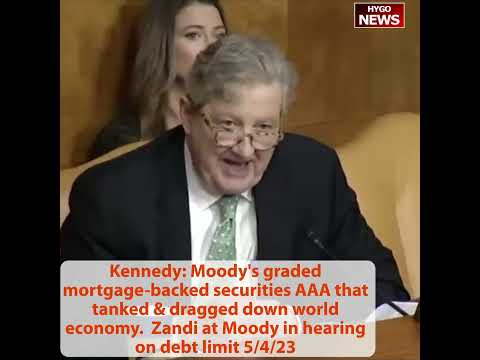
Kennedy: Moody’s Graded Mortgage-Backed Securities AAA That Tanked And Dragged Down World Economy
Senator John Kennedy (R-LA) opened a Senate hearing exchange with Moody’s Analytics chief economist Mark Zandi by raising the credibility question that has hung over Moody’s since the 2008 financial crisis: that Moody’s — like the other major credit rating agencies — gave AAA and A ratings to subprime mortgage-backed securities that “promptly tanked and almost dragged down the world economy.” Zandi clarified that he had joined Moody’s only in late 2005 (after selling his company, Economy.com, into Moody’s Analytics). Kennedy quipped he was “glad you missed that.” The exchange laid down a credibility marker before substantive Q&A on Zandi’s contemporary economic forecasts.
The Credibility Marker
- Opening framing: Kennedy used the historical reference to set a credibility frame for the hearing.
- Bold predictions reference: Kennedy noted Zandi had “made some pretty bold predictions today.”
- Disagreement signal: Kennedy said he agreed with some predictions but not others.
- Strategic choice: The opening positioned Zandi as a Moody’s-affiliated voice with institutional baggage.
- Hearing posture: The framing established Kennedy’s intent to push on the substantive forecasts that followed.
The 2008 MBS Episode
- Subprime ratings: All three major rating agencies — Moody’s, S&P, and Fitch — gave high ratings to subprime MBS.
- Tranche structure: Mortgage-backed securities were tranched, with senior tranches getting AAA ratings.
- Default reality: Senior tranches saw widespread downgrades and impairments after housing market collapse.
- Crisis trigger: The downgrades accelerated the 2008 financial crisis.
- Long arc: The episode permanently damaged the rating agencies’ reputational capital.
The Zandi Background
- Economy.com founder: Zandi co-founded Economy.com in 1990, building a forecasting firm.
- Sale to Moody’s: Zandi sold Economy.com to Moody’s in late 2005.
- Moody’s Analytics: The acquired firm became Moody’s Analytics, separate from Moody’s ratings business.
- Public profile: Zandi became one of the most quoted Moody’s-affiliated economists.
- Editorial reach: His forecasts shape financial media coverage of the U.S. economy.
The Late 2005 Timing
- Just before the crisis: Zandi joined Moody’s in late 2005, just before the housing market peak.
- Pre-crisis ratings: Moody’s most aggressive subprime ratings extended into 2006 and 2007.
- Editorial line: Kennedy’s “glad you missed that” framed Zandi as personally insulated from the ratings episode.
- Institutional layer: The exchange separated Zandi’s individual judgment from Moody’s institutional history.
- Hearing record: The timing detail now sits in the formal hearing record.
The Studies Reference
- Zandi offer: Zandi offered to send Kennedy “a couple studies I did at time that you would find very interesting.”
- Pre-crisis warnings: Some economists — including Zandi — had raised housing market concerns pre-crisis.
- Editorial value: The reference suggested Zandi’s pre-crisis analytical work had warned of the underlying risks.
- Moody’s response: Zandi added “I wish Moody’s had had them then” — a pointed institutional comment.
- Hearing impact: The offer placed pre-crisis analytical history into the hearing context.
The Bold Predictions Reference
- Forecast specificity: Zandi had offered specific forecasts during the day’s testimony.
- Substantive matter: The forecasts likely covered inflation, employment, recession risk, and interest rates.
- Mixed reception: Kennedy said he agreed with “some” but not others.
- Cross-examination setup: The credibility framing set up subsequent cross-examination on the forecasts.
- Editorial line: Senators frequently use credibility framing as a rhetorical lever before substantive Q&A.
The Rating Agency Reform Layer
- Dodd-Frank reforms: 2010’s Dodd-Frank Act included reforms targeting credit rating agencies.
- SEC oversight: The SEC was given expanded oversight of nationally recognized statistical rating organizations.
- Conflicts: Reforms targeted the issuer-pays compensation model that creates conflict.
- Limited progress: Critics argue post-Dodd-Frank reforms remain incomplete.
- Editorial reach: Kennedy’s reference invoked an unfinished reform agenda.
The Issuer-Pays Model
- Compensation structure: Rating agencies are paid by the issuers whose securities they rate.
- Conflict critique: Critics argue the structure incentivizes rating shopping by issuers.
- Reform proposals: Various proposals would alter compensation to address the conflict.
- Industry resistance: The industry has resisted material structural change.
- Editorial line: Kennedy’s reference reopened the structural critique on a public-facing platform.
The Moody’s Analytics Distinction
- Two arms: Moody’s operates a ratings arm and an analytics arm separately.
- Analytics independence: Moody’s Analytics — Zandi’s home — is methodologically distinct from ratings.
- Editorial choice: Zandi’s institutional reference allowed personal separation from ratings legacy.
- Hearing layer: The distinction matters for understanding the day’s testimony posture.
- Long arc: The two-arm structure has been institutionally durable.
The Forecasting Track Record
- Mixed record: Like all forecasters, Zandi’s track record is mixed.
- Strong points: Zandi has been quoted on labor markets, housing, and recession analysis.
- Weak points: Public forecasts rarely capture inflection points cleanly.
- Editorial reach: Zandi’s profile generates outsized media presence relative to track record.
- Hearing posture: Senators have used Zandi as both witness and target in past hearings.
The Public Communication Layer
- Soundbite design: The opening exchange was structured for clip distribution.
- Documentary value: The hearing record now contains a clean credibility framing on a Moody’s witness.
- Media uptake: The clip moved on conservative media as a Republican credibility marker.
- Audience targeting: The folksy senatorial style is built for retail political distribution.
- Long arc: The framing remained in circulation through subsequent hearings.
The 2008 Crisis Context
- Triggering episode: The 2008 crisis remains the operative U.S. financial crisis reference.
- Public memory: Public memory of rating agency failures remains vivid 15 years later.
- Reform agenda: Crisis-era reforms reshaped the financial system but left some structural questions.
- Editorial reach: Kennedy’s invocation tapped widespread public skepticism of rating agencies.
- Long arc: The 2008 episode will remain a credibility reference for decades.
The Senate Banking Dynamic
- Committee role: The Senate Banking Committee handles much of the financial system oversight.
- Witness selection: Witness panels typically include industry, academic, and advocacy representatives.
- Cross-examination: Senators on both sides use cross-examination to advance broader narratives.
- Hearing record: The hearings produce material for subsequent floor debates and elections.
- Bipartisan tension: Despite policy differences, the committee maintains substantive working relationships.
The Republican Credibility Framing
- Editorial choice: Republicans have used credibility framing to push back on Democratic-aligned witnesses.
- Hearing tool: The framing operates as a rhetorical tool more than a substantive critique.
- Witness response: Witnesses must navigate the framing without being drawn into defensive posture.
- Hearing record: The framing exchanges produce extensive on-the-record material.
- Long arc: Credibility framing has become a standard hearing technique.
The Democratic Response
- Forecast defense: Democrats have used Zandi forecasts to support fiscal and monetary positions.
- Counter-witnesses: Democrats often call counter-witnesses to balance Republican framing.
- Substantive engagement: Democratic senators typically engage Zandi on substantive forecast questions.
- Editorial line: The political layer of the debate complicates substantive engagement.
- Hearing posture: Democratic senators offered alternative framings during the same hearings.
The 2023 Banking Stress
- SVB collapse: Silicon Valley Bank failed in March 2023.
- Rating agency role: Rating agencies were criticized for failing to flag SVB risks earlier.
- Editorial parallel: The 2023 banking stress invoked 2008 rating agency parallels.
- Hearing context: The Zandi exchange followed several months of banking stress.
- Long arc: 2023 stress will likely shape the next round of rating agency critique.
The Reform Outlook
- Pending bills: Several bills propose tighter rating agency regulation.
- Constitutional questions: Some proposals raise First Amendment questions about ratings as opinion.
- Industry resistance: The industry has resisted material structural change.
- Editorial line: Reform prospects remain limited despite recurring credibility critiques.
- Long arc: Reform will likely require another major credibility episode.
The Inflation Forecast Layer
- Day’s testimony: Zandi’s testimony likely covered inflation forecasting.
- Mixed accuracy: Inflation forecasts have been challenged across the 2022-23 cycle.
- Editorial reach: Zandi’s forecasts reach financial media and policy debates.
- Hearing follow-up: Follow-up questions likely engaged inflation forecast specifics.
- Long arc: The forecasting accuracy debate will continue through 2024.
The 2024 Implications
- Election positioning: Both parties will use economic forecasting in 2024 positioning.
- Real wage politics: Real wage growth politics surfaces as a wedge issue.
- Banking sector: Banking sector concerns remain part of the policy debate.
- Long arc: The episode will shape financial system reform debates for years.
- Hearing legacy: The exchange will be cited in future credibility debates.
Key Takeaways
- Kennedy opened by referencing Moody’s pre-crisis ratings of subprime MBS as AAA.
- He framed the historical reference as a credibility marker before substantive Q&A.
- Zandi clarified he joined Moody’s only in late 2005 after selling Economy.com.
- Kennedy quipped he was “glad you missed” the worst of the pre-crisis ratings.
- Zandi offered to send pre-crisis studies he had authored on housing risk.
- The exchange opened a hearing on contemporary economic forecasting and policy.
Transcript Highlights
The following quotations are drawn from an AI-generated Whisper transcript of the hearing and should be considered unverified pending official transcript release.
- “Dr. Zandy, I have to ask you this, you made some pretty bold predictions today” — Sen. Kennedy
- “Some of them I agree with and some of them I don’t” — Sen. Kennedy
- “Were you at Moody’s in the mid 2000s when Moody’s graded a lot of these mortgage backed securities, AAA and A, good as gold, that promptly tanked” — Sen. Kennedy
- “I sold my company to Moody’s in late 2005” — Mark Zandi
- “I’m glad you missed that. Yeah. If you were there, I hope” — Sen. Kennedy
- “I can send you a couple studies I did at time…I wish Moody’s had had them then” — Mark Zandi
Full transcript: 137 words transcribed via Whisper AI.