 HYGO News
 Sen. Kennedy Grills Commerce Sec Lutnick on Tariff Goals: 'If Vietnam Offered Zero Tariffs Both Ways, Would You Accept?' Lutnick: 'Absolutely Not -- They Buy $90B from China, Mark It Up, Send It to Us'; Kennedy on Major Questions Doctrine and IEEPA vs. Trade Expansion Act
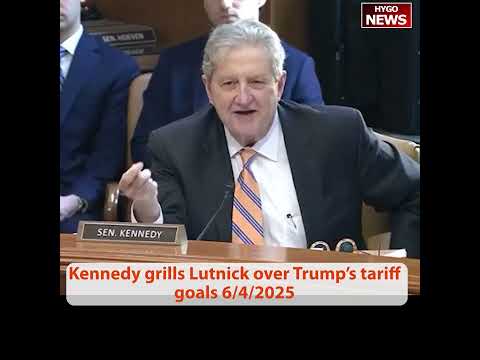
Sen. Kennedy Grills Commerce Sec Lutnick on Tariff Goals: “If Vietnam Offered Zero Tariffs Both Ways, Would You Accept?” Lutnick: “Absolutely Not — They Buy $90B from China, Mark It Up, Send It to Us”; Kennedy on Major Questions Doctrine and IEEPA vs. Trade Expansion Act
Senator John Kennedy (R-LA) conducted a substantive examination of Commerce Secretary Howard Lutnick’s tariff philosophy in June 2025. Kennedy opened: “It’s clear to me that the President listens to your advice about tariffs, so I want to spend my precious time trying to understand how you think.” He posed the key hypothetical: “If Vietnam, for example, came to you tomorrow and said, ‘OK, Mr. Secretary, you win, we’re going to remove all tariffs and all trade barriers. Would the United States please do the same?’ Would you accept that deal?” Lutnick: “Absolutely not. Absolutely not. That would be the silliest thing we could do… Vietnam has $125 billion in exports to us and imports from us, $12.5 billion… They buy $90 billion from China, then they mark it up and send it to us. So you’d just be a pathway of China to us. It’s a terrible deal.” Kennedy probed the underlying framework, pressing on reciprocity goals, and eventually challenged Lutnick on specific legal issues: “Why didn’t you advise the White House to proceed under the Trade Expansion Act instead of IEEPA?” Lutnick: “The president chose IEEPA because he could do it swiftly and sweeping in order to address the underlying problems that had created the $1.2 trillion trade deficit.” Kennedy then tested knowledge of the major questions doctrine in the VOS Selections case.
The Opening Framework
Senator Kennedy opened his examination.
“I’ll recognize Senator Kennedy, the senator I was so anxious to hear from,” the chairman said.
Kennedy’s framing: “It’s clear to me that the President listens to your advice about tariffs, so I want to spend my precious time trying to understand how you think.”
The Intellectual Examination
Kennedy’s approach was sophisticated.
What Kennedy was doing:
- Testing Lutnick’s analytical framework
- Probing policy underpinnings
- Examining legal understanding
- Exploring philosophical commitments
- Checking consistency
Why this mattered:
- Lutnick advised on major policy
- His thinking shaped administration positions
- Senate oversight role
- Public understanding of policy rationale
- Substantive engagement rather than political theater
The specific approach:
- Use hypotheticals to test principles
- Probe for contradictions
- Test knowledge of legal framework
- Explore policy goals
- Examine decision-making
The Vietnam Hypothetical
Kennedy posed the challenging scenario.
“If Vietnam, for example, came to you tomorrow and said, ‘OK, Mr. Secretary, you win, we’re going to remove all tariffs and all trade barriers. Would the United States please do the same?’ Would you accept that deal?”
Lutnick’s response was immediate and emphatic: “Absolutely not. Absolutely not. That would be the silliest thing we could do.”
Kennedy: “Why is that?”
Lutnick explained: “Vietnam has $125 billion exports to us and imports from us, $12.5 million.”
The Trade Asymmetry
The specific numbers revealed the issue.
The trade imbalance:
- Vietnam’s exports to US: $125 billion
- US exports to Vietnam: $12.5 billion
- 10-to-1 imbalance
- Vietnam selling much more than buying
- One-sided trade relationship
Why Vietnam would offer zero tariffs:
- Vietnam gains enormously from US market access
- Losing tariffs on $12.5B (small amount)
- Gaining unfettered US market access for $125B
- Mathematically hugely beneficial
- Strategic trade advantage
Why US refuses:
- Gain from zero US tariffs on Vietnamese imports: minimal
- Loss from zero tariffs: revenue, leverage, protection
- Imbalance not improved by zero-zero
- Structural problems not addressed
- American industries vulnerable
The China Pathway
Lutnick identified the specific mechanism.
“But where do they get it from?” Kennedy asked.
Lutnick’s explanation: “They buy $90 billion from China, then they mark it up and send it to us.”
Kennedy: “So you wouldn’t accept…”
Lutnick: “They’re just a pathway of China to us.”
Kennedy: “You wouldn’t accept that deal.”
Lutnick: “No, it’s a terrible deal.”
The Pathway Economics
This captured the fundamental problem with Vietnam zero tariffs.
How the pathway works:
- Vietnam imports from China: $90 billion
- Vietnam marks up and exports to US: $125 billion
- Actually Chinese products with Vietnamese labels
- Bypasses US tariffs on Chinese goods
- Vietnam is effectively trans-shipping
Why this matters strategically:
- US tariffs on China intended to protect US industries
- If Vietnam becomes pathway, tariffs fail
- China maintains market access through Vietnamese conduit
- American producers still can’t compete
- Policy goals undermined
Why zero tariffs would worsen this:
- Current tariffs at least capture some revenue
- Zero tariffs eliminate even that
- China-Vietnam-US pathway fully unobstructed
- Worst of both worlds
- Pure pathway creation
”We’re the One with Money”
Lutnick articulated the leverage reality.
“We’re the one with money. We’re the one with the store. Of course they want us to take down.”
The Negotiating Leverage
Lutnick captured the fundamental asymmetry.
The US market advantage:
- 330 million consumers
- High purchasing power
- World’s largest economy
- Premium brand positioning
- Essential export destination
Why countries need US market access:
- No substitute market exists
- EU, Japan, China markets smaller
- US consumers spend more per capita
- Premium pricing available
- Scale advantages unique
What this means for negotiations:
- US holds substantial leverage
- Countries need US more than US needs them
- Tariffs as leverage tool appropriate
- Zero-zero gives away leverage for nothing
- Strategic positioning requires maintaining tools
Why accepting zero tariffs would be foolish:
- Giving up leverage
- Accepting one-sided outcomes
- Enabling pathway economics
- Undermining American industrial base
- Forfeiting strategic position
The Reciprocity Question
Kennedy pressed the philosophical point.
“What’s the purpose of reciprocity then? Is reciprocity not one of your goals?”
Kennedy’s core challenge: “Are you telling the President that we shouldn’t seek reciprocity? If that’s what you’re telling him, why are you trying to do these trade deals?”
Lutnick’s nuance: “What do we want? We want to encourage Vietnam to produce products. They’re great at producing.”
Kennedy reiterated: “But I want to get back to reciprocity. You just said you don’t believe them. You don’t accept reciprocity as a goal. What are you negotiating in these trade deals?”
Lutnick’s framework: “Why would we open our bank account and their bank account?”
The Philosophical Tension
Kennedy was probing an apparent contradiction.
Kennedy’s position:
- Reciprocity is the goal
- Lower tariffs both ways
- Market-based approach
- Classical trade theory
- Consistent principle
Lutnick’s position:
- Reciprocity is a goal, not THE goal
- Context matters
- Strategic considerations override
- Americans first priority
- Complex rather than principled
The tension:
- Kennedy wants principled approach
- Lutnick wants strategic approach
- Different philosophical commitments
- Both defensible
- Genuine disagreement
”Why Are You Negotiating Trade Deals?”
Kennedy pushed harder.
“Why are you negotiating trade deals? You’re trying to get other countries to lower their tariffs and trade barriers in return for us lowering ours.”
Lutnick’s clarification: “That’s true for the things that they’ll take from us. That’s called reciprocity. Of course.”
Kennedy: “So are you or are you not seeking reciprocity in these trade deals?”
Lutnick’s careful framing: “We are absolutely seeking reciprocity with respect to things that can be reciprocal.”
The “Things That Can Be Reciprocal”
Lutnick’s qualification was important.
What “can be reciprocal”:
- Products both countries genuinely trade
- Market access for actual goods
- Meaningful two-way opportunity
- Genuine rather than superficial
- Beneficial to both sides
What CAN’T be reciprocal:
- Pathway trans-shipment
- Artificial trade flows
- Markup-based profits
- Indirect Chinese goods
- One-sided arrangements
The distinction:
- Real trade: should be reciprocal
- Fake trade: no reciprocity warranted
- Context-dependent analysis
- Substance over form
- Real outcomes over theoretical ideals
The Conditions for Acceptance
Kennedy pressed on conditions.
“Don’t you agree with me? Suppose they said we won’t buy from China. Now we’re talking. Now we’re talking.”
Kennedy: “If it was Vietnam. Would you accept that deal?”
Lutnick: “We would consider it.”
Kennedy: “For what things? For products?”
Lutnick: “What would you want to change? Well, there are certain products we want to reassure.”
The “Reassure” Framework
Lutnick continued with the strategic framework.
“We don’t want other people making them. We want to make pharmaceuticals here. We need to protect ourselves for certain things.”
Products the US needs to make domestically:
- Pharmaceuticals (Biden COVID vulnerability)
- Defense components
- Semiconductors (strategic)
- Rare earth processing
- Critical infrastructure
Why this isn’t simple:
- Even if partner country is willing
- Some products must stay domestic
- National security considerations
- Economic resilience needs
- Strategic autonomy
The framework:
- Some trade is fine
- Some trade must be restricted
- Context-dependent policy
- Not simple free trade
- Not simple protectionism
The Trade Deficit Question
Kennedy pivoted to trade deficits.
“Are trade deficits, are you advising the president that trade deficits are always bad in every situation?”
Lutnick: “No.”
Kennedy: “Okay. When are trade deficits good?”
Lutnick’s example: “Trade deficits, for instance, let’s say there was a company that had the cure for cancer. Let’s call it cancer cure. And we were buying it and it was located in another country. We would obviously have a trade deficit with them because they have the only one of it.”
He extended: “An example, our technology companies, our great technology companies, we’re the trade.”
The Deficit Nuance
Lutnick articulated sophisticated analysis.
When trade deficits are acceptable:
- Unique products we can’t produce
- Essential goods only available elsewhere
- Products where we can’t replicate
- Technology we genuinely lack
- Short-term necessary exchanges
When trade deficits are problematic:
- Products we could produce domestically
- Strategic goods critical for security
- Essential supplies
- National interest at stake
- Long-term economic damage
The framework: “Trade deficit is okay if they’re products we really need. If they’re the only ones with it and we can’t do it, then of course it’s fine. But if we can do it, then we darn well better think about whether we’re supposed to do it and whether we want to do it and if it’s in our interest as a country.”
The Trade Expansion Act
Kennedy pivoted to legal questions.
“Tell me your understanding of the Trade Expansion Act.”
Lutnick’s response: “I don’t have a really good understanding of the term. I may know the act, but I may not know its title.”
Kennedy’s explanation: “You, you know for me with the Trade Expansion Act of 1962 that gives the president almost unlimited authority to impose tariffs so long as you conduct an investigation. You don’t know about that?”
Lutnick’s recognition: “Oh, my 232s, of course I do. Okay. Sorry, I just didn’t know the title of the plan. But of course I know.”
The Legal Framework Question
Kennedy was testing legal sophistication.
The Trade Expansion Act of 1962:
- Section 232 is the famous part
- Authorizes tariffs for national security
- Requires investigation procedure
- Long-standing legal authority
- Specific framework
Why Kennedy was asking:
- Multiple legal authorities for tariffs
- Administration chose specific one (IEEPA)
- Section 232 was well-established alternative
- Choice of authority matters
- Legal basis affects court review
Kennedy’s implicit question:
- Why IEEPA instead of Section 232?
- Different legal requirements
- Different procedural needs
- Different review standards
- Different political dynamics
The IEEPA Choice
Kennedy pressed on authority choice.
“Why didn’t you advise the White House instead of proceeding under other statutes? Why didn’t you advise the White House to proceed under the Trade Expansion Act?”
Lutnick’s answer: “The president chose IEPA because he could do it swiftly and he could do it sweeping in order to address the underlying problems that had created the $1.2 trillion trade deficit that was haunted in the United States of America.”
The IEEPA vs. Section 232 Choice
The choice of authority had substantive implications.
IEEPA (International Emergency Economic Powers Act):
- Rapid deployment
- Broad scope
- Emergency framework
- Limited procedural requirements
- Political discretion
Section 232 (Trade Expansion Act):
- Extensive investigation required
- Limited to specific national security concerns
- Longer procedural timeline
- Specific scope of products
- Harder to deploy broadly
Why IEEPA chosen:
- Speed essential
- Comprehensive approach needed
- Trade deficit emergency
- Broader authority required
- Political moment critical
The trade-off:
- Speed vs. legal certainty
- Breadth vs. specificity
- Executive vs. deliberative
- Strategic vs. procedural
- Political vs. legal
The Major Questions Doctrine
Kennedy tested legal knowledge.
“Have you read the opinion in VOS Selections, VUS?”
Lutnick: “I have.”
Kennedy: “What role does the major questions doctrine play in that decision?”
Lutnick: “I am not a lawyer so I can’t speak to it with that kind of precision. That’s a litigation that’s under current investigation.”
Kennedy: “Are you familiar with the major questions doctrine?”
Lutnick: “Not offhand, but I did of course read the decision.”
Kennedy noted: “Well about three quarters of the opinion is on the major questions doctrine.”
Lutnick: “Again I tend to not know the title. I know the topic and the details of it, but I tend not to focus on titles.”
The Major Questions Doctrine Framework
The major questions doctrine was central to recent tariff litigation.
What the major questions doctrine says:
- Major political and economic decisions require clear congressional authorization
- Courts should reject broad agency interpretations of ambiguous statutes
- Preserves separation of powers
- Congressional role in major policies
- Limits executive branch expansion
Recent Supreme Court applications:
- West Virginia v. EPA (2022) - clean power plan
- Biden student loan forgiveness
- Various agency rulemaking challenges
- Progressive agency overreach blocked
- Applied to expand executive power
How it applies to tariffs:
- Trump administration using IEEPA broadly
- Questions about whether IEEPA actually authorizes such broad tariffs
- Courts evaluating whether “emergency” requirements met
- Major economic decisions through executive authority
- Potential limits on administration
The VOS Selections case:
- Specific tariff challenge
- Lower court ruled against administration
- Three-quarters of opinion addressed major questions
- Important precedent
- Under current appeals
Kennedy’s Substantive Concerns
Kennedy’s questioning revealed substantive concerns.
On legal framework:
- Administration using IEEPA broadly
- Major questions doctrine concerns
- Alternative authorities available (Section 232)
- Legal vulnerability
- Potential court restrictions
On policy:
- Reciprocity as goal uncertain
- Strategic considerations dominant
- Complex framework
- Political rather than principled
- Difficult to defend clearly
On communication:
- Specific legal knowledge gaps
- Framework not clearly articulated
- Intellectual challenges
- Needed more preparation
- Underlying substance
The “I’m Over” Acknowledgment
Kennedy closed: “I’m way over. Thank you for your indulgence Mr. Chairman.”
The chairman: “Senator Kennedy, thank you. Senator Shahid.”
The Exchange Significance
The Kennedy-Lutnick exchange was substantively important.
For the administration:
- Senior official’s understanding of legal framework
- Sophistication of policy analysis
- Ability to defend in public
- Legal risks apparent
- Communication challenges
For Senate oversight:
- Substantive rather than partisan
- Probing actual policy
- Legal sophistication required
- Genuine intellectual engagement
- Constitutional responsibility
For public understanding:
- Complexity of trade policy
- Limitations of simple reciprocity
- Strategic considerations
- Legal uncertainty
- Policy trade-offs
For future policy:
- Administration may need to address court challenges
- Legal framework may need strengthening
- Policy communication may need improvement
- Senate engagement valuable
- Intellectual engagement matters
The Fundamental Policy Framework
Lutnick’s analysis represented a specific approach.
Classical free trade:
- Reciprocal zero tariffs ideal
- Market allocation optimal
- Comparative advantage drives outcomes
- Government intervention limited
- Academic economic theory
Strategic trade:
- Considerations beyond simple economics
- National security matters
- Critical industries protected
- Pathway economics addressed
- Real outcomes over theoretical ideals
Trump administration approach:
- Strategic trade philosophy
- National interest primary
- Economic outcomes matter
- Specific rather than general
- Context-dependent policies
The trade-offs:
- Economic efficiency vs. strategic considerations
- Theoretical elegance vs. practical outcomes
- Principled vs. case-by-case
- Long-term vs. short-term
- Consumer cost vs. producer protection
Key Takeaways
- Kennedy tests Lutnick on zero tariff hypothetical: “Absolutely not. Vietnam would just be a pathway of China to us.”
- Lutnick’s framework: Reciprocity for “things that can be reciprocal” — not for pathway trans-shipment.
- Trade deficit nuance: Acceptable for unique products, problematic for products we could produce.
- Kennedy on legal framework: Why IEEPA over Trade Expansion Act of 1962 (Section 232)?
- Major questions doctrine: 3/4 of VOS Selections opinion addressed this — legal vulnerability for tariffs.