 HYGO News
 Sen. Kennedy Grills Trump's First Judicial Nominees: Hermandorfer, Bluestone, Stevens, Divine, Lanahan; Tests Fourth Amendment Reasoning with DWI Cop Scenarios, Roadblock Questions; Asks Originalist Theory: 'What Does the Text Say and What Did It Mean at the Time It Was Passed?'
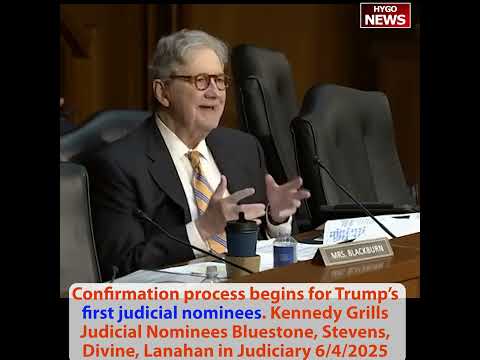
Sen. Kennedy Grills Trump’s First Judicial Nominees: Hermandorfer, Bluestone, Stevens, Divine, Lanahan; Tests Fourth Amendment Reasoning with DWI Cop Scenarios, Roadblock Questions; Asks Originalist Theory: “What Does the Text Say and What Did It Mean at the Time It Was Passed?”
The Senate Judiciary Committee began confirmation hearings for President Trump’s first judicial nominations of his second term in June 2025. Whitney D. Hermandorfer for the Sixth Circuit Court of Appeals, and Missouri district court nominees Maria A. Lanahan, Cristian M. Stevens, Zachary M. Bluestone (Eastern District), and Joshua M. Divine (Eastern and Western Districts). Senator John Kennedy (R-LA) tested their legal reasoning through hypothetical Fourth Amendment scenarios. “Suppose I’m a cop on duty. It’s three o’clock in the morning and I see somebody driving down the road not other many other people around. It’s on a Saturday night. Can I stop him just because you see him driving around?” Nominee: “There would need to be more of a basis than that.” Kennedy tested deeper: “Let’s suppose that I recognize and on three previous occasions he’s been caught for charge of DWI, but he’s not driving erratically. Can I stop him constitutionally?” Nominee: “Same answer. No.” Kennedy then asked about roadblocks. He questioned a nominee about reapportionment: “What’s the rule now that the Supreme Court follows on reapportionment cases?” Nominee: “The Supreme Court has decided that that’s a political issue… the courts really don’t have much of anything to say about political redistricting.” Finally Kennedy asked about constitutional interpretation: “Do you think the meaning of the Constitution is immutable?” Nominee: “My way of looking at the Constitution is to say what does the text say and what did it mean at the time that it was passed.”
The First Trump Second-Term Judicial Hearings
The Senate Judiciary Committee opened historic confirmation hearings.
The nominees:
- Whitney D. Hermandorfer: Sixth Circuit Court of Appeals (covering Michigan, Ohio, Kentucky, Tennessee)
- Maria A. Lanahan: Eastern District of Missouri
- Cristian M. Stevens: Eastern District of Missouri
- Zachary M. Bluestone: Eastern District of Missouri
- Joshua M. Divine: Eastern and Western Districts of Missouri
The significance:
- First judicial nominations of second term
- Building federal judiciary with Trump-aligned judges
- Continuation of first-term transformation
- Long-term influence on American law
- Multi-decade implications
The strategic importance:
- Federal judges serve for life
- Shape constitutional interpretation for generations
- Influence circuit court decisions
- Affect district court outcomes
- Long-term legal culture
The political context:
- Republican Senate majority enables confirmation
- Minimal Democratic opposition possible
- Quick confirmation pace anticipated
- More nominations coming
- Trump building lasting legal legacy
Kennedy’s Questioning Style
Kennedy’s hypotheticals were sophisticated.
The chairman set up Kennedy’s participation: “Now I gave Senator Kennedy an extra couple questions in the last round on condition to be nice, be nice to all of these folks. So with that, Senator Kennedy.”
Kennedy’s deflection: “I’m always nice.”
He posed his initial question: “How many of you worked for Senator Smith?”
He signaled his approach: “All four of you is it true that he was suspended 23 times in junior Askel in February alone.”
He then delivered his framing: “They’re under oath. Look, I’m not trying to trick you. I just want to I’m not gonna ask you how you won’t rule on cases and I’m not gonna ask you about your political beliefs. I just want to know how you think.”
The Fourth Amendment Scenario
Kennedy presented a classic constitutional law hypothetical.
“I suppose I’m a cop on duty. It’s three o’clock in the morning and I see somebody driving down the road, not other many other people around. It’s on a Saturday night.”
The question: “Can I stop me just because you see him driving around?”
Nominee’s response: “Yeah, there would need to be more of a basis than that.”
Kennedy confirmed: “So the answer is no, correct?”
The Basic Fourth Amendment Principle
The exchange tested basic Fourth Amendment understanding.
The Fourth Amendment:
- “The right of the people to be secure in their persons, houses, papers, and effects, against unreasonable searches and seizures, shall not be violated”
- Requires reasonable suspicion for stops
- Requires probable cause for searches
- Core constitutional protection
- Fundamental liberty principle
The basic rule:
- Police cannot stop someone without reasonable suspicion
- Time of day alone is not sufficient
- Being on a road alone is not sufficient
- Someone driving late at night has rights
- Specific articulable suspicion required
Why this was important:
- Tests nominee’s understanding of basic law
- Reveals analytical approach
- Shows practical application
- Demonstrates constitutional knowledge
- Indicates judicial temperament
The nominee’s correct answer (the answer is no) demonstrated:
- Understanding of Fourth Amendment
- Willingness to protect individual liberty
- Correct constitutional analysis
- Basic legal competence
- Appropriate judicial mindset
The DWI History Twist
Kennedy introduced a complication.
“Okay, let’s suppose that I recognize and on three previous occasions he’s been caught for charge of DWI, but he’s not driving erratically. I’m the cop again.”
The follow-up question: “Can I stop him constitutionally?”
The nominee’s response: “Same answer. No, no, you would need more than that to be able to conduct a…”
Kennedy challenged: “Why doesn’t that give me reasonable suspicion?”
The Prior History Question
The question tested sophisticated Fourth Amendment analysis.
Why prior DWI isn’t enough:
- Past convictions don’t create present suspicion
- Each traffic stop requires current basis
- Prior behavior isn’t current behavior
- Constitutional protection persists
- Pattern history isn’t traffic violation
The nominee’s extended analysis: “I think merely the fact that he was driving at 3 a.m and had been pulled over previously for driving under the influence wouldn’t be enough. Now, it certainly if you were swerving or driving improperly in some other way, if he committed a traffic violation or something along those lines. Certainly the officer would be well within his right.”
This response showed:
- Clear distinction between past and present
- Understanding of what justifies current stops
- Knowledge of traffic violation basis
- Ability to parse specific facts
- Sound constitutional reasoning
The Privacy Discussion
Kennedy transitioned to broader principles.
“So we can agree our privacy is precious to us, even if we’re in a car, right?”
The nominee: “I would agree that the Fourth Amendment very thankfully protects us all from unreasonable searches and seizures.”
Kennedy’s follow-up: “So how come the cops can set up a roadblock to and stop everybody when they don’t have either reasonable suspicion or probable cause just to check and see if they have insurance?”
The Roadblock Question
This tested sophisticated Fourth Amendment jurisprudence.
The roadblock issue:
- Police stop every vehicle
- No individualized suspicion
- No probable cause
- Apparent violation of Fourth Amendment
- Supreme Court has allowed them
The nominee’s response: “So there are limitations on scenarios like that roadblock.”
Kennedy pressed: “Okay, can they do it first?”
The nominee explained: “I mean, officers can set up roadblocks if they are applying it based on a neutral and articulable standard and if that standard relates to something that is specific to automobiles. So they could not stop every car too.”
Kennedy confirmed: “You’re right about the law.”
The Specific Legal Framework
The nominee correctly identified the rule.
The roadblock standard:
- Neutral and articulable standard (not discriminatory)
- Related specifically to automobiles (not general crime)
- Balancing costs and benefits
- Case-by-case analysis
- Specific Supreme Court precedent
Why roadblocks are constitutional:
- Public safety justification
- Minimal intrusion
- Neutral application
- Equal treatment
- Systematic process
Where roadblocks become unconstitutional:
- Without neutral standard
- For general crime detection (not vehicle-specific)
- Applied discriminatorily
- Beyond necessary scope
- Pretextual purposes
The nominee showed understanding of both:
- The basic constitutional protection
- The specific exception for roadblocks
- Why the exception exists
- The limitations on the exception
- The legal framework for evaluation
The Unreasonable Search Analysis
Kennedy pressed further on the Fourth Amendment.
“They don’t have reasonable suspicion. They’re stopping everybody. They certainly don’t have probable cause. It’s intrusive. I can spend 10 minutes in line from to check my insurance. What’s the basis for that being constitutional?”
The nominee’s framework: “I think the way I would frame it is that the courts have decided that’s in scenarios like that officers would not be acting unreasonably so that they would not be violating somebody’s Fourth Amendment right.”
Kennedy: “Because the Fourth Amendment guarantees against unreasonable searches and seizures, correct?”
Nominee: “Yes.”
Kennedy: “And how do you determine whether something’s unreasonable or not?”
Nominee: “I think that would very much depend on the situation, the specific facts, in the context.”
Kennedy: “Don’t you balance the costs and benefits in a scenario like that?”
Nominee: “Yes.”
The Reasonableness Analysis
The exchange captured sophisticated Fourth Amendment jurisprudence.
The reasonableness standard:
- “Unreasonable” is the key Fourth Amendment term
- Courts balance interests
- Intrusion versus purpose
- Case-by-case determination
- Specific facts matter
The balancing framework:
- Cost to individual (intrusion)
- Benefit to society (purpose served)
- Alternative methods available
- Proportionality
- Specific context
The nominee’s sound analysis:
- Recognized the balancing approach
- Understood “unreasonable” was key
- Applied situation-specific analysis
- Acknowledged cost-benefit framework
- Correct legal reasoning
The Reapportionment Question
Kennedy pivoted to a different area of law.
“What’s the rule now that the Supreme Court follows on reapportionment cases?”
The nominee clarified: “Congressional redistricting?”
Kennedy: “Congressional redistricting.”
The nominee’s response: “My understanding, Senator, is that the Supreme Court has decided that that’s a political issue, and under the political issue doctrine that essentially the courts really don’t have much of anything to say about political redistricting.”
Kennedy tested the application: “If Missouri’s legislature gets together and it redraws districts and they’re gonna say a majority of Democrats and the legislature, so they say we’re gonna redraw these districts to benefit Democrats. We’re not gonna be reluctant to say so. They said in front of God and country. Is that okay?”
The nominee’s answer: “Well, it’s pursuant to the Supreme Court precedent. It’s legal.”
Kennedy confirmed: “Yeah, okay.”
The Political Question Doctrine
The exchange tested understanding of political questions.
The political question doctrine:
- Some issues are reserved to political branches
- Not all issues are justiciable
- Courts have limited authority
- Specific categories of political questions
- Long-standing doctrine
Political questions in redistricting:
- Rucho v. Common Cause (2019)
- Supreme Court declined to adjudicate partisan gerrymandering
- Treated as political question
- Left to political branches
- Controversial but binding precedent
The practical implications:
- State legislatures can draw lines for partisan advantage
- Federal courts won’t intervene on partisan gerrymandering
- Racial gerrymandering still challenged
- Political gerrymandering enabled
- Controversial implications for democracy
The nominee’s proper application:
- Correctly identified the doctrine
- Knew the relevant case law
- Applied consistently to hypothetical
- Acknowledged it was legal under precedent
- Didn’t editorialize beyond law
This was a politically sophisticated exchange. Kennedy was testing:
- Whether nominees would apply Supreme Court precedent
- Even when the outcome might be politically controversial
- Whether they understood limits on judicial authority
- Whether they could distinguish legal from policy
- Whether they would show restraint
The Originalism Question
Kennedy’s final substantive question was about constitutional interpretation.
“Do you think the meaning of the Constitution is immutable? The US Supreme Court has said that. I wonder what you think.”
The nominee’s response laid out originalism: “My way of looking at the Constitution is to say what does the text say and what did it mean at the time that it was passed?”
The nominee continued: “And this is something that the US Supreme Court also says. If that’s not clear, I think there are other things you can look to like history and tradition to decide what the…”
Kennedy confirmed: “You look to what it meant at the time it was passed, correct? What it meant to the people who were passing it, to the people who wrote it?”
The nominee: “So I think there are various different ways of looking at this, and I think the US Supreme Court has said that you look at meaning that the words would have to the public at the time that the Constitution was ratified.”
Kennedy: “That’s right.”
The Originalism Framework
The exchange captured core conservative constitutional interpretation.
What originalism means:
- Constitutional text interpreted by original meaning
- Words mean what they meant when ratified
- Not what judges wish they meant today
- Based on public understanding at ratification
- Text-based rather than evolving
Why originalism matters:
- Prevents judicial activism
- Constrains judicial power
- Provides objective framework
- Respects democratic processes
- Stable constitutional law
Alternative approaches:
- “Living Constitution” interpretation
- Evolving meaning based on current values
- Judges shape meaning to modern needs
- Progressive view
- More subjective
Supreme Court’s current approach:
- Majority embraces originalism
- Text and history as primary tools
- Tradition as secondary resource
- Specific methodology (Bruen, Dobbs)
- Consistent framework
The nominee’s correct application:
- Identified originalism correctly
- Referenced “public meaning” standard
- Included history and tradition
- Followed Supreme Court methodology
- Showed appropriate judicial philosophy
Kennedy’s Final Remark
Kennedy closed: “I’m done. Thank you. Congratulations.”
The Approval Implication
Kennedy’s “congratulations” was significant.
By congratulating the nominees:
- Signaling approval
- Indicating likely support
- Recognizing successful performance
- Endorsing the appointments
- Political affirmation
Kennedy as a Judiciary Committee member had substantial influence. His approval:
- Indicated committee likely to advance
- Suggested Republican support
- Reduced Democratic obstruction options
- Accelerated confirmation timeline
- Built momentum for future nominations
The Broader Confirmation Pattern
The hearing demonstrated Trump’s second-term judicial approach.
Nominee profile:
- Experienced legal backgrounds
- Substantive constitutional knowledge
- Clear originalist/textualist orientation
- Capable of answering sophisticated questions
- Politically aligned with conservative principles
Contrast with possible Democratic nominees:
- Often specifically selected for diversity
- Sometimes limited experience
- “Living Constitution” approach
- Political activism background
- Progressive agenda orientation
The Senate environment:
- Republican majority
- Judiciary Committee Republican control
- Democratic minority unable to block
- Quick confirmation process
- Efficient judicial appointment
The Legal Scholarship Demonstration
The nominees’ sophisticated responses demonstrated intellectual seriousness.
Fourth Amendment mastery:
- Basic principles
- Key exceptions (roadblocks)
- Reasonable suspicion standards
- Balancing tests
- Practical application
Political question doctrine:
- Specific Supreme Court precedent
- Application to current cases
- Limits on judicial authority
- Democratic deference
- Legal humility
Originalism:
- Text interpretation
- Public meaning standard
- Role of history and tradition
- Supreme Court methodology
- Consistent framework
This was the kind of legal sophistication that conservatives had sought in judicial nominees. Not political hacks, but:
- Serious legal scholars
- Committed to methodology
- Respectful of precedent
- Intellectually rigorous
- Appropriate judicial temperament
Key Takeaways
- First judicial hearings of Trump second term: Hermandorfer (Sixth Circuit), Lanahan, Stevens, Bluestone, Divine (Missouri).
- Kennedy’s Fourth Amendment tests: Time of day alone insufficient for stops; prior DWI history alone insufficient.
- Roadblock analysis: “Neutral and articulable standard specific to automobiles.”
- Political question doctrine: Supreme Court has removed partisan gerrymandering from federal court review.
- Originalism: “What does the text say and what did it mean at the time it was passed?” Public meaning standard.