 HYGO News
 Sen. Kennedy to Nominees: 'Don't Ever Not Follow a Court Order'; Pack the Court 'Triggered My Gag Reflex'
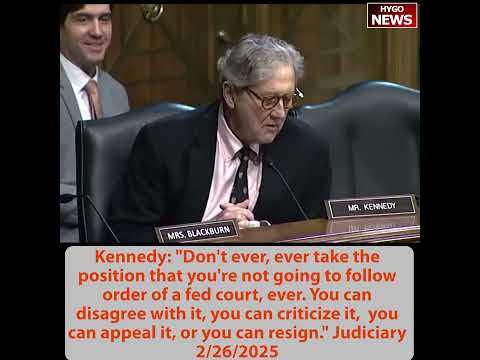
Sen. Kennedy to Nominees: “Don’t Ever Not Follow a Court Order”; Pack the Court “Triggered My Gag Reflex”
Senator John Kennedy of Louisiana delivered a memorable lecture to judicial nominees during a February 2025 Judiciary Committee hearing, opening with characteristic humor before shifting to a deadly serious admonition: “Don’t ever, ever take the position that you’re not going to follow the order of a federal court. Ever.” Kennedy then described four years of watching Biden-era Democrats try to “pack the Supreme Court,” threaten justices, and impose “unconstitutional” ethics codes, saying each attempt “triggered my gag reflex.” The hearing also featured sharp exchanges on equal protection doctrine and substantive due process with nominee Sauer, demonstrating the legal rigor Kennedy brought to the confirmation process.
The Ted Cruz Opening
Kennedy opened the hearing in his signature style — using humor to disarm before delivering substance.
“Mr. Wrights, I introduced Senator Cruz to some of his supporters one time,” Kennedy began. “I was asked about him and I said, let me tell you about Senator Cruz. He’s brilliant, but so was the Unabomber. You’ve got to watch him like a hawk.”
He continued: “Is it true that after a scotch, Senator Cruz can burp the alphabet backwards? You don’t have to answer that either.”
The jokes drew laughter across the hearing room and from the nominees themselves. Kennedy’s ability to be simultaneously entertaining and intellectually rigorous had made him one of the most-watched senators during confirmation hearings, and his opening signaled that the nominees should be prepared for both.
”Don’t Ever, Ever”
Kennedy then shifted to the serious message he wanted to deliver — not as a question but as counsel from a senior senator to future officers of the court.
“Let me say something serious for a second,” Kennedy said. “You’re all adults. You’re all officers of the court. So I’m going to give you some advice. I may be wrong, but I doubt it.”
He delivered the core principle: “Don’t ever, ever take the position that you’re not going to follow the order of a federal court. Ever.”
He then outlined the permissible responses to a court order one disagreed with: “Now, you can disagree with it. Within the bounds of legal ethics, you can criticize it. You can appeal it. Or you can resign.”
The four options — disagree, criticize, appeal, or resign — were exhaustive. Defiance was not among them. Kennedy was establishing an absolute principle: no government official, regardless of their position or the perceived incorrectness of a court order, could simply refuse to comply.
The statement was particularly significant given the ongoing confrontation between the Trump administration and federal judges over DOGE access, immigration enforcement, and other executive actions. VP Vance had publicly questioned judicial authority to block executive actions, and Speaker Johnson had called on courts to “step back.” Kennedy was staking out a position that, while supportive of the administration’s agenda, drew a clear line at defying court orders.
”It Triggered My Gag Reflex”
Kennedy then explained why he felt so strongly about judicial legitimacy by cataloguing the offenses he had witnessed over the previous four years.
“For four years, I have watched people in this town — not everybody, but many — try to undermine the legitimacy of the federal judiciary,” Kennedy said. “And it triggered each and every time my gag reflex.”
He listed the specific acts: “I’ve watched them try to pack the Supreme Court.”
The court-packing reference was to the Biden-era effort to expand the number of Supreme Court justices, a proposal championed by progressive Democrats as a response to the conservative majority established during Trump’s first term. Kennedy viewed the effort as an attempt to delegitimize the court by changing its composition when its rulings became politically inconvenient.
“I have watched an esteemed member of this body on the steps of the Supreme Court threaten Justice Gorsuch and Justice Kavanaugh,” Kennedy continued. The reference was to Senator Chuck Schumer’s March 2020 remarks outside the Supreme Court during an abortion case, when Schumer said Gorsuch and Kavanaugh had “released the whirlwind” and would “pay the price.” The remarks were widely condemned as a threat against sitting justices.
“I’ve seen this body — some in good faith, but some in bad faith — try to impose an unconstitutional, violative of the separation of powers doctrine, ethics code on the Supreme Court, just to try to undermine their legitimacy,” Kennedy said. The ethics code debate had been a sustained effort by Democrats to impose reporting requirements on Supreme Court justices that critics argued would subject the judicial branch to legislative oversight in violation of constitutional separation of powers.
”It Doesn’t Have an Army”
Kennedy concluded with the observation that gave his admonition its moral foundation.
“Now, all our judiciary has — an equal branch of government — is its legitimacy,” Kennedy said. “It doesn’t have an army.”
The point was profound in its simplicity. The executive branch has the military. The legislative branch controls the purse. The judiciary has neither — it has only the respect of the other branches and the public for its rulings. When that respect is eroded through court-packing, threats against justices, or refusals to comply with court orders, the judiciary’s power evaporates because it has no enforcement mechanism of its own.
“Don’t ever say you’re not going to follow the order of a court,” Kennedy repeated. “You may not agree with it, but that’s my advice. And I think you ought to take it.”
Constitutional Law Examination
The hearing also featured substantive legal questioning that demonstrated Kennedy’s depth as a former law professor. He engaged nominee Sauer in a detailed exchange on equal protection and substantive due process.
Kennedy posed a challenging question: “Give me an example of an instance where a legislative body could pass a statute discriminating on the basis of race — which of course is a suspect classification — that could pass the strict scrutiny test.”
Sauer acknowledged: “I can’t think of a hypothetical as I sit here.”
Kennedy then raised a structural constitutional question about the application of equal protection to the federal government. “I know the 14th Amendment says that the states can’t deny people equal protection of the law, but I don’t see anything in the Constitution about the federal government and equal protection — not in the 5th Amendment,” Kennedy said. “I’m not suggesting we shouldn’t, but how does it apply?”
Sauer identified the Supreme Court’s reverse incorporation doctrine from the late 1940s or early 1950s, which applied equal protection principles to the federal government through the 5th Amendment’s due process clause. Kennedy pressed further on whether Sauer agreed with the substantive due process methodology, producing an exchange that revealed both the nominee’s legal philosophy and Kennedy’s own sophisticated understanding of constitutional jurisprudence.
The Chairman’s Final Word
Committee Chairman Cruz closed the session with a joke that bookended Kennedy’s opening humor: “In light of your initial line of questioning, I ask unanimous consent that at subsequent hearings, Senator Kennedy be bound and gagged.”
He immediately added: “I’ll withdraw that request.”
Key Takeaways
- Sen. Kennedy told judicial nominees: “Don’t ever, ever take the position that you’re not going to follow the order of a federal court. Ever. You can disagree, criticize, appeal, or resign.”
- He described watching Biden-era Democrats try to pack the Supreme Court, threaten Justices Gorsuch and Kavanaugh, and impose “unconstitutional” ethics codes, saying each attempt “triggered my gag reflex.”
- Kennedy warned that “all our judiciary has is its legitimacy — it doesn’t have an army,” making respect for court orders essential regardless of disagreement.
- He engaged nominees in detailed constitutional questioning on equal protection, strict scrutiny, and the reverse incorporation doctrine.
- The hearing balanced Kennedy’s signature humor (Ted Cruz jokes) with deadly serious counsel about the rule of law.