 HYGO News
 Sen. Kennedy: Biden Bank Merger Rule 'Written in Sanskrit -- Like It Was Put Together by a Heroin Addict with a Socket Wrench'; Senate Rescinds
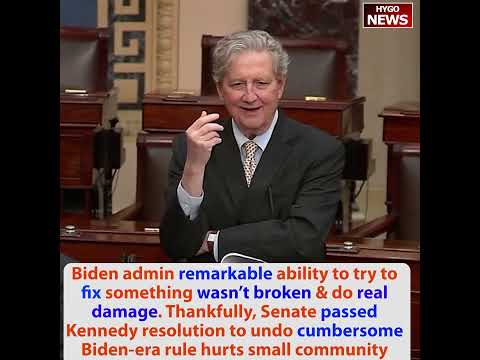
Sen. Kennedy: Biden Bank Merger Rule “Written in Sanskrit — Like It Was Put Together by a Heroin Addict with a Socket Wrench”; Senate Rescinds
Sen. John Kennedy (R-LA) delivered a floor speech in May 2025 demanding the Senate rescind a Biden-era bank merger rule that had destroyed a system working perfectly since 1995. “President Biden and his people had the remarkable ability to take something that wasn’t broken and try to fix it, take it apart, loosen a few screws, and then it would be broken,” Kennedy said. He described the old rule as “simple — 14 yes or no questions.” The Biden replacement required banks to “submit so much paperwork you could stack it right here and stand on it and practically paint the ceiling.” Kennedy’s assessment: “It looks like it was put together by a heroin addict with a socket wrench. Written in Sanskrit."
"Not Broken”
Kennedy opened with the fundamental problem.
“President Biden and his people had the remarkable ability to take something that wasn’t broken and try to fix it,” Kennedy said. “Take it apart, loosen a few screws, and then it would be broken.”
He introduced the specific topic: “The Office of the Comptroller of the Currency — I’ll call it the OCC. Small banks merge all the time.”
He described the working system: “The OCC in 1995 issued what’s called the Bank Merger Guidelines of 1995. Their rule for the merger of small banks was pretty simple.”
He outlined the elegance: “The OCC devised this short questionnaire where if you were two small banks and you wanted to merge, you had to answer yes or no to 14 separate questions. Very simple, very straightforward. 14 questions, you answer yes or no.”
He explained the review: “And then the folks at OCC could look at your answers and see if they thought there was any risk to consumers.”
He described the fail-safe: “The OCC also adopted a rule that said, ‘Look, if we don’t give you an answer within 15 days because we’re busy, your merger is automatically approved.’”
He assessed the result: “Short, sweet, very effective. We haven’t had problems with our small banks in none of these mergers — hundreds have taken place since 1995, which has actually made the financial system in America stronger, created virtually no risk.”
The 1995 rule was regulatory perfection. Fourteen questions captured all the essential information about a bank merger. The 15-day automatic approval ensured that government delay couldn’t kill legitimate business transactions. The result — hundreds of successful mergers over three decades — proved that the simple system worked.
”An Award for Being Stupid”
Kennedy described the Biden replacement with barely contained scorn.
“Well, President Biden’s people at the OCC decided that it wasn’t broken, so they were going to fix it,” Kennedy said.
He acknowledged the tonal challenge: “Again, I don’t hate anybody, but you got to call it like you see it.”
He delivered the judgment: “I think the folks at President Biden’s OCC got up one day and thought there was an award for being stupid.”
He described the damage: “They took this very simple, effective rule and procedure and they turned it on its head.”
He detailed the new requirements: “Here’s what they did. They threw out the old rule. They said, ‘We’re going to have a new rule. And the new rule is instead of these 14 simple yes or no questions, we’re going to make all these small banks submit so much paperwork to us that you could stack that paperwork right here and stand on it and practically paint the ceiling.’”
He listed the new criteria: “These small banks now — community banks — have to submit reams and reams of evidence. We at the OCC will start making a decision based on 19 criteria. The banks will have to prove that they comply with 13 of what the OCC called ‘positive indicators.’ The banks will have to show they do not align with six of what the OCC started calling ‘negative indicators.’”
He addressed the language: “The procedure not only did it require reams of evidence — just trying to read their rule that they put out, it was written in Sanskrit. You’d have to go hire a bucket load of lawyers to just understand the rule.”
He noted the killer change: “And not only that, but we’re going to throw out this 15-day rule that if you don’t hear from us within 15 days, your merger is automatically approved.”
He described the consequence: “It threw the merger process for small banks that was working beautifully into total disarray.”
The regulatory transformation was the bureaucratic equivalent of vandalism. A system that required 14 simple questions now required evaluation against 38 separate criteria (19 overall considerations, 13 positive indicators, and 6 negative indicators). A system that automatically approved applications after 15 days of government silence now let them languish indefinitely. A system that had produced hundreds of successful mergers was now producing paralysis.
The “written in Sanskrit” characterization was Kennedy’s colorful way of describing regulatory complexity that exceeded any rational purpose. The rule was not just long; it was deliberately obscure. Small banks that had managed their own legal compliance for decades now required specialized outside counsel to interpret what was required of them. The compliance cost alone was enough to kill many mergers.
Community Banks Devastated
The Biden rule’s target was community banks — the small, local institutions that served rural communities and small towns across America.
Community banks had been consolidating for decades through voluntary mergers, creating institutions large enough to serve their communities effectively while remaining small enough to provide personal service. This consolidation was a feature, not a bug, of the American banking system. It allowed small banks to achieve economies of scale without being absorbed by money-center giants.
The Biden rule had effectively halted this process. Community banks seeking to merge faced months of regulatory review, enormous legal costs, and uncertain outcomes. Many banks that would have benefited from merger instead muddled along with inadequate scale, hurting the communities they served.
”Heroin Addict with a Socket Wrench”
Kennedy delivered the memorable characterization.
“Let me just be blunt,” Kennedy said. “What President Biden’s OCC people did — put together a new rule that looks like it was put together by a heroin addict with a socket wrench.”
He emphasized: “I mean, it’s the most convoluted thing you’ve ever seen.”
He stated the remedy: “In a few minutes, I’m going to ask the Senate to reject President Biden’s cumbersome rule. I’m not going to suggest that we not regulate small bank mergers. I’m going to suggest that we go back to the procedure that we were using since 1995, which worked. That doesn’t mean that the OCC can’t revisit it at some point.”
He delivered the conclusion: “If we vote yes today — and I hope we do — then we will reject his rule and go back to doing it the old way.”
The “heroin addict with a socket wrench” metaphor was quintessential Kennedy — rural Louisiana vernacular deployed to describe Washington bureaucracy. The image was specific enough to be memorable (a drug addict with an inappropriate tool, attempting a task they couldn’t understand) and broad enough to apply to countless other Biden-era regulatory failures.
The Pattern
Kennedy’s speech was ostensibly about a narrow regulatory issue — bank merger procedures — but it captured a larger truth about the Biden administration’s regulatory approach. The administration had not targeted obviously broken systems for reform. It had targeted working systems and replaced them with complex alternatives that satisfied progressive policy preferences but failed to serve the public.
The bank merger rule was one example. The gas water heater rule Trump had rescinded the previous day was another. The appliance efficiency standards. The air traffic control neglect. The immigration enforcement deconstruction. In each case, the pattern was the same: identify something that worked, replace it with something that didn’t, and then defend the replacement as progress.
Key Takeaways
- Kennedy on Biden: “Remarkable ability to take something that wasn’t broken, fix it, and break it.”
- 1995 OCC rule: 14 yes/no questions, 15-day automatic approval. Worked for 30 years, hundreds of successful mergers.
- Biden’s replacement: 19 criteria, 13 positive indicators, 6 negative indicators, unlimited review time. “Reams of evidence.”
- Kennedy: “Written in Sanskrit. Like it was put together by a heroin addict with a socket wrench.”
- Solution: rescind the Biden rule and return to the 1995 procedure that worked.