 HYGO News
 "Justice Gorsuch Sold An Interest In An LLC To A Dem Donor" — Kennedy Questions Fogel On Ethics
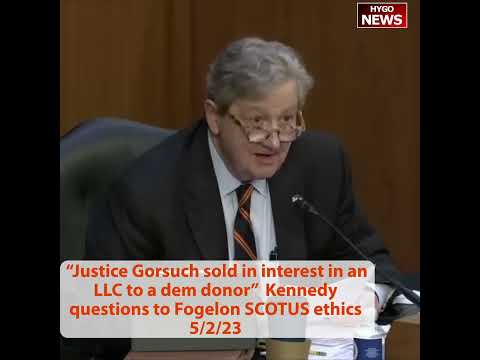
“Justice Gorsuch Sold An Interest In An LLC To A Dem Donor” — Kennedy Questions Fogel On Ethics
Senator John Kennedy (R-LA) used a Senate Judiciary Committee hearing on Supreme Court ethics to draw a hypothetical line between accusation and analysis. Pressing former federal judge Jeremy Fogel about reporting on Justice Clarence Thomas, Chief Justice John Roberts, and Justice Neil Gorsuch — who had sold an interest in an LLC to a buyer that turned out to be a Democratic donor — Kennedy framed the day’s debate as “two things going on”: a hyperpartisan political conflict layered on top of a real ethical question. Fogel pushed back on the implication that recent reporting was an accusation of bribery. Kennedy clarified he was not making such an accusation, then noted that “some people are.”
The Three Justices Mentioned
- Justice Clarence Thomas: ProPublica reporting in 2023 highlighted gifts and travel from a major Republican donor.
- Chief Justice John Roberts: Reporting raised questions about consulting income reported by his spouse.
- Justice Neil Gorsuch: A 2017 sale of an interest in a Colorado property LLC went to a buyer later identified as a Democratic donor.
- Reporting source: Coverage was led by ProPublica with follow-up by Politico, the New York Times, and others.
- Disclosure questions: All three stories raised whether existing disclosures captured the relationships in full.
The Gorsuch LLC Sale
- The transaction: Gorsuch sold his interest in a Colorado property LLC in 2017.
- Disclosure compliance: The sale appeared in his annual disclosure form, though without buyer name.
- Buyer identity: Reporting later identified the buyer as the head of a major law firm with cases at the Court.
- Donor profile: The buyer was a contributor to Democratic political causes.
- Recusal question: The buyer’s firm has appeared in cases at the Court since the transaction.
The Two Things Going On
- Political conflict: Fogel acknowledged a hyperpartisan political fight overlays the ethics debate.
- Ethical issue: Fogel said there is also a substantive ethics question that exists independent of partisanship.
- Disentangling: Both Kennedy and Fogel agreed the two layers should be separated for analysis.
- Editorial framing: Republicans argue the political layer dominates; Democrats argue the ethical layer is being ignored.
- Hearing posture: The hearing’s witness panels reflected the dual nature of the conflict.
The Bribery Language
- Fogel concern: Fogel cautioned against “accus[ing] people of being bribed” because of the gravity of that charge.
- Kennedy clarification: Kennedy responded that he was not accusing anyone of bribery.
- Some people are: Kennedy then said “some people are” — pointing to commentary outside the hearing room.
- Linguistic precision: The exchange dramatized how loosely “bribery” has been used in public commentary.
- Hearing record: The clarifications now sit in the formal hearing record.
The ProPublica Reporting Context
- Thomas reporting: ProPublica reported on undisclosed travel and hospitality from Harlan Crow.
- Roberts reporting: Coverage examined consulting income reported by Jane Roberts.
- Gorsuch reporting: Coverage examined the 2017 LLC sale and the buyer’s law firm caseload.
- Disclosure format: Some items appeared in disclosures with limited detail; others did not appear at all.
- Editorial impact: The cumulative reporting drove much of 2023’s ethics legislative push.
The Hearing Witnesses
- Jeremy Fogel: Former federal judge and ethics scholar; appeared as a witness.
- Witness panels: Both parties called witnesses with relevant judicial or academic credentials.
- Substantive testimony: Witnesses provided detail on existing disclosure rules and reform options.
- Cross-examination: Senators on both sides used hypotheticals to probe witness positions.
- Hearing record: The testimony forms the formal basis for any subsequent legislation.
The Hyperpartisan Layer
- Political incentives: Both parties have political incentives to frame Court ethics differently.
- Republican posture: Republicans argue the ethics push is a politically motivated targeting effort.
- Democratic posture: Democrats argue the reporting reveals real disclosure gaps demanding rules.
- Public messaging: The hearings serve as platforms for messaging more than legislative drafting.
- Hearing fatigue: Both parties report concern about hearings producing more rhetoric than rules.
The Ethical Layer
- Real questions: Whether existing disclosure rules adequately capture relationships with frequent litigants.
- Recusal practice: Whether justices recuse appropriately when financial relationships exist.
- Personal hospitality: How the long-standing hospitality exemption should be construed.
- Reporting precision: Whether disclosure forms should require buyer or counterparty identification.
- Enforcement gap: Whether self-regulation is sufficient or external enforcement is needed.
The Disclosure System
- Annual filings: Justices file annual financial disclosures with the federal judiciary.
- Reimbursement reporting: Reimbursed travel is reported with destination, source, and approximate value.
- Real estate: Real property and interests are reported, but counterparty names are sometimes omitted.
- Personal hospitality: A long-standing exemption has been narrowed in recent guidance.
- Reform proposals: Pending bills propose tighter reporting and external review.
The Republican Counter-Narrative
- Symmetric standard: Republicans argue ethics rules must apply across the political spectrum.
- ACLU example: Earlier in the same hearing, Kennedy used an ACLU-Sotomayor example to make this point.
- Targeting concern: Republicans argue the recent reporting selectively targets conservative justices.
- Editorial restraint: Republican senators have generally not defended specific transactions on the merits.
- Hearing strategy: The strategy is to expose perceived asymmetry rather than litigate underlying transactions.
The Democratic Reform Push
- Legislative bills: Pending bills would impose disclosure standards modeled on lower federal courts.
- Recusal standards: Proposals would tighten recusal standards and create review mechanisms.
- Executive enforcement: Some proposals envision external enforcement, raising constitutional questions.
- Constitutional debate: Debate continues on whether Congress can regulate Court conduct internally.
- Hearing trajectory: Democratic chairs are using hearings to build the public case for reform.
The Constitutional Debate
- Article III scope: Congress has broad authority over court structure under Article III.
- Internal conduct: Whether that authority extends to the Court’s internal ethics is contested.
- Court self-regulation: The Court has historically set its own ethics framework via internal practice.
- Statement of ethics: In late 2023, the Court would issue a written code in response to pressure.
- Enforcement gap: Even after the code, no external enforcement mechanism exists.
The Public Trust Layer
- Approval ratings: Court approval is at multi-decade lows in 2023 polling.
- Partisan divide: The partisan gap in Court approval is among the widest on record.
- Ethics narrative: Disclosure stories have driven much of the recent decline in approval.
- Repair pathway: It remains unclear how the Court rebuilds public trust without binding rules.
- Long arc: The public trust question will outlast any single piece of reporting.
The Recusal Question
- Personal financial interest: Justices must recuse when they have a personal financial interest.
- Counterparty awareness: A live question is how proactively justices must investigate counterparties.
- Information flow: Some transactions are intermediated through firms or trusts that obscure identity.
- Judicial conference guidance: The federal Judicial Conference has issued narrowed guidance in recent years.
- Practice variation: Recusal practice varies meaningfully across justices.
The Linguistic Precision Argument
- Bribery threshold: Bribery requires a quid pro quo connected to a specific official act.
- Disclosure violation: Most disclosure issues fall short of the bribery threshold.
- Public commentary: Some public commentary collapses the distinction.
- Kennedy intervention: Kennedy used the exchange to draw a clear line between disclosure issues and bribery.
- Editorial discipline: Both parties privately acknowledge a need for more precise language.
The Hearing Strategy
- Soundbite construction: Senators on both sides structured exchanges for clip distribution.
- Documentary value: The exchanges produced extensive on-the-record material for future debates.
- Witness use: Witnesses were used to advance partisan narratives more than to draft rules.
- Substantive hearing: Despite the partisan layer, substantive testimony was placed in the record.
- Future reference: The exchanges will be cited in subsequent ethics debates.
The 2024 Implications
- Election-year horizon: 2024 campaigns will likely use Court ethics as a turnout issue on both sides.
- Court rulings: Major end-of-term rulings will sharpen attention to the ethics debate.
- Confirmation echoes: Republican memories of recent confirmation battles inform current posture.
- Down-ballot effects: Senate races may turn in part on competing Court reform visions.
- Long arc: How the Court itself responds will shape Court politics for the next decade.
The Reform Outlook
- Legislative chances: Major reform legislation faces uncertain prospects in a divided government.
- Court action: The Court itself is under increasing pressure to issue a written code.
- Voluntary disclosure: Some justices have expanded voluntary disclosure in response to reporting.
- Public pressure: Continued reporting will keep pressure on existing rules.
- Institutional outcome: The institutional outcome will shape the next decade of Court politics.
Key Takeaways
- Kennedy walked Fogel through reporting on Thomas, Roberts, and Gorsuch.
- Fogel framed the debate as two layers: hyperpartisan politics and a real ethics question.
- Fogel cautioned against accusing justices of bribery; Kennedy said he was not.
- Kennedy noted “some people are” — pointing to commentary beyond the hearing room.
- The exchange clarified the distinction between disclosure issues and bribery.
- The hearing record now contains a Republican counter-narrative on Court ethics.
Transcript Highlights
The following quotations are drawn from an AI-generated Whisper transcript of the hearing and should be considered unverified pending official transcript release.
- “All these articles about Justice Clarence Thomas and the Chief Justice in the United States and Justice Gorsuch” — Sen. Kennedy
- “Sold an interest in an LLC to a Democratic donor who had never met that they bought him” — Sen. Kennedy
- “I think there are two things going on here today” — Jeremy Fogel
- “There is a political conflict, which is…very intense. It’s hyperpartisan” — Jeremy Fogel
- “When you accuse people of being bribed, it kind of gets their attention” — Jeremy Fogel
- “I’m not accusing anybody of being bribed. I’m not. But some people are? Some people are” — Kennedy / Fogel exchange
Full transcript: 127 words transcribed via Whisper AI.